
From April 2 to 6, a by now familiar credo echoed through the streets of Innsbruck: the absurd is the only possible way. The DIAMETRALE – Filmfestival returned to the Leokino and other cultural venues. This year, the festival was dedicated to the cinematic exploration of the question “What if?”. Among the films contemplating possible futures was Doppelgängers³ by Nelly Ben Hayoun-Stépanian. A playful documentary about space travel and how we earthlings can avoid repeating old mistakes when we venture out into space.

“This film is a stylised work of ‘factual entertainment’ minus the Ritalin.” That’s how Nelly Ben Hayoun-Stépanian, the director, describes Doppelgängers³ and it is pretty spot on. It’s a film like an amusement park. Absurd interview snippets like cotton candy. A roller coaster through visual impressions – from dark caves to kaleidoscopic carpet patterns. A carousel of autobiographical moments. And while enjoying this wild ride one learns about outer space, colonial history and physics without even being aware of it.
Doppelgängers³ captures the complexity and interdisciplinary spirit of its director. Nelly Ben Hayoun-Stépanian operates at the intersection of film, design, space science, and activism. She makes films, stages performances, organizes large-scale events, and conducts academic research. Their work fuses art, science and everything in between into genre-defying experiences that joyfully transgress boundaries.
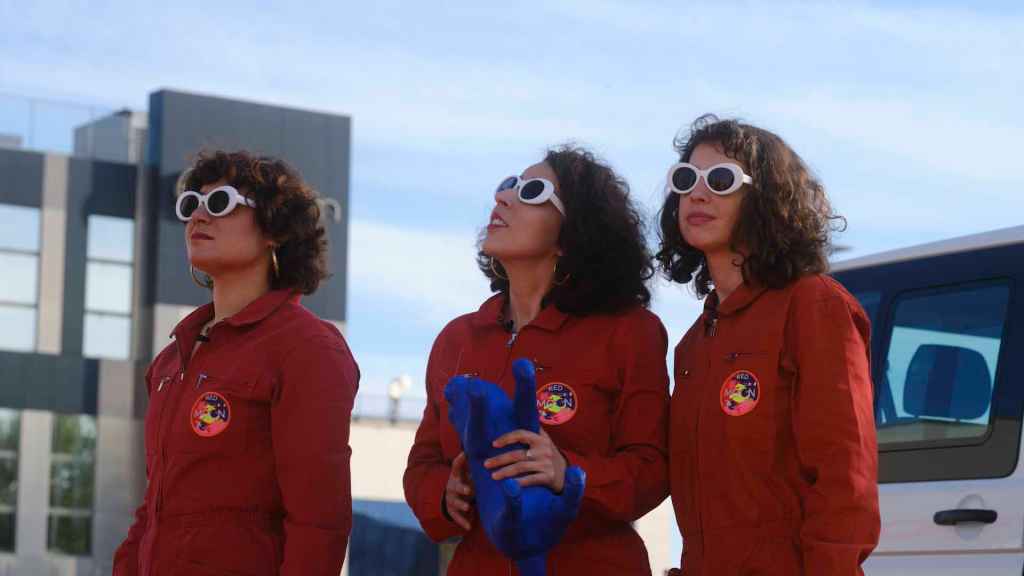
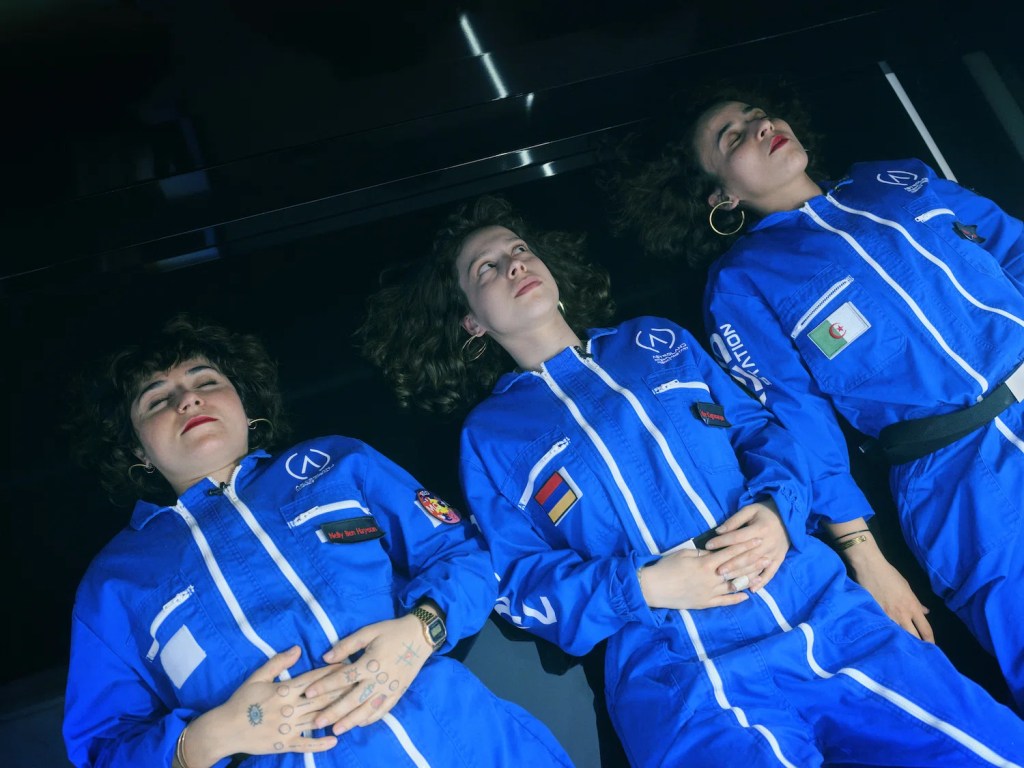
For Doppelgängers3, Nelly collaborated with Armenian musician Lucia Kagramanyan and Algerian curator Myriam Amroun – artists from the countries of her own heritage. Through the lens of their respective histories, they envision possible futures of space exploration that defy traumatizing practices we encounter on Earth. Together, they meet with scientists, visionaries, and cultural pioneers. To dig deeper into their imagination of an utopia in space the doppelgängers spend two weeks deep inside a cave in Spain, where astronauts train to live in confined environments and navigate the unknown.
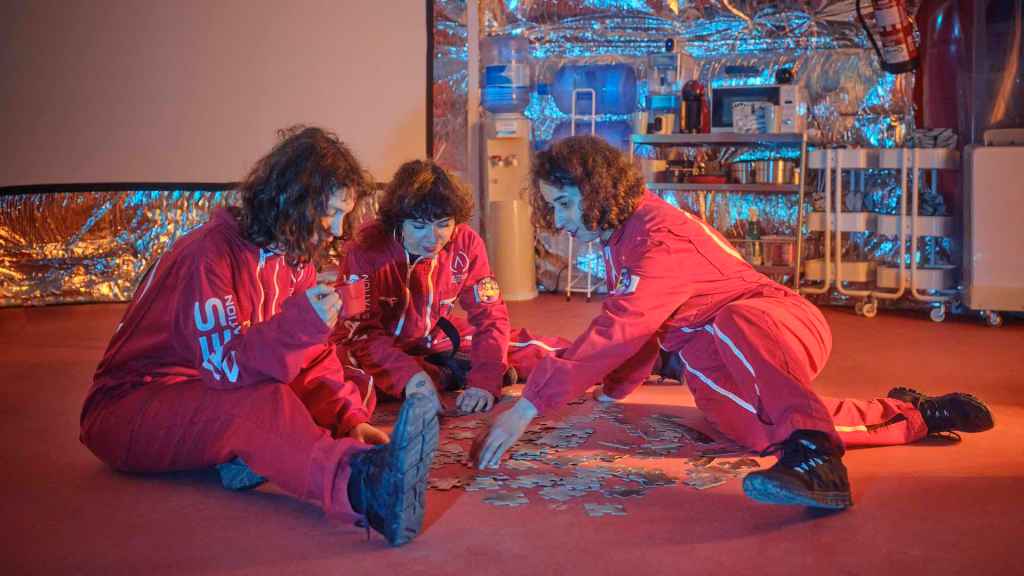
We spoke with Nelly over Zoom. She was calling from Paris, where she was attending the annual International Astronautical Federation congress, presenting her paper Decolonization Practices in Space – a direct outcome of the film.
You are one of the most interdisciplinary artists I ever encountered. Or should I say scientist, designer or performer. How did the journey to working at this intersection of fields begin?
Alright, we’re going all the way back to the anal stage. I grew up in Valence, in the south of France. My grandfather is from Armenia and his family had to flee due to the genocide happening there. They fled through Syria and ended up in the South of France where he became an activist. Together with his colleagues in France, he fought to get the Armenian genocide officially recognized. That history was formative for me. I was always part of communities organizing themselves to be heard by institutions and politicians.
Recognition of genocide is a long process – requiring documentation and evidence. I think experiencing this process very early in life also shaped my way of thinking. Through it I soon discovered the power of archives and the importance of things being documented.
My father grew up in Algeria. The way of communicating and relating to history on that side of the family is completely different – they don’t talk about the past. France colonized Algeria for 132 years. There was torture, trauma, and immense pain within families. It’s still not talked about in France. No reparations and there still are massive tensions.
How did your path continue?
Working with textiles became a foundational craft for the Armenian community in France. As the Armenian side was the more extravagant side of my family, I emulated them and started working with textiles too. From there, I moved into fine arts. I got selected for a scholarship for an art school – the Royal College of Art – in London, where I studied a Master in Design Interactions. The program focused on how science and technology will impact our lives in the next five to ten years and how to design innovative methods to engage the public in thinking about their futures. Through this exploration, I began to get more and more interested in politics. I then went to do a Ph.D in politics and geography at Royal Holloway, focusing on the design of experiences and the philosophy of political theorist Hannah Arendt. Besides academics I was always involved in theatre and worked as a creative director for nightclubs.
What drew you into the world of space exploration?
I’ve always hated institutions that feel exclusive and make people feel like they don’t belong. When I see one, I try to design an intervention – an event, an installation – to disrupt and open it up.
NASA became a major focus. If you’re not a US citizen, you can’t access it. I also think the relationship between NASA, nation-states, and militaries is very interesting.
In 2013 I launched the International Space Orchestra (ISO), an orchestra composed uniquely of space scientists from NASA Ames Research Center, the SETI Institute, Singularity University, and the International Space University. Together they play musical performances inspired by spatial missions.
I would say my core skill is designing events that reveal cracks in power structures. I also spend a lot of time reading contracts to legally infiltrate institutions.
Rather than criticizing institutions from the outside, you find ways to crack them open and rewire them from within?
Exactly. My focus is on public institutions because they always reflect nation-states and their ideologies. Space is particularly interesting because in the space sector, governments often use space exploration to push specific political narratives. Trump wants to go to Mars to be remembered for it. US imperialism and glorification of technology.
In contrast, Europe has ideas like the “Moon Village”. All together as collaborators. I find it fascinating how different ideologies are expressed in visions of space travel.
I advocate for plurality, for me that’s the opposite of ideology. Plurality is about multiple viewpoints. I design platforms that are transitional, not static. I infiltrate spaces and “queerify” them – to change how knowledge is produced and futures are imagined. Because right now, the futures being built are patriarchal and capitalistic. Through hybrid, experimental formats I aim to induce agitation. Chaos. Because I think that’s what’s needed to build truly pluralistic, inclusive futures.
This is also what we teach at the University of the Underground, a university I founded in 2017 with activists and visionaries – and it is free, pluralistic and transnational. Students learn how to work within institutions and modify them through the means of an event – but in that – the outcomes depend on their creative interest. The University of the Underground is based in the basements of nightclubs and so we work as a collective in collaboration with nightlife workers.
This aim for plurality is also central for your film – you disrupt your own authorship through implementing doppelgängers.
Exactly. The doppelgängers are a literal way to explore plurality. On a personal level, Lucia and Myriam are imaginary, idealized versions of what my life could have been if I’d been born in Algeria or Armenia, if my families had been able to stay.
What I found an interesting exploration was how – beyond having surface level similarities – our unique origins and different personalities shaped our perspectives on the project. While the project left me deflated and thinking we failed, they saw it as a great success, largely because they felt it allowed for self-reflection. I don’t view self-reflection as an end goal. For them however, meeting each other was the point. The process itself was the achievement.
What made you feel the project didn’t succeed?
I was hoping the three of us could create a new vision for humanity in space – one far from the extractive, manufactured visions of Jeff Bezos or Elon Musk. But we didn’t come up with a vision. At first we couldn’t even find living material and when we eventually did we didn’t decide what to do with it. We couldn’t come up with a decision as a group. For me, that felt inconclusive. We did not put a product out there. It left me quite drained – maybe having been in a cave for two weeks was also a factor.
But after the movie a lot happened. We ended up founding the Decolonial Practices session at the International Astronautical Congress, addressing oppressive narratives in the space sector. Building on the momentum of the film, we also wrote the first ever scientific paper on intergenerational trauma in relation to space exploration. Neuroscientists, trauma specialists, and scientists featured in the film all contributed. The paper argues that understanding the past is essential for imagining the future in space. I mean it’s not rocket science: You need to understand the past in order to make anything happen in the future. It seems obvious, but in the space exploration world, this is not common practice. There’s no archive department. No reflection on humanity’s past to shape common practices in the future.
Your film is visually striking. How do you balance aesthetics and truth in your documentaries?
First off, I never use a script. Ever. That’s my boundary with “truth”. I improvise and stay open to what’s happening in the moment.
We also never redo scenes. Ever. If you redo it, it becomes fiction. So either we have it, or we don’t.
How do you manage to capture these authentic and often absurd moments in your interviews?
It took me 18 years of practice to get to the point where I don’t drive the interviewee to do something but anticipate what they might do and go with it. I’ve always worked with the same cinematographer – my friend from high school, Fiona Braillon. She knows me so well and anticipates my moves. It’s like jazz.
Moreover I deliberately work with small crews. Too much noise makes it almost impossible to reach authentic moments. Moments like the one when Uday Mehta, mid-interview, spontaneously rolled me up in a carpet.
Your film has a collage-like rhythm – how do you approach the editing process?
While interviewing I already imagine the edit. I even listen to the soundtrack before interviews to guide the tempo of conversations because music to me is central in the editing process. I always edit to a beat.
My editing style also reflects my admiration for the cut-up technique pioneered by artists such as William Burroughs in the 1960s. With Doppelgängers³ I worked with four different editors as I wanted the edit to be like piano with four hands 🙂
Your works challenge a human-centric worldview. What draws you to posthuman perspectives?
I draw from queer, transfeminist and posthuman feminist literature. These schools of thought critique human-centered systems, challenging Enlightenment ideals and the belief that “man” is the center of all systems.
Posthuman thinking invites us to imagine life beyond the human – other forms of consciousness, other modes of existence. That’s why I work with the SETI Institute (Search for Extraterrestrial Intelligence). I’ve been there since 2013. Founded by Carl Sagan and others in the ‘80s, SETI Institute pushes us to think beyond Earth and beyond human frameworks.
In Doppelgängers³ I reference other forms of consciousness that exist outside of the realm of humanity – bacteria, non-living entities, animals. But I also try to look inside our heads and try to touch upon the possibility that there are components to our brain that are not homo-centric. That connect us with the cosmos and can be unlocked in some way.
Maybe through madness or through existing outside dominant norms. One scientist in the film says: To go to the moon, you have to be mad, because you can not live on the moon. You have to go to the imaginary to exist in these spaces. Imagination may be a realm that is not homo-centric.
Is that why you believe art and science need to be in conversation?
It’s not just art and science – it’s about supporting non-linear frameworks where multiple disciplines engage each other. That’s the foundation for real innovation: different perspectives, all in dialogue and represented.
Humor plays a big role in your films – why?
Well, humor, for me, is the essence of accessibility. I think there are many ways you can build accessibility into a film. I truly believe in making sure the film comes as a complete, accessible package. It has audio description. The subtitles are part of the film – you can’t get the film without them. That’s one way I think about inclusivity in filmmaking.
The other side of that, for me, is humor. Of course, you could argue that humor is culturally dependent – what’s funny in one place doesn’t always translate in another. But I find that there’s a kind of universal, simple humor too. Like when a person trips and falls. That can be funny, not in a bullying way, but just in that basic, human way. I think humor is a powerful way to talk about complex issues and make them more accessible. I always try to do that.
And honestly, if you’re going to give me 75 minutes of your life to watch a film, then I feel like you might as well have a good time doing it.
Last question: If you had a space agency, what would your motto be?
Definitely something about love and compassion. We need that more than ever.
Recently, we did an installation in Piccadilly and Leicester Square called Piccadilly Un:Plugged where we sent the heartbeat of my Armenian family into space to the moon and back. The track was produced by my friend, noise-punk artist Láwû Makuriye’nt aka EOBIONT (also known as Mango and half of Mirrored Fatality). Láwû was very active in the underground avant-garde community and produced tracks for this project- but also many others like my film Doppelgängers³ has some of Mirrored fatality music and it opens on a quote by Láwû and Samar who both composed Mirrored Fatality. Láwû engaged with the world with love but also rage. Rage for what history should never be again, rage against the establishment, rage and noise as a form of healing.
Láwû passed away during the making of the installation, this was completely unexpected and extremely shocking. It is unbelievable that the track we sent to space was one of the last tracks Láwû produced. That track now holds love, grief, remembrance – and the sound of the Big Bang. It carries the beginning of the universe, and the end of a life.
I think love and compassion can do a lot for us moving forward. And remembering that nothing should be taken for granted.
Films Nelly Ben Hayoun recommends:
- The Color of Pomegranates – Sergei Parajanov
- Holy Mountain – Alejandro Jodorowsky
- The Watermelon Woman – Cheryl Dunye
- Survive Style 5+ – Gen Sekiguchi
- Big Man Japan – Hitoshi Matsumoto
| Johanna Hinterholzer
 komplex-KULTURMAGAZIN
Ein Gedanke zu “How To Not Colonize The Moon – An Interview With NELLY BEN HAYOUN-STÉPANIAN”