
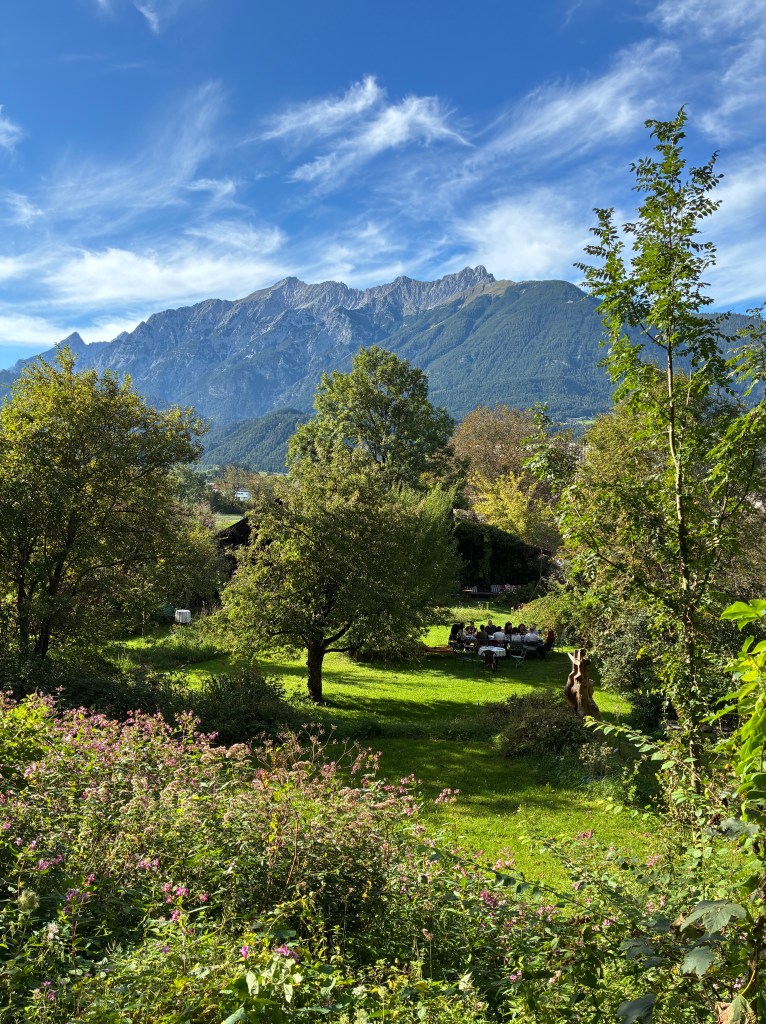
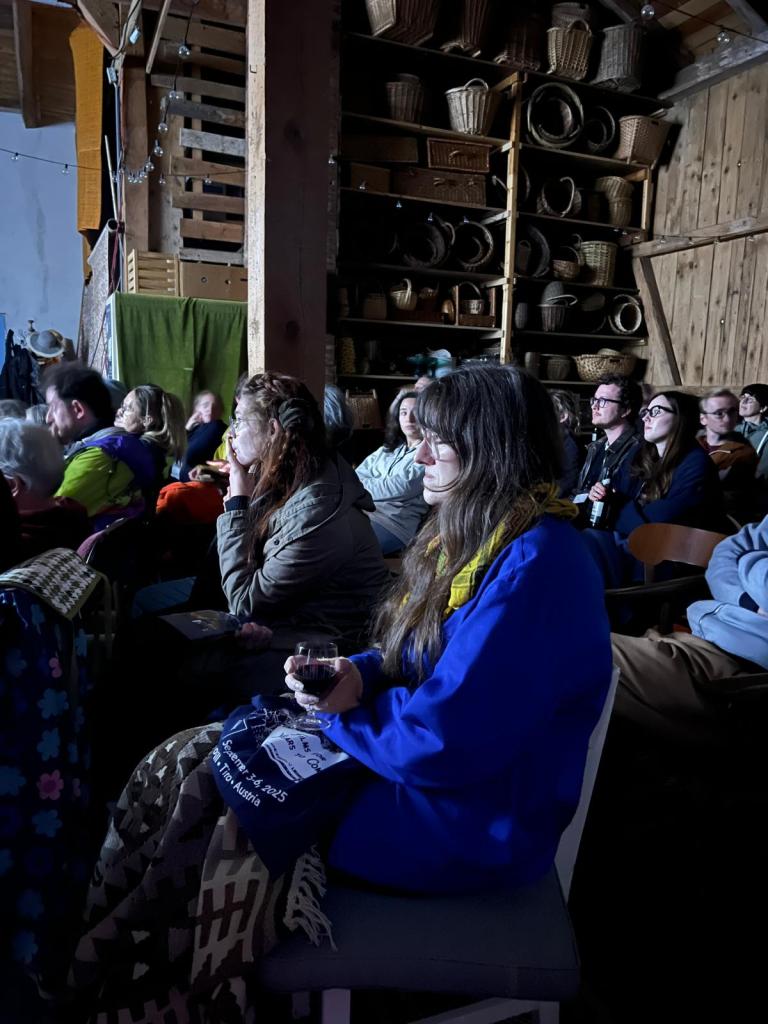
From September 3 – 6, the Tyrolean village of Pill once again became a meeting place for international cinema lovers: The fourth edition of the Pillusion Film Festival took place in the warm, familiar setting of the Decristoforo family’s historic farm. Surrounded by a garden and framed by the Alps, the festival offered an intimate and welcoming atmosphere where filmmakers and audiences could meet directly. This year’s theme was Contradictions, explored through fiction and documentary films from around the world – as the 2025 edition was supported by TKIopen25_Widerspruch.
Founded by the filmmaker couple Leo and Marina Decristoforo, Pillusion was created out of their love for cinema and their wish to make independent film more accessible in rural Tyrol. Alongside screenings, the festival included 16mm workshops and Q&As, encouraging exchange on cinema and topics discussed in the presented films.
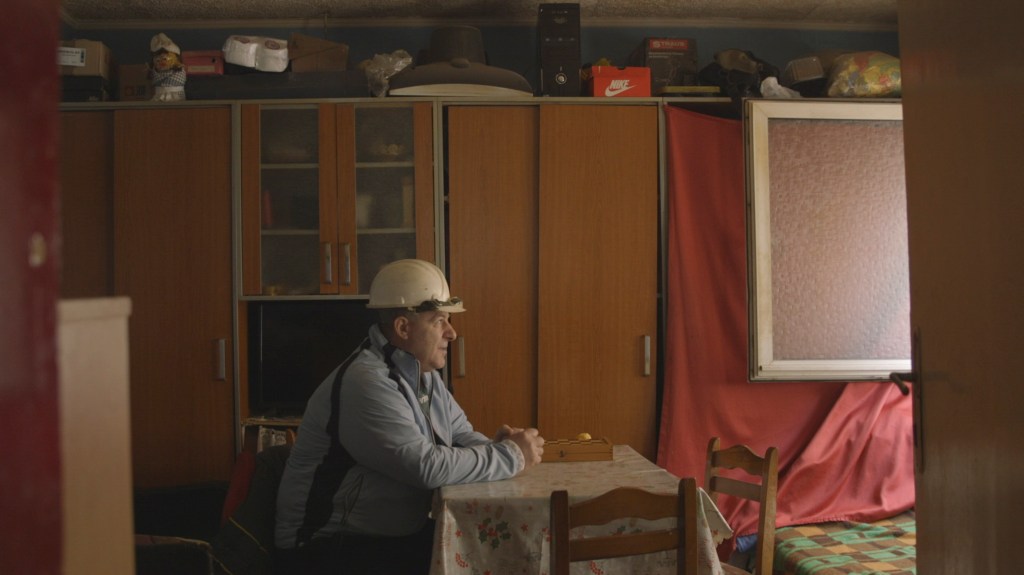
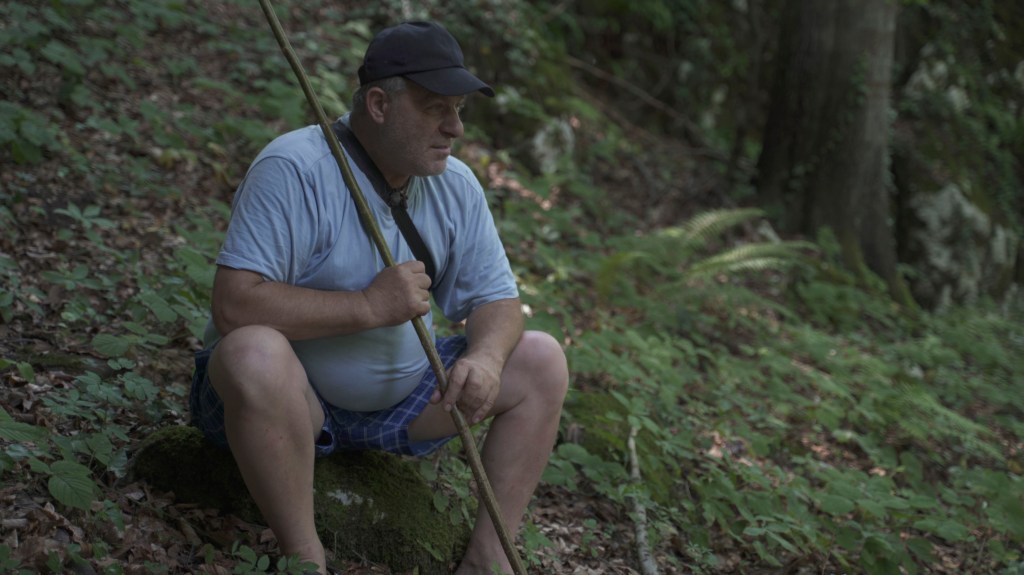
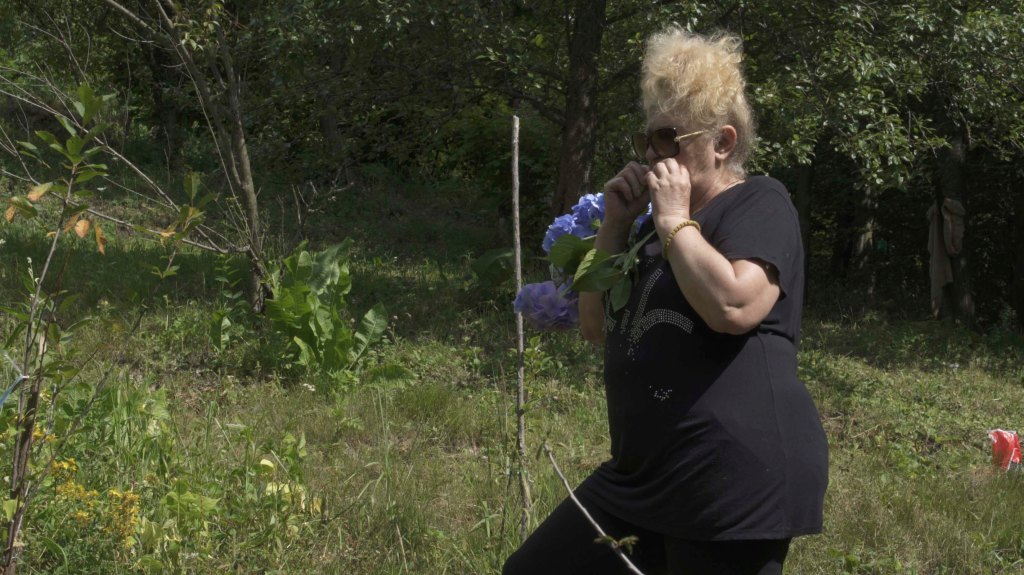
Among this year’s films was Flotacija (2023), directed by Eluned Zoë Aiano and Alesandra Tatić. Filmed over eight years, it portrays a village in Eastern Serbia whose identity is tied to mining and to myth. At its center are the siblings Dragan, a miner and dragon hunter, and Desa, the widow of a union leader who continues his fight for mine workers. Beyond its intimate portraits, the film also connects to today’s political situation in Serbia, where questions of mining, labor rights, and corruption remain highly debated. As the festival directors explain, they selected the film because it shows “how a community preserves its myths in times of industrial change, while bringing its characters close without exposing them.”
For Zoë Aiano, small festivals like Pillusion carry a special value. She appreciates the closeness between filmmakers and audiences and the way such events bring culture to rural communities. Growing up in the countryside herself, she describes festivals like this as “precious for places that often lack access to cinema.”
Pillusion shows how an independent festival, set in a small Tyrolean village, can create lasting connections between people and films from around the world. We also had the chance to meet Zoë Aiano in person and to speak with her before the screening of her film. In the conversation, she shared how she and her co-director approached the long process of making Flotacija, what fascinated her about the topic, and how the film has – in a way – even changed her life.

How did you end up doing a documentary film in Eastern Serbia?
It started by chance. I met my co-director at a film festival in Rovinj, Croatia. We had an instant connection and both of us were looking for a project. She proposed making a film in Eastern Serbia – something she had always wanted to do. I didn’t know anything about it at the time, I had never been to Serbia before, but I thought, sure, let’s do it. I imagined it would be something small and easy. But the more time we spent there, the more we wanted to say, and after a year or two it became clear it was not a topic for a short film. Suddenly, I found myself stuck there for years.
My relationship to the Balkans started earlier. I lived in Croatia when I was 18 to learn Italian, and I realized I didn’t know anything about this area and became interested in it. So I started to study Slavonic studies at the University of Glasgow in the UK. But it was a very small department and they didn’t have any Balkan representation. There were three professors: a Russian, a Pole, and a Czech. So I ended up specializing in Czech. At some point, though, I had this urge to get to know the Balkans better. That’s why I went to this festival, where I met Alesandra.
Do you remember your first impressions when you arrived in the country?
Our first point of interest was witchcraft and vlaška magija. We wanted to look at witchcraft through a feminist lens – what it meant to be a woman involved in these practices and how they were viewed by society. I arrived late at night in Belgrade, and the next morning we went to Alesandra’s friend’s father’s physiotherapy practice to meet a witch. I had just arrived, barely slept, and suddenly we were there. She told us all these crazy things.
For Alesandra, witchcraft wasn’t a taboo topic. Her family always consulted various kinds of mystics. I had been prepared to go to a rural area, but it was interesting to arrive in a capital city and meet a witch in a physiotherapy practice. This was how it was introduced to me – as a normal form of consultation.
Was this woman included in the film, and overall, how did you find your main characters?
No, we just talked to her. It was this kind of early stage, when you’re beginning a project and you follow every possible thread. I never met her again, but it set the tone.
It began with a very classic research topic. We got in touch with the ethnographic museum in Majdanpek, and the guy there said: “Do you want to meet the dragon hunter?” And obviously, we did. The very first interview was a bit clumsy, and the filming process was a mess. But immediately after, when we went to his home, he adopted us like family. Very soon it became clear we were making a film about this guy and his family.
His sister Desa we met one or two years later – at first she lived somewhere else. But when she moved back it was love at first sight. We adored her, and she was born to be the star of the film.
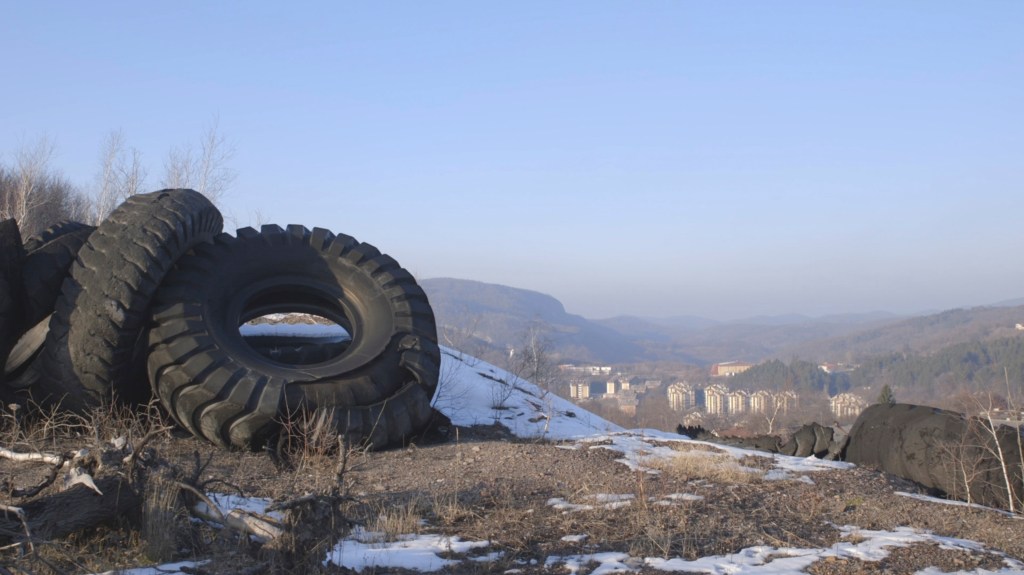
We started off thinking we would make a film about magic, but then we discovered this huge mine in the background of the town. We thought it looked insane – a massive hole, the first thing you see when you enter the town. Dragan was even working in the mine. As we got to know the people and the place, we sensed that these topics were totally connected: the people, the magic, and the mining. Ultimately it became a very character-centered story.
You mentioned that the initial idea was to approach the topic from a feminist perspective. How did this evolve once the dragon hunter became the central figure?
In the end it’s always like this: you start with an intention, and then it changes. It wasn’t like we included Desa just because she was a woman, but because she was super fascinating. Still, part of us was relievedto have a woman in the film. Until that point, we were structuring it around Dragan, his father, and his son: three male generations. It felt more natural for us to have a strong female element in it. But we shifted away from feminism as a topic in and of itself.
Do you know how long the mine in Majdanpek has existed?
Mining has existed in this region for millennia. It’s one of the oldest mining regions of the continent, dating back to before Roman times. The mine as it is now, throughout more recent centuries, was owned by the French, the Austrians… basically by everyone except the locals. In the 1950s, in early Yugoslavia, a big copper deposit was found, and Tito made it into a mining town.
After the breakup of Yugoslavia it remained state-owned, but there was little investment. Wages were very bad and there was little concern for safety. Inevitably it was bought by a Chinese company in 2019 – that’s also part of the film.
It’s a mine for copper and gold. This is part of the mythology of the place: first, the idea that the city is sitting on gold and one day everyone will be rich. Clearly, that is not the case. The wealth there is to be had doesn’t go to the locals but to industrialists. There’s also the mythology around Chinese ownership. Officially, they only had the concession for copper at the beginning, not gold. But supposedly they were smuggling gold out, hiding it in rocks. With everything related to the Chinese it’s very difficult to get clear information, so it invites rumors and gossip. It’s hard to know what is true and what isn’t.

What was your research process like, and how did you deal with the challenge of representing so much historical and political information accurately?
In the end there is a lot of stuff we don’t talk about in the film – we thought it was too distracting. The film is structured around the characters, and we couldn’t find a way to include a lot of the context without interrupting the flow. So we debated a lot and decided just to tell the story of this place, and hope people take away the feeling of it: the mystical aura. People are very attached to it, but it is also very dilapidated, underfunded, and neglected over the years.
In terms of research, we had eight years, so we had time. A lot came from talking to people, from first-hand information passed on, because much of this hasn’t been written about academically. It was a combination of piecing together what we could find, cross-referencing facts people told us, and figuring out what was correct.
You mentioned the stories of the dragon hunter and the mine are so connected. How?
We arrived in the city and met Dragan. We thought, wow, dragon hunting is so cinematic. He as a character was great too. But when we came back a few times, it wasn’t really working—we couldn’t figure out how to tell the story. Part of the problem was, when we asked him to show us something, he said: “I can’t, the dragons are gone.”
The reason the dragons are gone is because the mine pushed them out. Their natural habitat is the forest, and the forests are being cut down and polluted. The dragons lived in this weird symbiosis with the population. The family we filmed said if someone in town had a problem with a dragon, they would be called to take care of it. Even though the dragon caused harm, it was part of the ecosystem.
I see the disappearance of the dragons a loss. Someone might say, but the dragons harmed people, isn’t it good they are gone? But it’s a strange relationship that mirrors the mine. The mine is killing people too – there are terrible rates of cancer, low life expectancy, all kinds of pollution in the ground and air. But it’s also the only source of employment. So there’s this weird tension, this interdependence.
And when they killed a dragon, they collected parts of it to use in magical potions. Again, similar: it kills you, but you use it.
In local belief, how are the dragons imagined? What do they do, and when do they appear?
My favorite thing about the dragons is that they are supposed to come on Tuesdays and Thursdays. People argue about which specific days. If you ask them what a dragon looks like, they say: “It looks like a dragon.”
It’s hard to translate because in Serbian you have three words for dragon: zmaj, aždaja, and ala. In English you have only “dragon.” So if you ask: “Kako izgleda zmaj?” (what does a dragon look like?), they might answer: “Kao aždaja” (like a dragon).
Historically, the dragon represented a problem the community had to solve. It was a symbolic way of addressing issues. But the dragon could also take other forms or be invisible. Often it appeared as a handsome man. Maybe your wife had an affair, but actually it was with the dragon. Or if a child was born without a father, it was the dragon’s child. I haven’t heard of the dragon taking a female form, though.
Were the locals willing to talk with you about dragons and magic, or were they rather hesitant?
It’s kind of a taboo topic in the region. People don’t like to talk about it much. I think they fear being judged for believing in dragons. It helped that we filmed for such a long time – turning up again and again, people got used to us, knew us, stopped in the street to talk.
But with TV reporters, it’s different. In the last years, many of them turned up, made spooky stories about Vlach magic, and offended the community. That’s why people sometimes don‘t want to talk about it anymore. It has a lot to do with how the media mistreats it, representing it as something exotic.
Did you live in this town for longer periods while working on the film?
No, we came and went. I personally wanted to stay longer, but honestly nobody could stand it very long. There is something about the town that drives you crazy. One time we stayed for a month in the lower part close to the mine, and the noise of the trucks really gets to you… there’s something about the frequency. Somehow everyone wanted to leave after a few weeks. The longest we stayed was a month.

What was the atmosphere like for you in the town? Did you get a sense that magic was present?
I would not say it was visible, which was a bit problematic for the film. It was difficult to show – it’s not like you see people doing mystical things in the street. Now and then you would see traces: things left in the river, memories related to the dead on graveyards…
We ended up making short films about things we found interesting – more explicitly about witchcraft – that didn’t fit in this film.
How did the local community and the dragon hunter’s family receive the film – were they happy with how it turned out?
Really embarrassingly, we haven’t had a Majdanpek screening yet, though we’ve been talking about it for a long time. There’s only one cultural center and it’s under reconstruction. But for the Belgrade premiere at Beldocs 2023, we brought the whole family. We were nervous because they didn’t really understand what kind of film we were making – they’re not used to watching films like this, it’s not in their frame of reference.
We tried to show them a rough cut, but for them it was like a living photo album. They didn’t see it as a film, but as a personal memoir. That actually made me very happy. They really enjoyed it, even if that wasn’t the point. Luckily, they were very happy about the screening in Belgrade.
And Desa died not long after. She had cancer, sowe rushed the premiere a bit because we wanted her to be there and see the film. That was the greatest moment: she had that one night where she was treated like a superstar, ranting on stage, everyone cheering.
What was the reception like both within the Balkans and internationally?
Mostly very positive. Majdanpek is such a small place – even within Serbia, nobody really knows about it. Mining has become a huge topic in recent years, but still, people would often ask: why this town?
In the Balkans, the response was amazing. Outside the Balkans, not so much. Many festivals weren’t interested – they found it too niche. I think it didn’t fit the way people want to depict the Balkans. There are certain aspects Western Europe finds interesting, and this isn’t one of them. It’s too many degrees away: a rural place, a community that isn’t even classically Serbian – why should we care?
But there are so many layers: environmental issues, rituals, labor struggles. It just doesn’t tick a clear box.
In what ways does your film reflect the current mining issues in Serbia?
The anti-mining struggle in Serbia with the most visibility is in the West , around the lithium mines being planned there. Bor and Majdanpek, which are in the East, show the before and after. When the governmentsays, we’ll take care of the environment and workers, nobody believes it. And you have living examples right there that prove they don’t care.
I got involved in a struggle to stop another mine opening in Homolje, the wider Eastern Serbian region. It’s similar – copper and gold. There’s an amazing group trying to stop it, but tests have already been going on for years, laying the foundations to open it. They are massively polluting the water. It’s an area with many endangered species, next to a natural park – conveniently, the park border ends exactly where the mine would begin.
And again, there’s little reliable information, lots of false information. It’s a rural, depopulated area, so it’s hard to build resistance. In Loznica, where they plan to open the lithium mine, people are angry because they’ll be displaced and lose their homes. In Homolje, people have already been leaving for years, so it’s harder to mobilize.
Basically, what everyone assumes is that when this mine opens – which is being prepared by the Canadian company Dundee – it will end up in the hands of the Chinese company that owns the others. Eventually, the whole of Eastern Serbia will be one giant mine. It’s very depressing but at least people are still taking a stand.
How do you personally engage in fighting against mining in Serbia?
Mainly by telling people about it. After finishing the film, I felt a responsibility. I didn’t want to be someone who just came, made a film, and left. I made an effort to connect with people working on extractivism.
By chance, this led me to a Berliner Gazette conference in Berlin three years ago. Every year they have a workshop, and that year the topic was uniting the labor struggle with the environmental struggle. That felt important and spoke to the core of our film. We weren’t saying: get rid of all the miners. We wanted justice for the miners as well as an environment that doesn’t poison everyone.
During the workshop we founded an environmental platform called ZBOR. I’ll go there after this film festival, it’s in Breza, outside Sarajevo. It’s an annual gathering in the Balkans where people from the region support each other and also connect with people from Europe, so they understand what’s happening and how their own countries are implicated. Germany, for example, is a major factor – pushing for lithium mines in Serbia for its electric car industry.
Corruption is a side theme in the film. Having lived in Belgrade until recently, how do you see the connection between mining issues and the current protests in Serbia?
The trigger of the protests now was different – the collapse of the railway station in Novi Sad. But it’s important to understand the context of the massive anti-mining movements of the previous years. Vučić already tried once to open the lithium mine, and mass protests managed to shut it down. Then of course he found a way to persuade them to reopen it. Deals have already been made, and it’s hard to stop it. But people are really angry, and protests are massive.
The important thing is they’re not just in Belgrade—they’ve spread throughout the country. The anti-mining struggle is definitely part of the student uprisings now. Of all the things the Serbian government has done against its people, mining is emblematic. There’s a strong parallel between corruption literally killing people – through a collapsing building – and mining, which deteriorates the quality of life for everyone it affects.
People are making that link. Part of what the students are doing is pro-actively learning about different issues and democratic formats. Even in Homolje, in recent months, students have shown more interest in helping stop the mine.
It’s fascinating where this filmmaking process has taken you. Do you see yourself as an activist filmmaker now?
It’s wild. I never imagined it would take over my life to this extent.
I think “activism” is a very loaded term. I wouldn’t call myself an activist. I’m just trying to learn and figure out how I can be useful.
The most useful thing so far was when we organized a series of screenings of Flotacija in Germany – in Kassel, Berlin, Frankfurt. We brought over a delegation from the Balkans involved in different struggles and used the screenings to meet union representatives. We held panel discussions. It was really enlightening, a chance to understand each other’s contexts better. I think it was fruitful. I can’t take credit for organizing it, but I’m happy the film was a catalyst.
And as your film project started from it – where does your interest in magic and pagan rituals come from? I read that you also did a short documentary about Krampus in Austria…
I always assume everyone is interested in witchcraft and magic. In recent years it became kind of trendy – almost too much, oversaturated, with reclaiming witchcraft and all that. But I have a lot of love for folk customs.
I have a mixed relationship to traditions. Aesthetically, I feel compelled by them, but I always want to point out that tradition is a construct – it changes over time. Much of nationalist rhetoric tries to fix tradition in one moment, in one way, but that’s not how it works.
Part of my interest is in this tension. It’s really interesting in relation to the dragons. The relationship to them has shifted as the town’s situation shifted. They didn’t drop them from their belief system – they understood them differently.
But I also just love masks, possessions, rituals. And I’m interested in why we still do these things. They have such a long history, but it’s still an active choice to keep them alive.
What do you think is the power of such small Film festivals as Pillusion?
Small festivals are my absolute favorite kind. I really appreciate the closeness that comes from everyone being together in the same place. The filmmakers get to know each other on an intimate level but you can also interact with the audience much more directly. As someone who grew up in the countryside and felt the lack of accessible culture, I think these kind of events are really precious for rural communities.
I also think there’s a huge amount of value in festivals that are created out of pure love of cinema. A lot of festivals get trapped in a commercial mindset, either only wanting premieres or films that have already been successful in A-list events, and the programs end up being quite homogenous and not necessarily very well curated. Festivals with a more personal touch, like Pillusion, can just avoid playing this game entirely and as a result the selections are often much more interesting, and you get the chance to see things you wouldn’t elsewhere.
Pillusion is an interesting case in that its location means that it can’t physically grow and there will always be a limit to its scale. I think there’s something very beautiful in that, and hopefully it means it will keep its unique and special atmosphere in the years to come.
| Brigitte Egger
 komplex-KULTURMAGAZIN