
Was ist Natürlichkeit, was ist Natur? Lässt sich zwischen ihr und dem, was menschengemacht ist, denn eine Grenze ziehen? In komPOST #49 verhandelt ein philosophischer Text von Santiago Colombo Migliorero diese Frage, begleitet von der Fotoserie „Nottabird“ von Heyse Ip. Im zweiten Teil wandern Gemälde von Katja Moritz ins Traumhafte hinüber – dorthin, wo Natürlichkeit und Künstlichkeit miteinander verschwimmen.
/ What is natural, what is nature? Can we draw a line between nature and what is human-made? In komPOST #49, a philosophical text by Santiago Colombo Migliorero addresses this question, accompanied by the photo series “Nottabird” by Heyse Ip. In the second part, paintings by Katja Moritz wander into the realm of dreams – where the natural and the artificial blur together.
NATURE: PART I
Santiago Colombo Migliorero, 2024
“Maldigo la cordillera
de Los Andes y de la Costa,
Maldigo, señor, la angosta
y larga faja de tierra,” 1– Violeta Parra, Maldigo del alto cielo (1966)
What is natural, like what has been said about night and day, is a word that cannot be understood on its own, but only in opposition to what is cultural. They need each other, and in this dualistic need, they tend to extend toward opposing adjectives tied to these two concepts. But where is the boundary that separates them? If I begin to observe the room around me, few things could truly be called natural. Perhaps the three plants, all in pots. The cat, sitting on the chair? Myself?
Indeed, all the objects surrounding me originally come from a natural context, untouched by humans at some initial stage. The thermos or the lamp come from steel mined from the earth, or the plastic of the chairs from petroleum. If we trace the origin of any atom, we will always arrive at the same source: a natural one. But everything also seems to have been altered by human action – even the plants I mentioned earlier, which all descend from generations of plants mass-produced by humans, modified, many of them bearing a label, a European Union passport, and an identification code. The idea of virgin nature, untouched by human presence, appears as a romantic and somewhat outdated concept, as if we could separate a portion of the world, draw borders around it, and remove ourselves from the equation – as if everything wasn’t interconnected.
If nature is defined as that which has a material origin unaffected by humans, then we must ask: how many things on the planet actually meet this criterion? Possibly very few, or even none, depending on how we define the boundary between the human and the non-human– because everything exists within an ecosystem of exchanges. And besides, where do humans themselves fit into this equation? Are we artificial beings rather than mere primates? Why is an anthill – constructed by organisms such as ants for their habitat and benefit – considered natural, while a city created for human habitation is considered artificial?
But above all, we must be aware that the concept and idea of nature is itself a human construct and therefore, in these terms, artificial. It is often tied to a romanticized view of the term, where the natural is seen as something pure, primal, kind, and gentle, in opposition to the artificial. But it can also be seen through perspectives like that of Herzog:
“I don’t see it as erotic at all, but rather full of obscenity. Nature here is vile and base. I see nothing erotic about it. I see only fornication and asphyxiation, struggle for survival, growth, and de cay. Of course, there is much misery, the same misery that surrounds us… Compared to this immense articulation, we appear and sound like poorly pronounced and half-finished sentences from a cheap, stupid novel. And we must become humble in the face of this overwhelming misery, overwhelming fornication, overwhelming growth, and overwhelming lack of order. Even the stars in this sky seem like chaos.”
Ecology often seems to yearn for a return to a previous stage. It feeds off a nostalgia for the past, presenting it as better in contrast to an apocalyptic future marked by disconnection from nature and environmental crisis. In this view, the future is stolen from us in favor of an idealized past, often forgetting the shorter life expectancy, higher disease rates, lower population density, and other problems that characterized the past. When the future becomes hard to envision, when everything seems homogenous and apocalyptic, with no change or improvement in sight, the past begins to be idealized as a common space where things were better. But if we wish to return to the past, perhaps there will be too many humans.
- “I curse the Andes / and Coastal mountain ranges, / I curse, sir, the narrow / and long strip of land” – Violeta Parra, I Curse the High Sky (1966)
↩︎
Nottabird
Heyse Ip, 2024 (– ongoing)
In a landscape teeming with birdsong, I often only saw their shadow. The elusive Nottabird. I watched from behind the safety of glass.

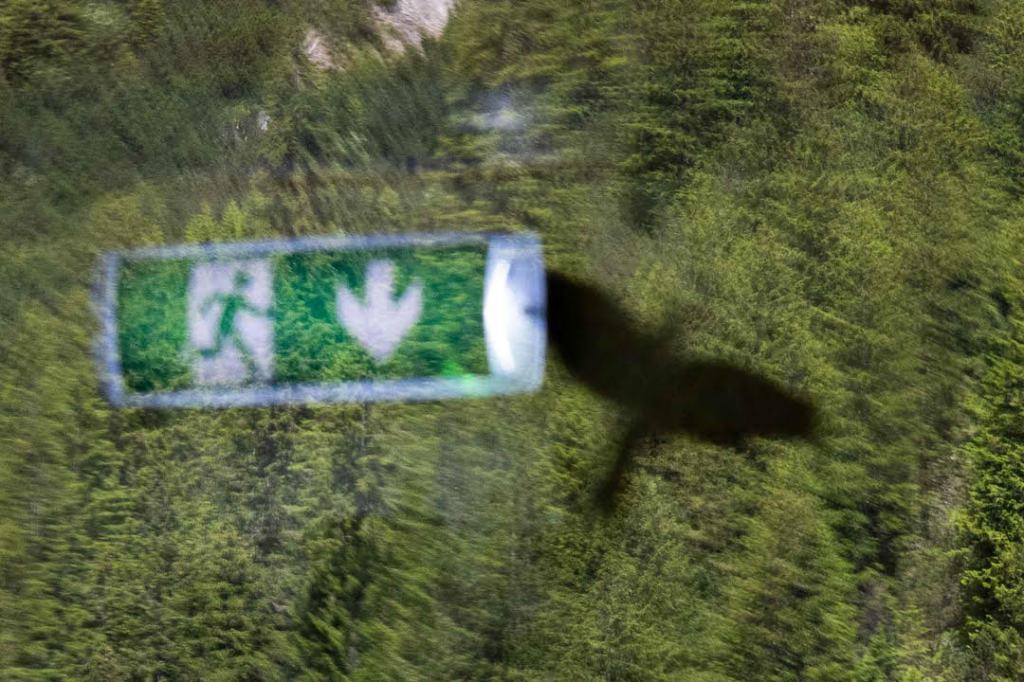
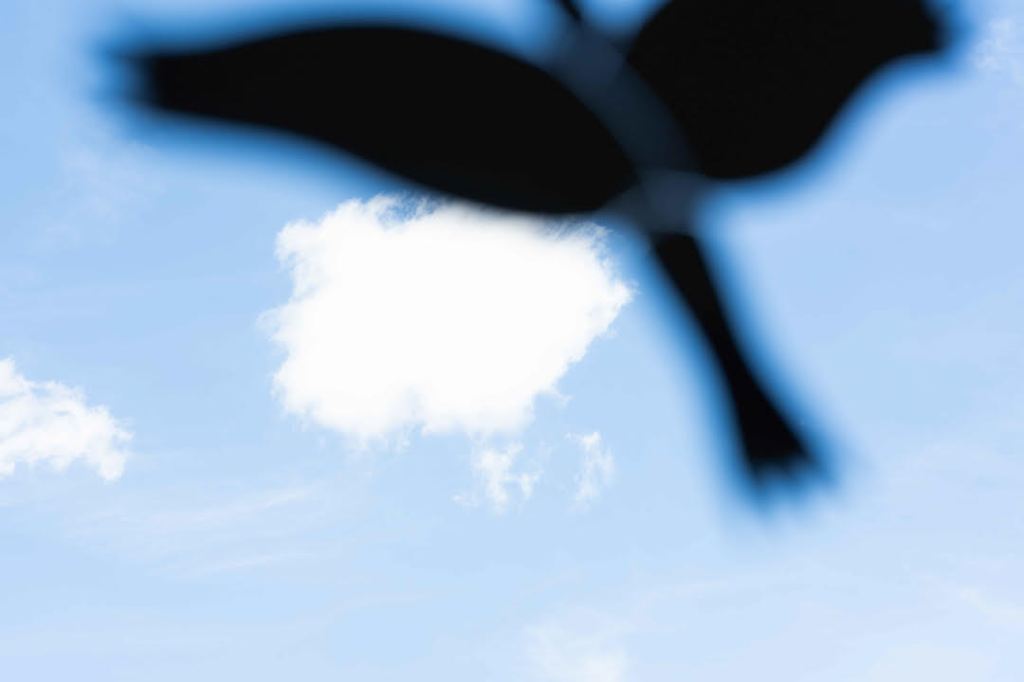
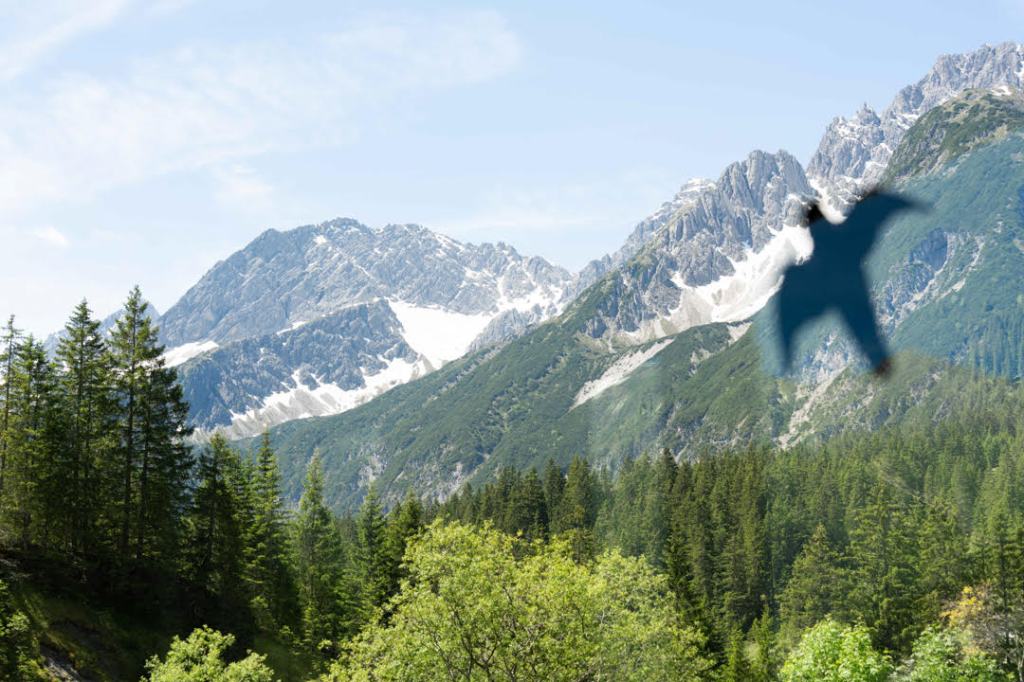
A series of images first captured during the Medienfrische Art Festival in Boden, Austria. *Nottabird – A term used by birdwatchers to describe something that looks like a bird from a distance but turns out to not be a bird at all.
NATURE: PART II – EPILOGUE
Santiago Colombo Migliorero, 2024
“Nature is a language, can’t you read?”
– Morrissey, Ask (1986)
Perhaps the feeling that I didn’t understand nature was what first made me take that trip into the heart of the mountain. Or perhaps it was the thought that I didn’t understand people or language that first made me leave the city and start writing. After all, these solitary and quiet places have always been favorable for writing and introspection. A retreat. A space surrounded by nature.
It was still early, and the sun was already shining in the sky. However, the deeper I went into the forest, the darker it became. It wasn’t the darkness of night, but rather a thick atmosphere that covered everything, stripping objects of their contrast. Outside the forest, the heat was suffocating, but under the canopy you could almost see frost between the scattered pools of water – small black swamps that sharply reflected all the surrounding darkness. In these places, things merge into one. They merge with you.
It seemed as though I was walking aimlessly, though I really wasn’t. I had never been there before, and it’s easy to get lost in a forest, yet I felt oriented, as if caught in a long déjà vu. As I walked, a familiar verse came into my head:
With my gipsy ancestress and my weird luck / And my Taroc pack and my Taroc pack.
– “It’s comforting to have a little bastard in all of us,” – I thought.
In a clearing, a pile of junk. A car wheel, a shovel, sheets of metal. Perhaps the only undeniably human space I had seen in that forest.
From time to time, I could feel a presence at the back of my neck or on my fingers. Something faint, like the ghost of a ghost. The echo of a fragment, like a distant and kind witch. The trees stood tall, their leaves wilted on the ground. Like thousands of eyes watching, the forest as a whole felt alive and alert – dark and green.
When I first noticed the presence, I jumped. I wanted to say something, but I went mute. That happens to me sometimes – I go mute when it matters most. I soon realized the presence wasn’t threatening; I’m not sure if it was peaceful either, but it would accompany me along the way. A pair of insect eyes, a grasshopper or a beetle. Those insects that mark bad thoughts are guided by selfish souls. I thought of Eurydice. Don’t look back.
At last, I reached my destination. A building in the middle of the forest. Empty, with no sign of civilization around it. Not even overtaken by nature – just worn down by time, like any building in a peripheral neighborhood. I went inside and climbed the four flights of stairs. I felt as though I were at the very center of the forest, as if everything else surrounded me, orbited me. As if nothing came before me, as if the entire forest had been placed here just to encircle this building.
Inside, the floor was covered in water. On the table, something caught my attention. It was without a doubt a strange sight. I thought about how we know nothing about things that we haven’t placed into them ourselves, and with that excuse, I moved closer. I saw a pufferfish on the table, flapping, trying to return to the water. Watching it made me think: pain demands our full attention.
I walked a few steps away from the table, but the water grew deeper and deeper, until I couldn’t touch the bottom. As I sank, I thought that sometimes fragments contain everything; that sometimes certain images mean nothing – are nothing beyond themselves; and that sometimes, only sometimes, the distance upwards is the same as the distance down.
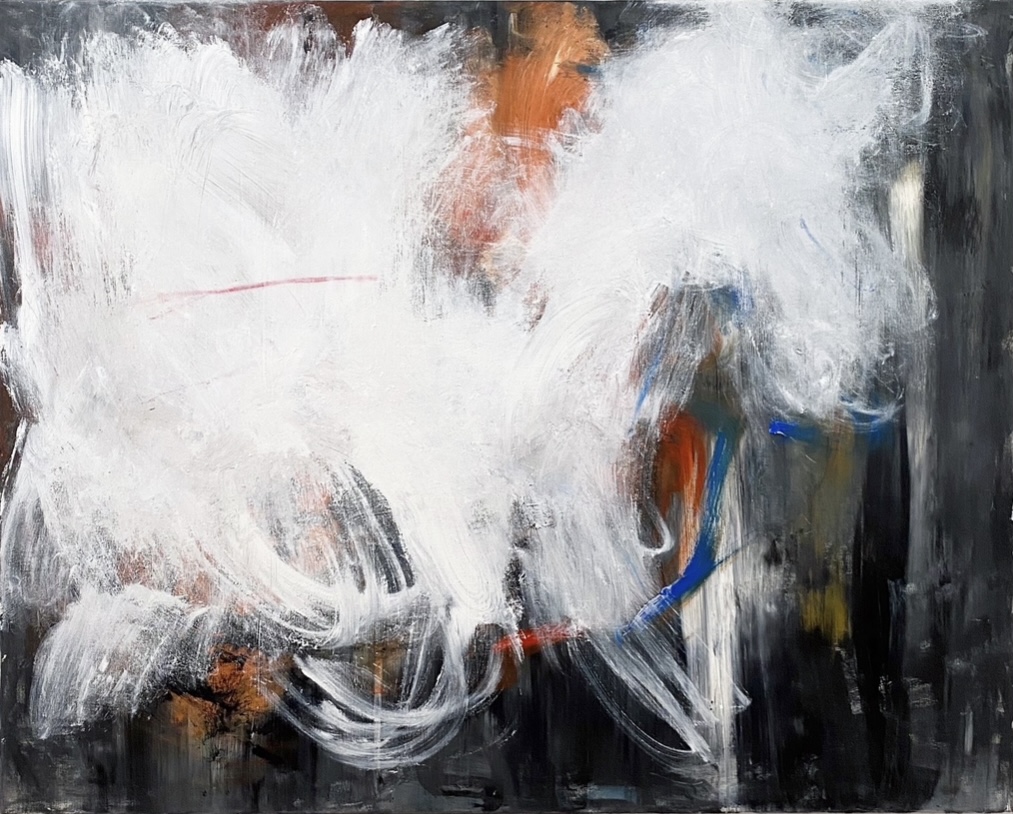
Lighthouse in Storm / Tulips / The Daughter’s Painting / GHOST SERIES
Katja Moritz, 2025
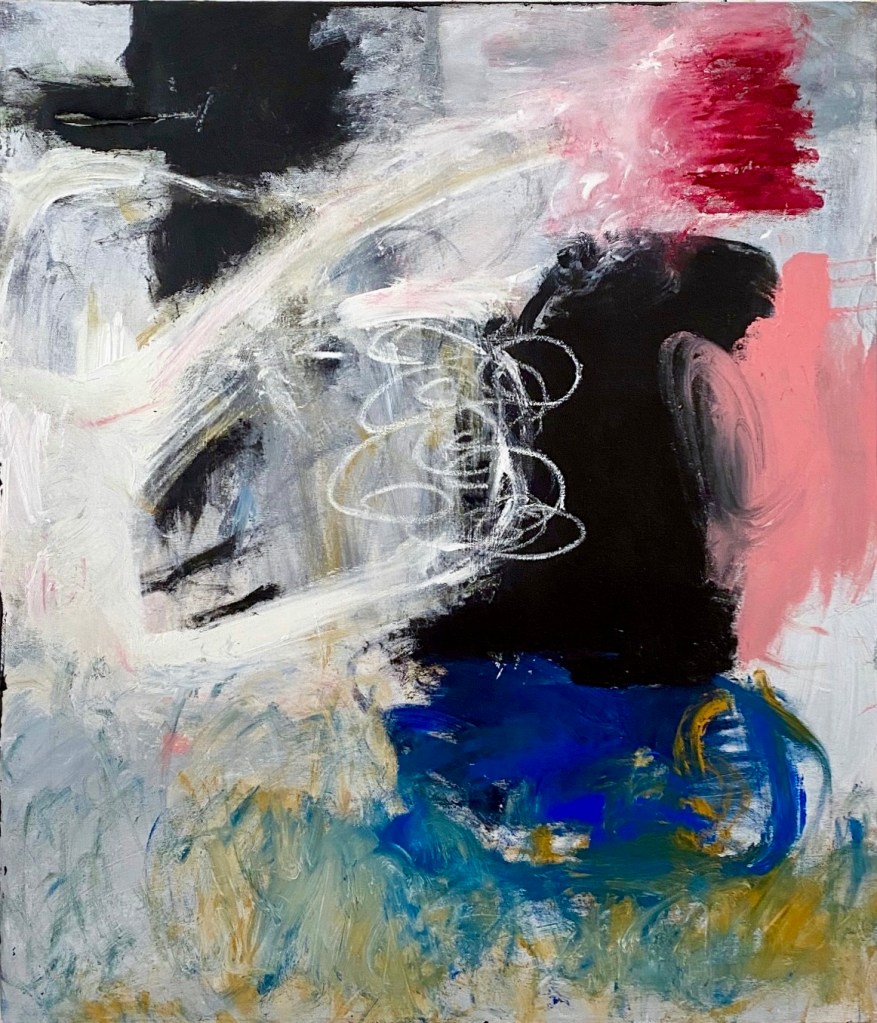


The komPOST series presents monthly artistic submissions in a wide variety of media. The works are selected and combined by the editorial team of komplex–KULTURMAGAZIN. If you also want to be part of komPOST 25, read our open call and submit your works.
Bios
Heyse Ip
(b.1995, Hong Kong) is a multi-disciplinary artist working in London and Hong Kong. His works range from multimedia installations of video and sound to kinetic sculptures and performance. His absurd and humourous interpretations of banal and familiar objects create scenes exploring the power dynamics in urban ecology between humans and animals. Often by giving a voice to the animal or inanimate, he reframes our relationship with ’nature‘, in so he examines our own definitions and perspectives of humanness.
Santiago Colombo Migliorero
[Arg, 1992]. Visual and audiovisual artist. His work explores the memory of objects and materialities, and how they are affected by traces, ghosts, temporality, and the cadences of objects. He investigates the limits of video and animation techniques and media, as well as the intersections between the digital and non-digital: the haptic materialities of sculptures, mechanical objects and matter, and the ethereality of the digital, CGI, and territory. His practice is centered on exploring material, kinetic, and digital practices and aesthetics, and how these can coexist in other material worlds.
www.santiagocolombo.com / @santiagocolombomigliorero
Katja Moritz
ist eine im Süden Österreichs geborene Malerin. Sie lebt und arbeitet in Wien. Ihre Werke sind expressiv und vielschichtig. Sie kreiert kryptische Geschichten mit einem starken und rohen Gefühl. Ihre Arbeiten wurden in Wien, Italien und Paris gezeigt.
 komplex-KULTURMAGAZIN