
Rauschende Wellen und nachhallende Echos: In der 28. komPOST-Ausgabe haben uns Einsendungen aus Elefsina und Cannes erreicht.
E-choes (Voices of Eleusina)
Katerina Giannisi & Konstantinos Mitrou, 2023*
Couple:
[translation]
Eleusina was not the way it is now, not at all. You would get out on your balcony and the railings were white colored because of the cement in the air. The sea on the other hand… Every factory of Eleusina used to drop their wastes in this sea.
I was a kid back then, around fifteen years old. In the neighborhoods where I grew up, near the “Kronos” factory, there were lots of wooden platforms in the sea. Not for diving, one couldn’t swim in those waters, yet people used to fish. Lots of fishermen in those days. My friends and I also used to go there to fish mullets. They usually come on the surface of the water those fish.
And there was also a sports field nearby. The “Americans’ Court” we used to call it. The American fleet used to embark in the port of Eleusina back then and the sailors would play baseball in that court. They also used to bring some big plastic barrels with them which they filled with ice to keep their drinks cold. Brands like 7UP and others which we have never heard of before. We only had orange juices or lemonades in glass bottles. But we used to go and watch them play and they would share their drinks with us.
Back then all the plains of the upper Eleusina were full of swamps and the part around the port was filled with factories. No one would care about the ancient city and its relics. Eleusina was not the way it is now.
Mr. George:
[translation]
This place is full of history. First of all it has been flooded three times. Ancient relics everywhere! As the years came to pass, there weren’t only Christians here, but pagans and Hellenists too. Merchants were using the port and there were lots of local communities in the city. There still are. Communities from Thessaly and Epirus, from the Black Sea, from Siros Island and a community of Arvanites too. And all of them used to and still hold many events.
People were closer to one another back then. Our mothers used to meet in their porches to talk and gossip while we were playing games in big groups. We played soccer, hide and seek, the
leapfrog, games with a ball… To play soccer we used to build corners in fields, we drew lines of lime and we fabricated our own football jerseys. Every day we were fighting with one another and the next one we would meet on the same spot to play together once again.
Now… Now people do not communicate. We don’t talk with each other anymore. You know, if you have a problem and you choose to discuss it, you can find a solution right there and then.
Personally, I help whenever I can. I grew up in a poor family and I know how it is. Six brothers we were and our father was a salesman in Monastiraki. A smart man he was. He used to sale folk objects from places around Greece. I remember a time when some people from the folk museum of Siros Island came to our porch. They were still organizing it back then, and they took countless of different objects to exhibit in their museum.
I am glad for what you do. We also had a radio station in Eleusina back then. A pirate one and we would dedicate songs to each other. It was a big deal to talk to someone through a radio station. It was nice. People don’t talk these days…
Cannes
Daniel Kalkhofer, 2019
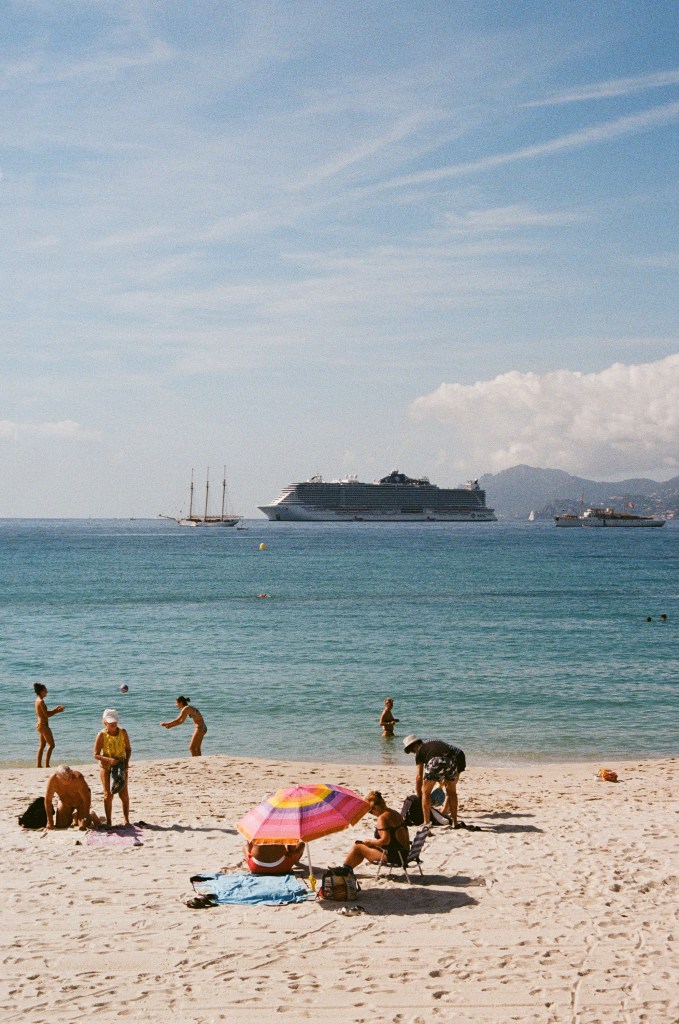
Daughter:
[translation]
There’s sea here as well. I’m only here for the job, that’s why I’m staying. It’s convenient. There are two cafes and a pedestrian street, no life for young people. They’re thinking of moving the port to Vlicha, connecting it to the railway and turning the current one into a marina.
We said it has the good things of the province but it’s close to Athens and it’s convenient. I can find parking outside my house. It’s still kind of a neighborhood. I’ll get out to walk, run, I’m not afraid.
I’m not afraid to walk around at night.
*Sound Recordings 2023
In the context of the Elefsina Festival, Katerina Giannisi and Konstantinos Mitrou, collaborated on the collection of sound material that would include oral testimonies from residents of Elefsina, about the city and its history through the years, as they lived and remembered it, and soundscapes from various parts of the city. Following the direction of Karl Heinz Jeron, initiator of the idea and project manager, the goal set was to gather material that would highlight both the natives‘ perspective of their place and the framing of their soundscapes of the city of Elefsina.
The project was completed with the collection of 6 testimonies, capturing life in Elefsina from the 1930s to the present day. People of different ages shared their own aspect of the city’s history and the material was recorded in the form of a narration. For privacy reasons, the participants will remain anonymous. Apart from Katerina Giannisi and Konstantinos Mitrou, the actresses Spyridoula Gekas and Zeta Theodorelou offered their voices for the needs of the recording of the testimonies. Finally, the soundscapes consist of edited recordings on the beach of Elefsina, within the archaeological site of the city, from the Elefsina Park and the People’s Square.
Kurzbios
Katerina Giannisi
Born in 1994 in Athens where she lives and works. She is an actress, designer and engineer and has been active in the refugee sector. She was an “Onassis Foundation” scholarship holder for her undergraduate studies and has been an intern at the Stavros Niarchos Foundation. Since 2022 she is a postgraduate student at the Department of Theatre Studies of the University of Athens and as a theatre researcher she participated in the action „Prologue“, hosted by the “Athens Epidaurus Festival 2023”. She has studied at the Higher Drama School of “Αρχή” with Nellie Karra. In addition, she has attended courses in Drama (Elephas tiliensis), physical theatre (Rosa Prodromou), contemporary dance (Androniki Marathaki), storytelling (Lily Lambrelli) and polyphonic music (Natalia Labadaki), as well as seminars on oral history, Theatre of the Oppressed and traditional dances. As an actress, she has participated in recordings and storytelling, performances in theatre festivals („Festival of Rematia“ in Athens, „Stories from the lockdown era“ in London, „Rose Moon“ in Epirus, „Page 31“ in Athens) and dance („Crater“ in Athens, „Kinono 2“ in Tinos).
Konstantinos Mitrou
Born in 1995 in Athens where he lives and works. He is a theatrical researcher and educator, active in the field of special education. He is a graduate of the Department of Theatre Studies of the University of Athens (UOA) and throughout his studies he was employed in educational institutions of formal and special education in the context of his diploma thesis and internship. He has attended seminars on special education and mobility disability (UOA), on special education and education (ΚΕΔΙΒΙΜ), on the promotion of creative writing in education (ΕΕΠΕΚ) and on the promotion of arts in Greek schools (UOA). He has worked as a theater teacher in the private educational sector (Pan. Giannimara Educational Institutions), as a caregiver for people with disabilities in a semi-independent living structure (Margarita Special Education Workshop) and as a theatre animator in social skills workshops for children with disabilities (Centre for Special Therapies – Alfavitari).
Daniel Kalkhofer
arbeitet als interdisziplinärer Künstler und erzählt Geschichten zwischen auditiven und visuellen Welten.
 komplex-KULTURMAGAZIN