The Potential of the Present Moment: A Cyanotype Workshop with CHARLOTTE OSTRITSCH
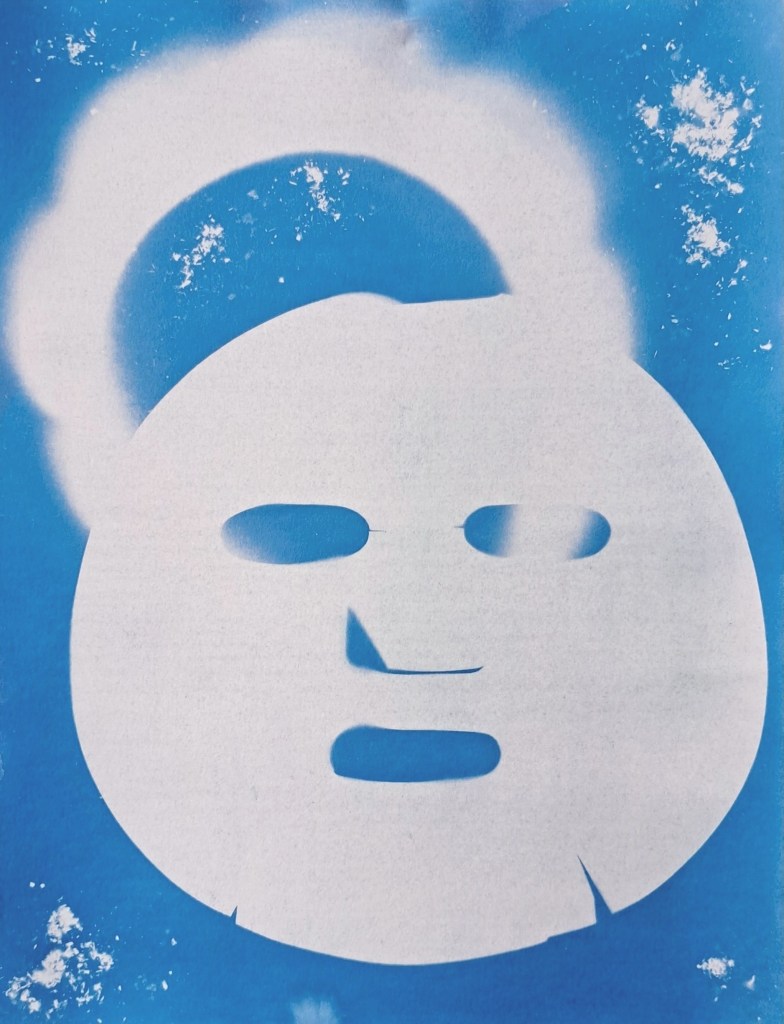
One month ago, from 29.06. – 30.06.24, a small group gathered at openspace Innsbruck for a workshop described as „multi-sensory investigation,“ focusing on shadow painting using the cyanotype technique, a camera-less photography method that creates blue and white images. This two-day workshop was conducted by Swedish artist Charlotte Ostritsch as part of the KUNSTRAUM INNSBRUCK Summer School, in cooperation with the EU platform Magic Carpets.komplex was also part of this experimental process.
Creating Cyanotypes with Charlotte Ostritsch | photo: Uchii Ivan Okello
When I arrived at openspace on the first day of the workshop, I was ten minutes late. The participants were already gathered around a large table, listening attentively to Charlottes introduction. „We just started to talk about time, so you are right on time,“ she welcomed me. The workshop, titled MEASURING TIME BY WALKING, was inspired by the quote „I measured time by walking it“ from Tarkovsky’s mesmerizing film Stalker (1979). Charlotte has been fascinated by the concept of time since her childhood: “Time is always different. An hour can be so long and so short,” she said. “I’m sort of time dyslexic. Since I was a child, I’ve been immersed in the present moment. I have a problem with time as a concept.”
In the first part of the workshop, Charlotte shared with us biographical stories from her life: growing up in a “boring” fine art environment, studying anthropology and rhetoric, attending theatre school, experiencing stage fright, making music in a black metal band, teaching at a pre-art school, and being a mother to an eight-year-old son. She never aimed to become something specific in life. “I just want to learn something new every day. I don’t want to waste any time.” Although Charlotte tries many different things, they all connect to her artistic practice. She didn’t consider herself an artist until the age of 35 when she redefined for herself what art meant: “Art is everything that is made by humans. What we do as humans is the artificial thing.” Influenced by Joseph Beuys, who claimed that everyone was an artist, Charlotte values the anthropological view on life. For her, changing perspectives is essential to understanding things:
“It has bothered me a lot that I couldn’t see myself from the outside and others from the inside. I have always been interested in micro-perspectives and overview perspectives. It helps me if I have a problem and think it’s the biggest problem in the world – I try to see it from the perspective of the universe.”
A text written and read out by Charlotte Ostritsch during her workshop MEASURING TIME BY WALKING at openspace Innsbruck
After a short break from listening to Charlottes somehow even performative introduction, we moved on to the practical part of the workshop. The cyanotype technique is about “entering a dialogue with the possibilities of the present moment,” as described in the workshop outline. This is where the relationship to the central topic of time comes in. For the first exercise, Charlotte proposed a task to bring us closer to the notion of time passing. We received a piece of paper pre-coated with a 1:1 mix of ferric ammonium oxalate and potassium ferricyanide. These chemicals are very sensitive to UV light, so we had to be careful not to expose the paper to light before starting the shadow painting process. The first task was a light test: we exposed additional parts of the prepared paper every 30 seconds. After approximately three minutes in strong sunlight, we created a color gradient – our first cyanotypes. This test was crucial for understanding the day’s UV intensity, which varies constantly, even when clouds are moving.
Christina Burger, a high school teacher and student at the Bildende Innsbruck, who also participated in the workshop, shared her enthusiasm about this creative experimentation process:
“Trying out the cyanotype technique was exciting because these works of art are created very quickly. The choice of motifs can take longer, but there are always moments of surprise in the technical realization, even if the motifs are planned. I find this technique magical.”
Cyanotype experiment by Christina Burger | photos: Christina Burger
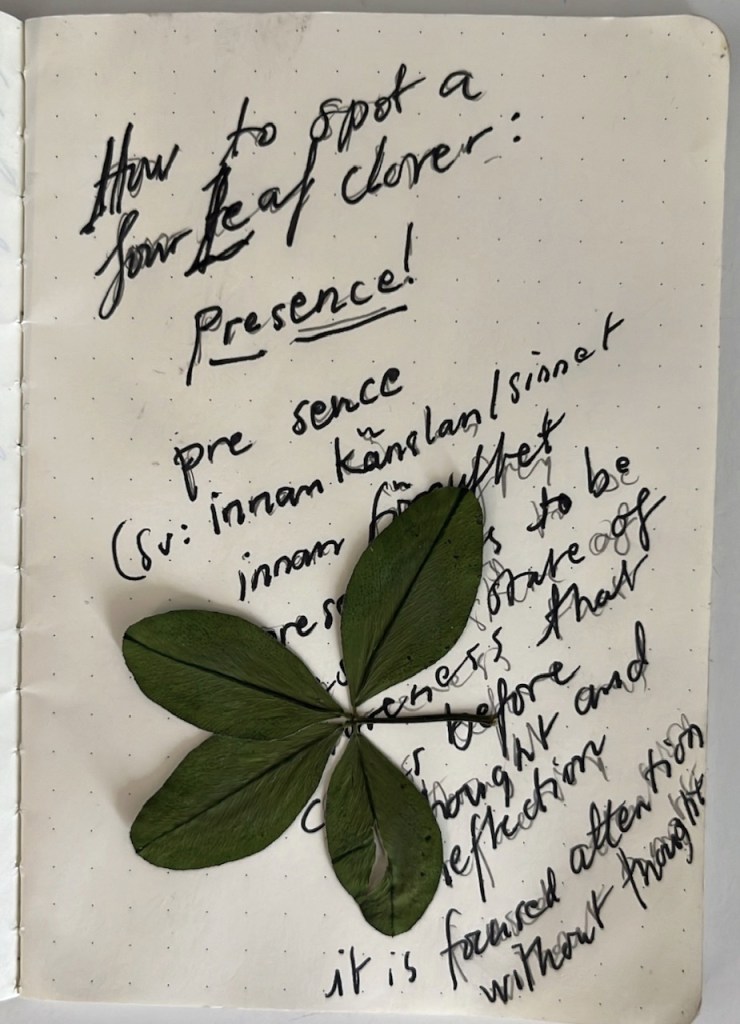
On the second day, Charlotte originally planned a walk in the city to observe and find potential materials for shadow paintings. However, she changed the plan when it became clear that the backyard of openspace offered more than enough unused materials and shapes for experimenting with exposure times. This spontaneous change of plan – despite the central WALKING part mentioned in the workshop title – characterizes Charlotte’s workflow: “For me, spontaneity and doing things unplanned is connected to freedom.” Usually, she would walk outside, confident in finding something interesting. “There is always an impulse to build or to do something. Every moment has the potential of creation”. Charlotte is adept at finding things, including four-leaf clovers, which she found right away in a meadow in Innsbruck. “I always spot this leaves. I could even do a workshop on finding them,” she laughed. In her case, the lucky clover can be read as a symbol for finding luck by being in the present.
A Note by Charlotte | photo: Charlotte Ostritsch
“When we are too concerned with time and controlling it, we miss the moment we are in. We don’t even take time to heal from certain things. Weforget to listen to our own body. I think the world would be a better place if we all lived more in the now.”
For Charlotte, as always, the time of the two workshop sessions was not enough. “I think we are taking too little time to go deeper into things. Our culture and society are forcing us to be producing all the time.” Despite this, it seemed all participants had a lot to take home after these two days with Charlotte – not only knowledge of the cyanotype technique but also new philosophical perspectives on life and practical tips on just being truly ourselves rather than focusing on becoming something.
| Brigitte Egger
BIO
CHARLOTTE OSTRITSCH
b. 1980, Örebro, Sweden… is a Swedish artist with a master’s degree in fine arts from Umeå Academy of Fine Arts. Her works are often based on site-specific performative actions which then turn into temporary installations – remnants of human activity. The work can be seen as futile attempts to patch up a crumbling world by salvaging the discarded material shards that are the treasures of the urban collector, and by using them in new ways revitalize and give them context. Key words are care and concern for places and remains, to create meaning and relationship in the seemingly detached and meaningless.


 komplex-KULTURMAGAZIN