
As you approach the Neue Galerie in Innsbruck, a stack of Monobloc chairs in red, green, and yellow awaits you by the entrance. At first glance, they seem ordinary – as if you could grab one and prepare yourself a spot to rest – but on closer inspection, you notice deliberate artistic interventions. The backs of the chairs are cut, their familiar forms reimagined, the three chosen colors creating a reference to the Pan-African movement. Inside the gallery, more such clusters of plastic chairs are installed, each altered in a unique way to remind on other Pan-Movements. These everyday-objects can be seen as a symbol of reclaiming space.
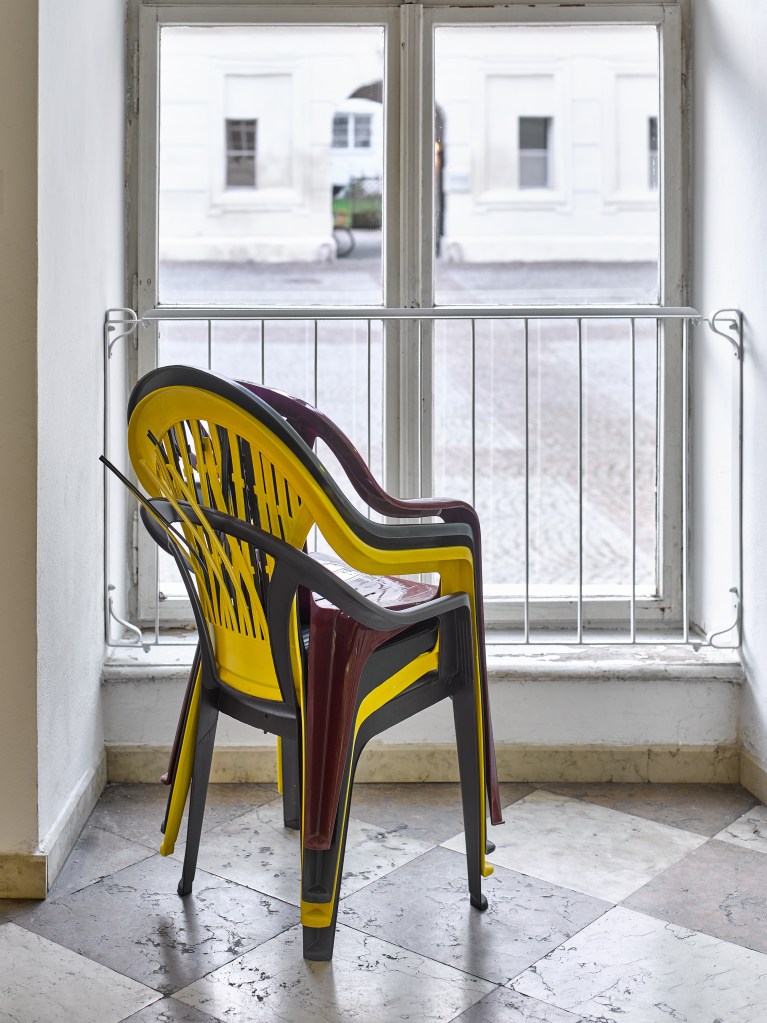
„The Prefix Pan“-series is part of Pillar of Societies, an exhibition by Berlin-based collective Center for Peripheries, on view from November 29, 2024, to February 8, 2025, as part of the annual program The Resistance of Nothingness, curated by Bettina Siegele. Through interventions and setups of everyday objects like store signs and plastic chairs, the collective explores how migrant communities subtly but powerfully reclaim their space in cities of the Global West.
After receiving an exhibition tour from Bettina Siegele, I had the opportunity to speak with Roshanak Amini, Mariam Kalandarishvili, Uroš Pajović, the three members of Center for Peripheries, about their practice. In our conversation, they talk about how their art bridges social research and artistic work, but also how they personally experience narratives of othering in their daily life as migrants in Berlin.

Brigitte: Can you tell me something about your individual backgrounds and how you met each other?
Uroš: We all studied together at the Kunsthochschule Weißensee in Berlin. We were part of a program called Raumstrategien, which is a mix of art in public space, and urban theory, but we all come from different backgrounds, both culturally and in terms of our practice. I come from Belgrade, and I studied architecture before coming to Germany. I have always been more interested in the theoretical aspect of architecture, and as my practice developed, it proved to be the case: it shifted more toward research and curatorial aspects.
Roshanak: I come from a fine arts background. I was born in Iran and moved to Canada when I was 13 years old. I received my BFA in Vancouver and moved to Berlin for my Master’s. I also have my own practice alongside the CfP, which includes visual arts, curation, and artistic research.
Mariam: I’m from Georgia. I studied Cinematography and Photography and then moved to Berlin for this master’s program. Meanwhile, I do more visual arts and ceramics.
How did you come up with the idea of establishing the Center for Peripheries?
Uroš: We started working on a project together as a trio, and we realized there were a lot of similar experiences shared in the sense of migration, movement, belonging, and community, which are now our main topics. Based on these shared experiences, we thought it made sense to start working on a regular basis as a collective. I think it was both a conceptual and an emotional reaction to being foreigners in the Global West.
Roshanak: I think it’s also a lot of conversations before making any artwork, centered around similar topics or our individual experiences, which overlapped – even just daily life experiences we had, whether it’s going to the Ausländerbehörde for a visa or the ways that we as “Ausländer” are often treated by the German public.
Uroš: But also the differences. For example, I might appear more European than Roshanak and Mariam and I experienced the kind of softness this brings in face of bureaucratic processes, for example.
And what about the name “Center for Peripheries”?
Uroš: We wanted something that sounded institutional at first but, when you actually think about it, it becomes clear it can’t be something institutional. Also, it incorporates the themes we are working with, which is always, inherently, this dialectic between center and periphery.
Your project is mainly focused on migrant communities. You just mentioned you found many similarities but also differences in your experiences as migrants in Berlin. Can you share examples of what aspects are very different between your communities?
Roshanak: One of the works we exhibited in Innsbruck is “All Iranians I know are doctors”, it actually comes from a personal experience of mine where an acquaintance who wanted to somehow include me in their German community while belittling the Arab community, decided it was okay to say, “Oh, Iranians are different though; all the Iranians I know are doctors.” These are insults meant as compliments. We all had these kinds of experiences. Uroš, you also had a story like that…

Uroš: Yes, it was actually on my first night after moving to Germany. For the first two months, we had accommodation with a German family during our language course, and there was an elderly woman there who asked me where I was from. I told her, and she responded with, “Oh, that’s nice. Your people don’t open stores all across Berlin.” I was stunned. It’s these kinds of backhanded “compliments” that are actually loaded with xenophobia.
Mariam: I also have a funny story: When I did the Einbürgerungstest, it was postponed for several months. Finally, we got the test date and went there. Before the test started, the person doing the Aufsicht pointed out that we managed to pass the first and the most important test: the virtue of Pünktlichkeit. She went on and on about it. When being asked “But why was this test postponed for months?” she quickly dropped the topic and switched to the virtue of Geduld. And she again went on and on about it….
Uroš: I also have a story about the Einbürgerungstest. You have to sign your test on the first page. As we were handing them in, an Asian women before me was told by the Aufsichtsperson, “You cannot sign it like this. In Germany, we sign with our full first name and our full last name.” The woman explained, “No, but on all documents, I use this signature. That’s always been my signature.” The Aufsichtsperson put it aside, commenting she wasn’t sure if it would be accepted. I was next. My signature is in Cyrillic, only my first name without my last name. She said, “Thank you.” You know, probably as a white, European man, there was no question about my signature. But with the Asian woman, it became this big thing. Especially in bureaucracy, Mariam and I have it a bit easier because we are white – which we also see, at a larger scale, with the Ukrainian war. There are differences in how Ukrainian refugees are treated by Germans and the German state compared to other refugees.
I also noticed shortly after the first Ukrainian refugees came to Austria that public trains added Ukrainian language to their announcements – which is, of course, a positive thing to do. But at the same time, they don’t do this for other big migrant communities…
Roshanak: Yeah, the first project we did together was actually dealing with this idea of language in public spaces, where we were looking at signs within our everyday life. Across from the space where we were exhibiting, there was an ATM – maybe, Uroš, you can explain it because you were the first one who interacted with this ATM…
Uroš: Before you had to insert your card, there were two screens alternating. The first screen was saying “Please insert your card,” in German, English, Spanish, Italian, and French. Then it switched to the next screen, which said, “Attention: Any attempt of a break-in is futile, the money will get inked,” and that was in German and then Bulgarian, Romanian, Polish, and Turkish. We thought – that’s the work, it’s a ready-made; there’s nothing to add here.
But my awareness of this kind of linguistic segregation initially came from Austria; a friend in Vienna told me years ago that even though people from Yugoslavia are the biggest immigrant community there, the only sign in Serbo-Croatian in the public space is the one that says, Schwarzfahren is illegal on public transport.
This is how I became interested in paying attention to what gets translated where and into which languages. Usually, it’s like this: warnings or information about illegal activities are in one set of languages, and the general welcoming or service-oriented messages are in another set.
Roshanak: And during the pandemic, many of the Corona-Abstand-signs (social distancing) were translated into Turkish, Arabic, but not even into English.
Mariam: Also, at the Ausländerbehörde (immigration office), it’s never the directions or helpful information you really need. Instead, the signs are like “Be quiet” or other restrictive commands.
Uroš: Or “Parents, watch over your children.” – we had this in another exhibition. We found this sign in the waiting room of the Ausländerbehörde. It was the only sign translated into Turkish, Arabic and Farsi.
Roshanak: When certain immigrant communities are constantly and frequently confronted with ways they cannot behave or things they should not do in public spaces, they are singled out as inherently “criminal” and “rule-breaking”. Such gestures become internalised by both those they are directed at and those who belong to the “good immigrant” category. These mechanisms of othering are deeply rooted in everyday-life and that is what we want to show.
As part of your exhibition, you also created a newspaper* in which I found the quote: “for many of us living in a different culture, the first sense of home comes not from finding a comfortable apartment one can afford but from finding a storefront full of packaging that reminds us of childhood“. This made me think about the notion of nostalgia when it comes to supermarket products. You also did a project on that topic, I read on your website…
Roshanak: We did a whole project on supermarket products: „Des Nachbars Garten” (2023). I think we all have so many pictures of different products – whether they’re from our own cultural or geographical backgrounds or products where the design just mesmerizes us. The aesthetic instinct comes from this nostalgia you mentioned. It’s this love for products that speak to us, not just through language but through design and the memories we associate with them.
Then we took this a few steps further. We started questioning our relationship with these products – how we connect with them, how others see them, and how what they contain can represent relationships between regions or countries. We explored the idea of “neighbors” – starting from micro-level relationships, like one district with another, and expanded it to a macro level, for example between Eastern Europe and Western Europe.. Each product told a story of a relationship. For example, Kajmak which highlights the often-absurd ways in which neighbouring countries can have vastly different ideas of a border, based on the political/economic groupings they belong to (in this case the EU).
* The newspaper can be downloaded here:
Is there also a relation between the project „Des Nachbars Garten” and the project “Around the Corner”, the second project that is currently exhibited in Innsbruck?
Uroš: The connection is, probably, the power and potential of nostalgia. Being part of a migrant community, nostalgia is always present in your everyday life. It’s there whether you’re longing for home, planning your next visit, or even avoiding it. For us, “Around the Corner” was about creating a substitute for what you get when you go home – a tiny, sovereign space, like a piece of home away from home.
In the supermarket project, nostalgia was the initial impulse. The designs triggered memories and emotions. In “Around the Corner,” the focus shifted to the experience of how migrant communities take up space. There’s a design element in both projects, but in “Around the Corner,” it was secondary to the conceptual and emotional ideas.
Roshanak: These kinds of stores or spaces are like safezones where your mother tongue is understood. You’re not at risk of saying or doing something “wrong” because you not only understand the context but are accepted as part of it. But we also try to question this. It’s not about representing our communities as monolithic entities in the West. We want to show the diversity within these communities and break stereotypes. That process of understanding differences, even within one’s own community, is very important to us.
I noticed this questioning approach in the way you set up your exhibitions – how you present signs in opposing sides. For instance, one side of a sign focused on Artsakh, and the other on Azerbaijan. I found this dialectical approach very compelling. How do you see the potential of making contradictions visible?
Uroš: By complicating narratives, we provide agency and individuality to the communities. Otherwise, the whole community is just being read as whichever one thing. By complicating that – even in the critical direction, in all directions, really – we give members of these communities, including ourselves, a face and a personal history, rather than an assigned communal one – assigned by the host society.
There’s this podcast called “Bad Gays,” where a group of queer researchers talk about queer people in history who were gay, and evil. It kind of expands – by complicating – the neoliberal idea of queer people as a political token: Of course there is a necessity for fighting for gay rights, but it does not mean that all gays are good or all about flowers and rainbows. That’s identity politics, and pinkwashing. So, by complicating this history of gays, it gives them the full palette of being a historical character, not just about being gay. We are also not just members of the Yugoslav, Iranian, Georgian, or whatever community. We are persons with our own individual experiences, and they shape us as much as our heritage does.
Often, we were even told by our professors, “Why don’t you do something about Yugoslavia/Iran/Georgia?” No, we are artists and we can make works on whatever we want.
Roshanak: Yes, we were always told in our studies, here in Germany especially, to do something related to our backgrounds because it was understood as “exotic”… one professor asked all of us to bring examples of corporate designs from the ’60s from our backgrounds, and there was one colleague from Mexico who was like: “But we didn’t have corporate fucking design in the ‘60s.” This way of thinking that everyone from around the world has the same historical path and enforcing the Western trajectory and timeline onto every other region of the world is something we have all experienced. What we, however, try to do with our work is not only talk about our own communities/regions but through researching, conducting interviews and observing to learn about and bring into our works others’ experiences. It is always a risk to do this, but for us, making these works is also an expansive learning process. It is important not to only place ourselves and our experiences at the center of our exhibition, or to take the role of the “educator”. In our exhibition we are both viewers and artists. By using languages and including works about communities we do not belong to, we hope to create a space of horizontal learning.
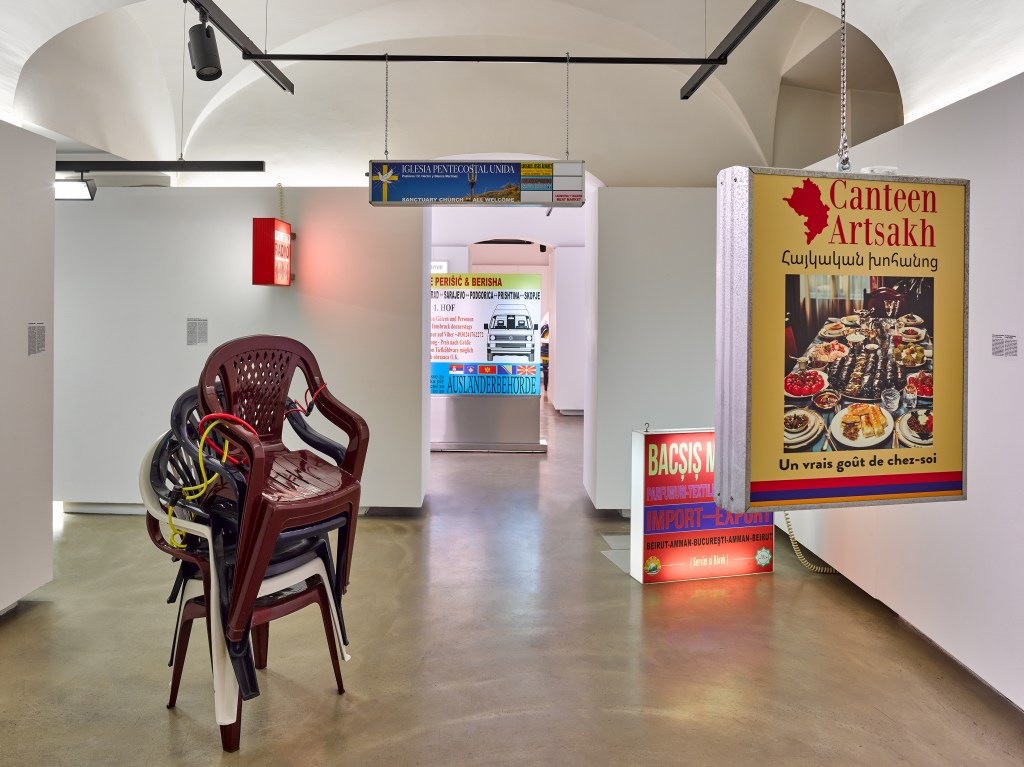
But also, as you were bringing up the Azerbaijan/Armenian sign in our current exhibition in Innsbruck, for example, even as someone from the region, whose father is an Azeri/Iranian the disputed territory of Karabakh is a subject that I never thought about nor knew about. This is something Mariam brought up as a topic. We’re constantly learning from each other, from the other’s knowledge and what is shared in our communities.
Mariam: Even in Georgia, they rarely talk about such regional conflicts, but rather about European politics. There are so many similarities and things we can learn from each other.
Can you also say something about „The Prefix Pan“-project – how is it linked to „Around the Corner“? And what about the plastic chair as a key element?
Uroš: Going back to the idea of taking up space, for us this was more about creating a kind of an ephemeral microstate in the public space, where the store sign is the flag, and the chairs are the delineation of the space, the border. If you walk through Berlin, you often find these staples of chairs where people, in the evening, would talk and arrange them in a certain kind of constellation and enjoy the public space together. I would say almost always, these are communities speaking a language other-than-German. Then there is also this loaded/unloaded history of the plastic chair – this contextless piece of furniture that you can actually find everywhere around the globe. Taking this idea of marking your space, taking from the public space for your community – that would be the connection between the two projects.
And the way we intervened on the chairs was to reflect this kind of relationship within these prefixes of “Pan,” which are themselves complicated. Sometimes they are nationalistic, sometimes anti-nationalistic, they often have some kind of hidden agenda, but they also provide a sense of belonging and recognition.
Did you also do research on the history of the Monobloc chair itself?
Uroš: Yes, it was produced for the first time during ’70s, the exact point of origin is disputed, between France and Italy and Canada. They kept reducing the time of its production, which is why it became so successful. There’s also an amazing eponymous documentary about it, Monobloc from 2021 by Hauke Wendler. And this is also very funny – the chair was banned in the city of Basel, Switzerland, in public spaces because it was considered too ugly. I think it was from 2008 to 2017.
How is it for you when you go back to your hometowns or countries – do you observe similar things in the public space regarding migrant communities, as I can imagine they also exist?
Uroš: I haven’t been back to Belgrade in three years. I don’t think they exist in the same way, as it’s not as attractive a destination as other cities in Europe are.
Mariam: For me, in Tbilisi, it’s actually similar to Berlin. I live in the old city, where we’ve had for centuries migrant communities that are very blended. But of course, there are still divisions. If you are Georgian, people will always mention their heritage. With the new communities, it’s very similar to Berlin. It’s very mixed, but there is still a distance between Georgians and migrant communities, much like with Germans in Berlin.
Roshanak: What I know from Iran is that all these problems exist. Of course, there is racism and xenophobia – there are all these ways of othering. It doesn’t disappear just because you are in a third-world country; it may actually even heighten it. But the ways in which they manifest can differ based on many variables such as history, the economy and even city structure. We tried to show in our project “Des Nachbars Garten” how and where such relationships, conflicts and solidarities exist.
For example, I am an avid listener of a the Iranian Podcast “Radio Marz” that was recommended by an Iranian colleague. The podcast deals with reasons one can feel othered. These can range from disabilities, life experiences, or cultural backgrounds. Listening to the episode discussing the Afghani-Iranian experience in Iran was not only heart-breaking but extremely eye-opening for me.
When you spent time in Innsbruck, did you also witness something interesting there in the public space?
Uroš: Yes, many beautiful signs that survived, which we photographed throughout the visit. In Berlin, they are disappearing more and more. All these small family-owned stores, which had signs from decades ago, are disappearing or being horribly modernized, visually and otherwise.
One thing we noticed was the number of Nepalese establishments. We were told this was because of the mountains, that there’s a lot of collaboration between Nepal and Tyrol. After our conversation, Bettina Siegele, the curator of Neue Galerie, mentioned to us that she started noticing store signs more and more in the city, and this was, for us, the most beautiful feedback we could get – we want to bring these signs, which are very mundane, a bit more into the spotlight, together with the stories and politics which inevitably are behind them.
| Brigitte Egger
 komplex-KULTURMAGAZIN