
muSa mattiuzzi ist Fellow des Künstler*innenhauses Büchsenhausen. Im ersten Halbjahr 2025 konnte die in Berlin lebende Künstlerin ihre Praxis vertiefen und auf die Infrastruktur in Innsbruck zurückgreifen. Zusammen mit den anderen Fellows (Ren Loren Britton, Kris Dittel und Felix Kalmenson) ist die Ausstellung TELLURIAN SKIES: Casting Acts of Solidarity, Liberation and Desire in Times of Collapse entstanden. Sie ist vom 12. Juni bis zum 6. September 2025 im Kunstpaviliion Innsbruck zu sehen. Für das Interview haben wir uns Anfang Juni im Schloss Büchsenhausen getroffen. Im Gespräch haben sich die Fragen entwickelt, die im Anschluss schriftlich gestellt und beantwortet wurden:
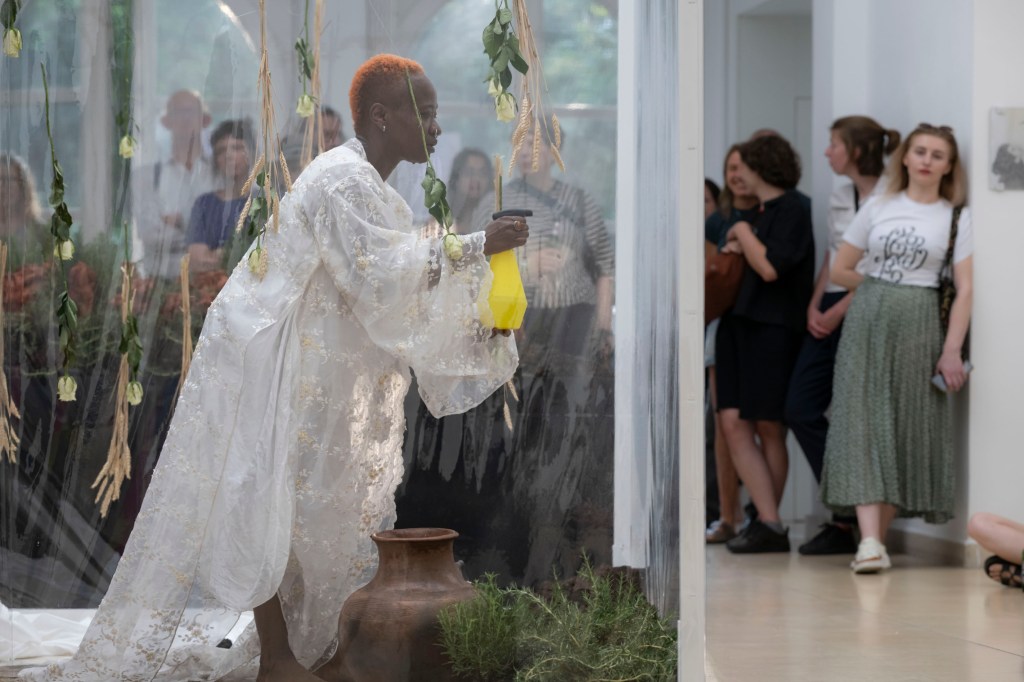
You have been working on the themes of the archive and memory recently. How do these subjects affect your work and what does the term archive mean to you personally and artistically?
Yes, I started thinking about the archive as soon as I began working with performance back in Brazil. I was perplexed by how Brazilian art history denied the histories of Black and Indigenous people. At the same time, Brazilian art history always presented a rich archive, but one that was subordinated to ethnography. The people documented in these archives were treated like objects – they had no names, only their ethnic group was mentioned. I became very aware of this legacy of violence imposed by the Brazilian elite. It’s a deep contradiction, because everything that is culturally compelling in Brazil comes from Black and Indigenous communities. For example: all the richness of Brazilian food comes from the culinary wisdom of Black and Indigenous peoples. At the beginning of my performance practice, I was often photographed by professional photographers. But when they presented my work, they would erase my history with performance and appropriate the work as if I didn’t exist. As if the image captured with a high-quality camera, with all the professionalism of the photographer, wasn’t directed and performed by me. That’s when I started reflecting on the archive and performance outside of Brazil, through the Black and Indigenous diaspora in Europe.
During your residency at Büchsenhausen, you reconsidered your previous practice. Before that, you mainly worked in the medium of performance and have now transferred this embodiment into clay, both physically and metaphorically. How can we picture such a translation process?
I was tired of doing performance and having its archive appropriated by photographers – or, in many cases, not being documented at all. I realized that all my work could be erased, forgotten. So I began thinking about how to translate the poetics of performance into a materiality that couldn’t be stolen, appropriated, or erased. While researching colonial archives, I understood that I could create a tangible legacy through a material that was no longer the body itself, but still deeply connected to it. I saw many forms of material in the archives – paper, wood carvings, iron sculptures, terracotta figures, mummies, plants, taxidermied animals. That’s when I decided to work with terracotta clay. In working with terracotta, I realized that to mold a shape you have to transfer heat from your hands to the clay. I learned that I need to use my entire body to shape an object. It takes about an hour just to prepare the clay before forming it. It’s a practice of deep focus, just like performing for an audience. But this time, the performance with the clay is private.
What does language mean to you in this matter?
After many years of dedicating my life to art, I came to understand that art is a universal language. When I present myself and connect with the audience, I experience speaking this universal tongue. I realized that I could work with different materials and engage with many people through art. And that’s how I perceive language – as something that transcends words and allows for communication across diverse contexts and experiences.
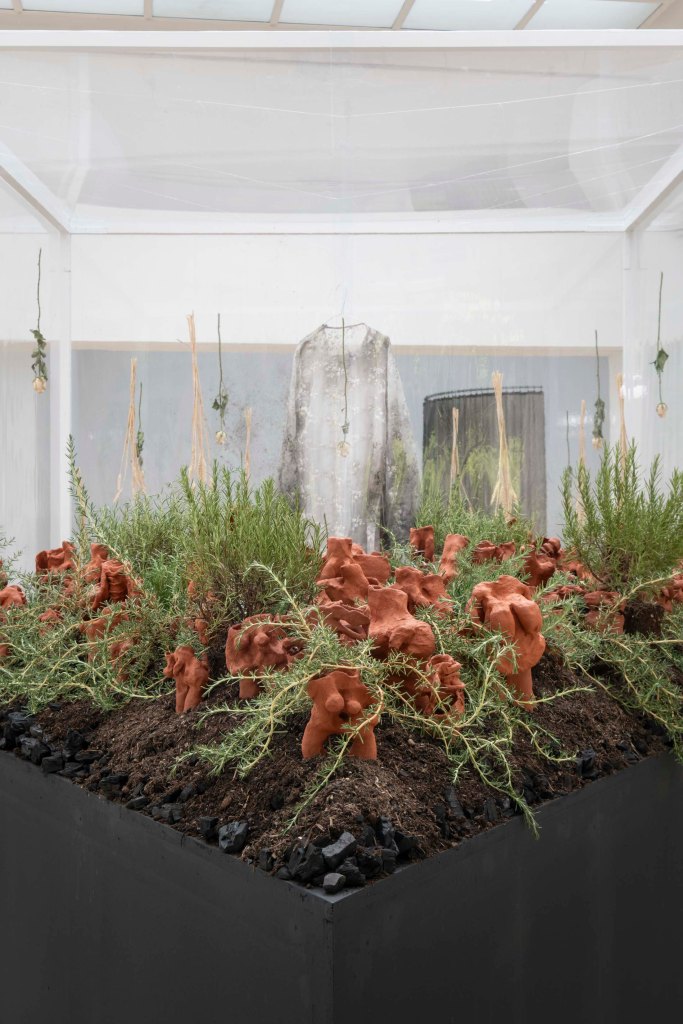
In advance to the interview you mentioned that working with terracotta reminds you of your grandmother and how she shaped things with her own hands. And you are concerned with the canonisation of art and the inscription of your work in the body of art history. How would you situate identity or identities in your practice?
Since 2021, I’ve been experimenting with terracotta clay – and it started as a frustrating learning experience. I didn’t want to take formal classes; even though I had the opportunity to do so in Florence, I refused. I wanted to follow my intuition, which made the process slower, full of trials and errors.
In March 2024, I had the chance to work with terracotta in the garden of the Max Planck Institute in Florence, as part of my study on medicinal plants. I was also developing a new sculpture for *Abolition Garden III*, located within the institute’s grounds. Unfortunately, the clay didn’t hold – it rained for days, and I didn’t yet have the knowledge I do now. But I needed that frustrating experience to understand how to shape clay. I trusted my intuition, and I recognized that my grandmother’s memory was guiding me.
My paternal grandmother, Joaquina, was an Afro-Indigenous woman who built her own house with her hands – it still stands today. In my family’s stories, she’s always remembered for her ability to make clay pots, jars, and cups. In a casual conversation with my father about my work with clay, he recalled her making earthenware and even her own home from the earth.
Here in Innsbruck, I had the pleasure of meeting the artist Judith Klemenc, who generously shared practical knowledge about working with terracotta clay and introduced me to Chinese terracotta. It felt like discovering gold – everything started to work. There’s nothing like having a master to guide your intuition. Intuition frees the imagination.

You were previously at the Max Plank Institute in Florence. You usually live in Berlin. So Innsbruck is located roughly at the halfway point. What does the city – living and working here – mean for your practice? What opportunities have you been given here?
In 2021, I was invited by curator Anselm Franke to do a residency at Villa Romana in Florence. That’s when I started to gain a deeper understanding of historical archives and also began my relationship with the Max Planck Institute there. The garden at Villa Romana inspired me to create an outdoor version of Abolition Garden – I had previously developed an indoor version for the Mercosul Biennial, which unfortunately didn’t take place due to COVID-19.
Living at Villa Romana was incredibly fulfilling. I left Berlin – a major urban center – to live in a residency surrounded by plants and trees. Because of the COVID-19 safety measures, Florence was unusually empty, which gave me the rare opportunity to visit gardens and monuments without the typical crowds. In those colonial gardens, I realized I could work with medicinal herbs and reflect on how to translate my family’s affective memory with plants into a work of art.
When I did the first Abolition Garden action in the Villa Romana garden, then-director Angelika Stepken organized a guided visit with art students. It was such a meaningful exchange that I realized I was on the right path with the project. I then decided to create a wrought iron sculpture to mark my intervention in the garden. The sculpture consists of seven tridents – an offering to EXU, the Yoruba deity of crossroads, who is venerated in Brazil. Abolition Garden is designed in the shape of a triangle, as a reference to Black feminism and its connection to the cultivation of land.
I performed the first *Dive into the Dark* action in my studio using elements from the Abolition Garden: soil, plants, and oral narratives. The soundtrack was created by Bartira, a Brazilian artist living in Italy whom I invited to join the project. That was the moment I realized Abolition Garden is a study of materialities – and it marked a turning point in my artistic practice.
I also understood that continuing this research meant working in environments where nature is strong and present. Arriving in Innsbruck was significant for me. I came in January, in winter, and as the months passed, I witnessed how the city transforms with the seasons. Seeing the mountains covered in snow and then gradually changing was magical.
Abolition Garden is a project that activates intuition through the memories of plants. So for me, stepping away from big cities to work on this project has been an affective experience and a way to reconnect with my family’s practices.
I hope to continue unfolding new chapters of this project – breathing life into these uncertain and shadowed times.
| Alexa Dobelmann
muSa michelle mattiuzzi
is a performer, visual artist, writer and filmmaker based in Berlin. She works across a range of media and modalities – often with the body and voice – and deals with presence, physicality, and communication. Unspoken contracts, colonial violence, official archives, personal fictions, and plantation memories – these are just a few of the elements that find their way into her work. muSa: “How to perform an official archive is one way of talking about what I do, whether I am making a video, a performative text, a sound work or a performance. Translation is the method I use to prepare for an encounter; it is not just a process of reformulating a message from one language into another. Translation is a labor-intensive, context-dependent process, as well as a form of critical fabulation.”
 komplex-KULTURMAGAZIN