
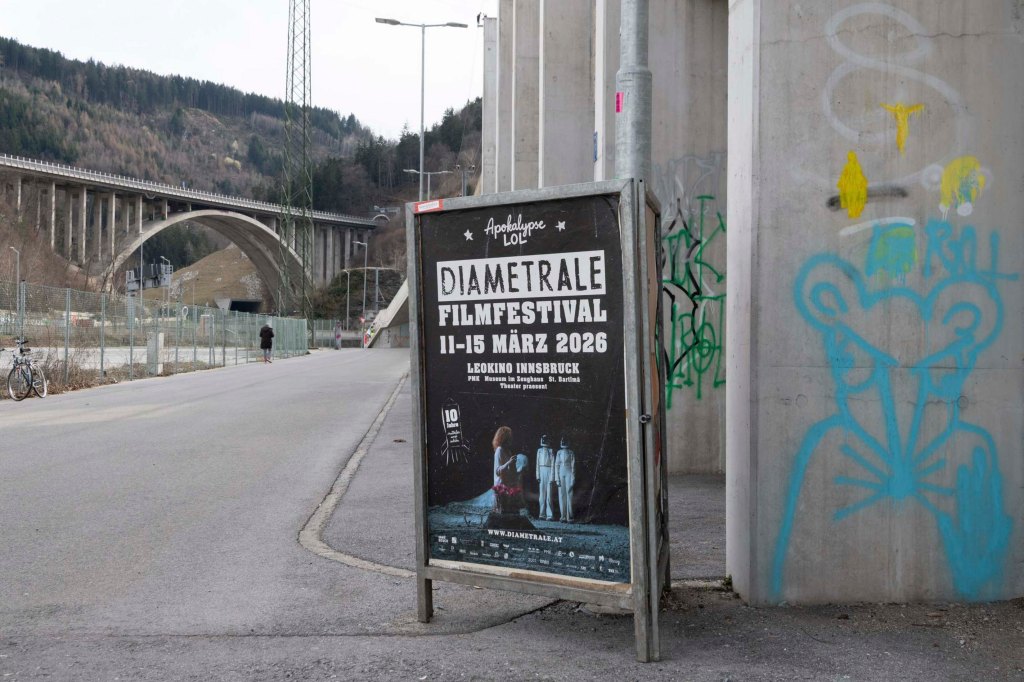
Every March, the DIAMETRALE Film Festival transforms Innsbruck into a space for cinematic experimentation — an invitation to step outside familiar viewing habits. For its 10th edition (March 11–15, 2026), the festival expanded its program beyond the traditional cinema setting. For three days, instead of sitting in the comfortable cinema chairs of the Leokino Cinematograph, I found myself returning to the halls of St. Bartlmä — an industrial site at the outskirts of the city that temporarily became a portal into immersive worlds. Here, one could explore virtual environments, interactive narratives, and hybrid realities, curated by the artistic and architectural research duo Me AndOther Me.
Under the format Immersive XR Experiences, Cenk Güzelis and Anna Pompermaier continued the Innsbruck Immersive VR Film Festival they initiated in 2024, now presented as an experimental extension of DIAMETRALE. The program brought together VR films, mixed-reality works, interactive installations, a participatory workshop, and critical artistic reflections on artificial intelligence. Their program invited audiences to reconsider the social, cultural, and political impact of digital technologies through embodied experiences.
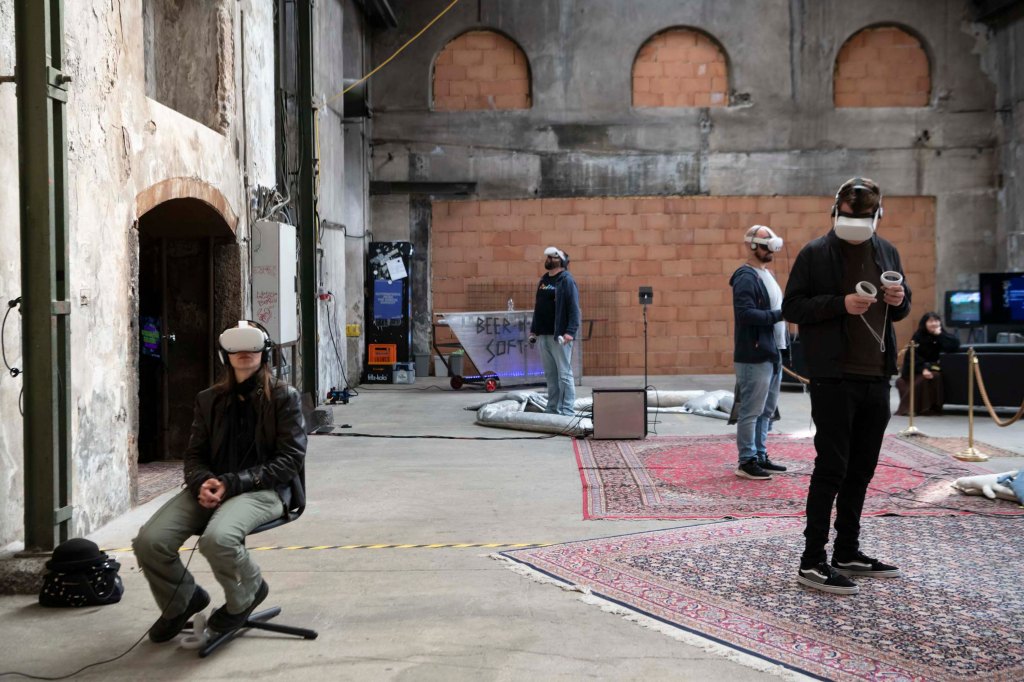
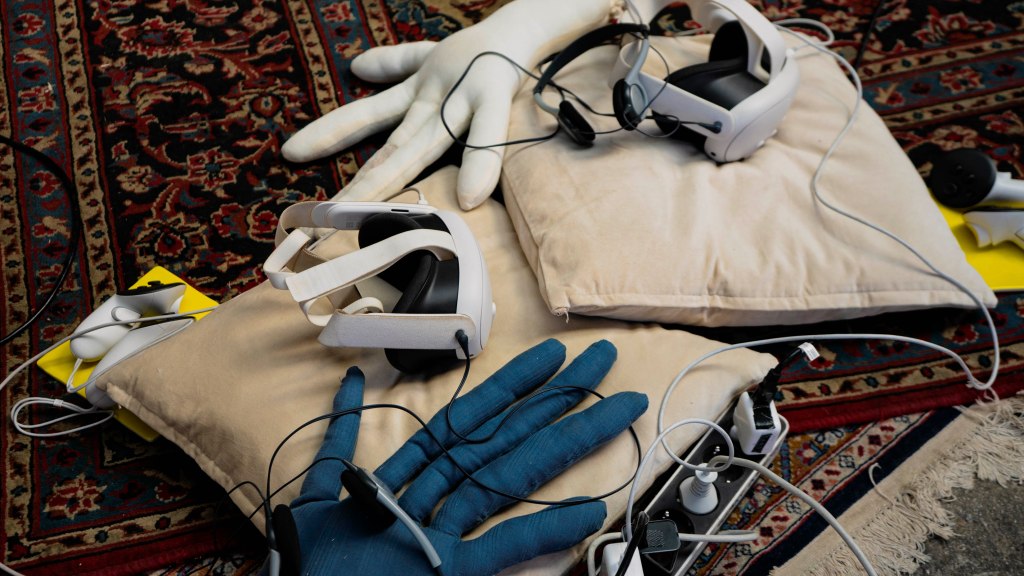
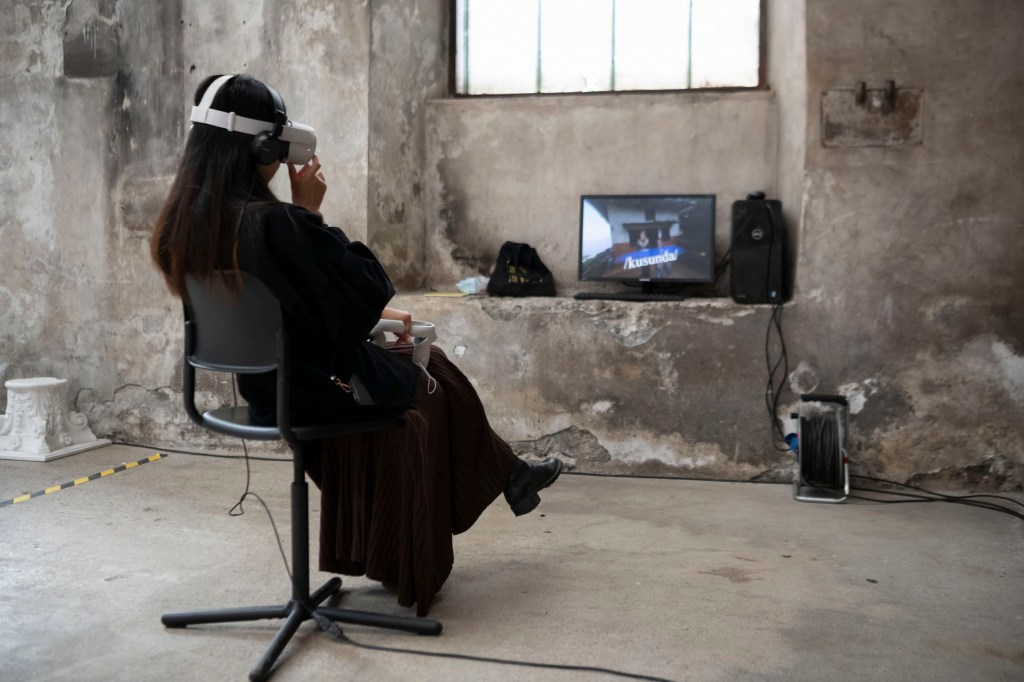
For me, it was also a first encounter with virtual reality — and quite an intense one. Watching several VR films over two days felt physically and mentally demanding. Compared to traditional cinema, it is immersive not only visually, but also bodily. One becomes aware of subtle sensations, triggered by images that are not part of the physical world — the imagined warmth of a virtual fire, the illusion of wind, moments of dizziness, or a blurry distortion of time. At certain moments, for example when my own hands appeared as digital meshes, it seemed difficult to tell where the virtual ends and the physical begins. From the outside, it might seem as if I am reaching into the air, but from my perspective, I am touching a plant that reacts and makes a sound.
Some works created strong contrasts between worlds also in terms of content. In Kusunda, for example, an interactive VR documentary about a nearly extinct language in Nepal, indigenous knowledge intersects with cutting-edge technology. The gap between these worlds could hardly be greater — and it made me wonder what it must feel like for the indigenous protagonists themselves to encounter their own surroundings through a VR headset.
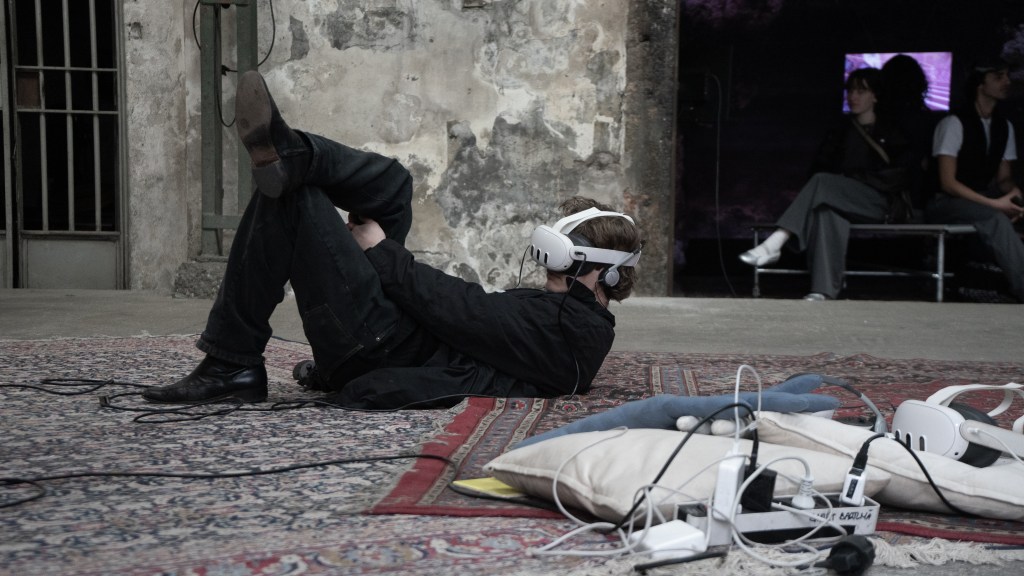
Other pieces explored inner psychological and neurological landscapes, sensory intimacy, or hybrid realities that merged physical and digital space. While these experiences were impressive, they also felt somewhat isolating. Unlike in a cinema, reactions are not shared simultaneously. While some visitors were immersed in their individual experiences, others stood in the room chatting or observing — watching people wearing headsets reach into empty space, stare into corners, crawl on the floor, or make some cautious steps through the room. There was a certain absurdity to it. Only afterward, in conversation with friends who had experienced the same films, did a sense of collectivity emerge again.
Alongside the XR program, the festival also screened films engaging with artificial intelligence and authorship, such as About a Hero, a mysterious narrative revolving around a fictionalized Werner Herzog investigating a death. Herzog seems to have a special role in discussions about artificial intelligence. I was reminded of the fully machine-generated Infinite Conversation between Werner Herzog and Slavoj Žižek — one of my first encounters with this technology. The film About a Hero builds on a similar idea: that AI could imitate Herzog’s voice and style — which resonates with the director’s own skepticism towards artificial intelligence. (However, despite this concept — to challenge Herzog’s skepticism and create a film as good as his own work, the film, in my opinion, of course could not be mistaken for a Werner Herzog production; it does not reach the same level in terms of cinematic language and atmosphere.)
Overall, across formats, the curated program by Me AndOther Me raised questions and sparked discussions about technology, the possibilities and risks of AI, and the political dimensions of tech companies that increasingly shape our lives. Curious about the ideas and personal motivations behind their work, I spoke with Cenk Güzelis and Anna Pompermaier — architects, researchers, and founders of Me AndOther Me.
Can you tell me something about your duo — how it was formed, and how the name Me AndOther Me relates conceptually to your work?
Cenk: We both work at ./studio3, the Institute for Experimental Architecture, where we do research and teach, and we both engage with media and media culture in architecture. Over time, it developed that we started doing projects together, and writing together. After a while, we applied for a residency — the European Media Art Platform residency (EMAP) — with a project called Be My Guest, a collective mixed-reality dinner hosted by AI. It was selected by an institution in Brussels called iMAL.
When we went there and had already done a couple of projects, we realized we needed a name, because every time we applied for projects it appeared as two individuals. So honestly, it came from a practical need — for funding applications.
Me AndOther Me refers to the digital self — the self you extend into digital spaces.
Anna: It can also be read differently. It could be “media and other media,” or “me and other media.” You can play with the words, with identities. There isn’t one single fixed meaning.
Cenk: In our works, especially mixed-reality projects, you are confronted with your digital self — an expanded body, an avatar. So the name also plays with that. We are very influenced by theory and enjoy translating theoretical ideas into projects. It relates to posthuman theory — the expansion of the self, and so on.
As you both work in academia and collaborate as a duo, do you also pursue individual research directions?
Cenk: My research comes from a very personal experience. My PhD continues my master’s thesis, which dealt with PTSD, mental health, trauma, and the effect of virtual space on these conditions — how virtual environments might help deal with symptoms. I went through PTSD myself in 2017–18, so it became my project.
Later I looked more closely into serious games, influenced by the media theorist and artist Harun Farocki. That shaped my perspective on media, culture, and architecture — starting from mental health and virtual space.
Anna: I’m interested in how media integrates into architecture at a one-to-one scale. I’ve always questioned the idea that media integration in society happens only through screens or interfaces. The internet also has spatial potential. So I explore how to deal with media integration at architectural scale, and the concept of immersion more broadly — also in relation to image studies and how the concept of the image has evolved. Today we write about the image becoming spatial through its circulation online.
Do you have a central research focus or guiding question within Me AndOther Me?
Cenk: Both of us share an interest in how media affects the body. My work starts from fascination with media extending the body, while Anna’s looks at how media returns to the body. Our common ground is the body being constantly influenced by media practices.
Over the last two years this shifted toward platform thinking — platform capitalism and platform-making. Since around 2020, we’ve developed a framework that became a kind of platform: a space where people can meet remotely, especially in mixed reality.
We built two platforms ourselves — bottom-up, custom-made. We use Oculus headsets, but the software is built with game engines and open-source tools. It is very bodily and physical. This is also the foundation of our PhD research.
At the same time, we observe the corporate tech landscape shifting politically. That led us to ideas of platform capitalism and counter-platforms — alternative spaces to hang out outside major surveillance platforms like Instagram. We look at theories like the “dark forest,” where people retreat into smaller communities online — a “cozy web” rather than public exposure.
What exactly is the “dark forest” — can you give an example?
Cenk: Examples include closed Discord servers, Slack channels, private Instagram profiles, invitation-only communities — like the early internet. One example we studied is VRChat, a social VR platform with millions of users that is still relatively non-commercialized. People form communities there — dancing, watching films, socializing.
Anna: It’s a fantastic community.
Cenk: You can also access it on a computer, but with a headset you gain full bodily presence. We conducted interviews there about how people organize their lives between online and offline identities. Many form real connections.
One film we showed at DIAMETRALE — The Reality of Hope by filmmaker Joe Hunting, documents this. He made three films in VRChat. In one, two users meet in real life because one needs a kidney donor. They meet — one from Stockholm, one from New York — and one donates a kidney. It’s not just gaming or commercial — it also has a social side.
Why do you think VRChat fosters more social connection than other social media platforms like Instagram or TikTok?
Anna: I think VRChat has the extremely interesting potential of being explored in a spatial way. There is a big difference compared to classical social media platforms that operate on a two-dimensional interface like a screen. In VRChat, users can explore worlds and meet others in a much more embodied way.
The platform is also bottom-up: it allows users to create their own worlds and form communities around their interests. You are not fixed in one environment — you can move freely from world to world, meet new people, and encounter very different personalities from all around the world within this shared virtual space.
Cenk: It is also much more fun. You are inside a virtual body, and it becomes a social experience. You can also enter from a PC, but with a VR headset it is much more immersive — you can look around, move, and explore relationships.
There are spaces like rooftop bars, karaoke pubs, sushi restaurants, bedrooms where people gather and even cuddle, striptease clubs with pole dancers. It is based on social and shared activities.
We spent a couple of months exploring and recording these spaces. The platform economy is based on creators — people build their own worlds and avatars, and there is a strong sense of collaboration. It is very different from traditional social media, where you mostly consume content. Here, you inhabit the content.
How can we imagine the platform you are building — what kind of experience does it create for users?
Anna: VR is powerful because it is spatial — you feel present. But fully immersive VR disconnects you from physical reality; you become blind to your surroundings. So we built a mixed-reality social platform that keeps the physical world visible through headset cameras while overlaying digital content. For example, you can cook at home while remote friends appear virtually in your space.
Cenk: But we emphasize that none of these projects envision a desirable future where everyone wears headsets. They are artistic and theoretical explorations — speculative installations.
Anna: It’s an investigation. Because at the same time, big tech companies are heavily investing in augmented reality and digital twins. The aim is seamless AR in cities — potentially saturated with advertising. Devices like Meta’s Ray-Ban glasses are becoming lighter (even if current headsets are still bulky) — the underlying vision is being pushed forward regardless of whether people want it. This raises major architectural questions: what does it mean to inhabit two realities simultaneously?
Cenk: Especially if those augmented layers are owned by tech corporations. Imagine entering your bathroom and seeing advertisements projected there — like in a Black Mirror episode, but we are almost there.
Anna: Since 2020, Meta’s Project Aria has involved scanning cities to create precise digital twins. AR requires this data infrastructure to align virtual content with physical space. This raises issues of data ownership, public space, and surveillance.
You also started the podcast series WebRTC Backrooms as a format to bring these topics to the public. Do you see your practice in general as politically engaged?
Anna: Yes, very much. The podcast is the second platform we started building — again a counter-platform, an alternative platform. It builds on this idea of social mixed reality, but excludes the headset, also for political reasons. First of all, the headset is a very bulky device. Second, it is owned by Meta. In theory it could be another headset, but still — it is bulky, not realistic to distribute widely, not easily accessible, and therefore not sustainable.
So together with a developer we built an app that allows you, with a simple click, to stream yourself as a volumetric stream — as a three-dimensional object — into our virtual space. Everything that happens through this app passes through our own private server, which does not collect or store any data. It also bypasses major servers such as Amazon or Microsoft. So it again refers to the “dark forest” idea of private spaces.
What makes the podcast unique is that you don’t just invite guests for conversations — you create an entire individual virtual setting for each episode beforehand. That seems like a lot of effort. How does this format work, and what role does the architectural environment play in the conversation?
Anna: Basically all the data are streamed into our Unity project, let’s call it that. For the podcast, for every person we interview, we build a virtual room that reflects their research aesthetically and conceptually.
Cenk: It comes with staging — world-building.
Anna: Yes, but it’s interesting because as the conversation unfolds, the environment unfolds as well. For example, with Valentina Tanni — an art historian and theorist who has researched digital and online culture for many years — when you enter her room you encounter elements related to her work: internet aesthetics, digital myths, folklore. Since she is a writer and historian, visual material helps her ideas unfold during the conversation. She talks about backgrounds, vaporwave, memes as political forces.
Cenk: Old internet aesthetics, old Windows interfaces. Everything is pre-designed in the virtual world, and as the conversation progresses we trigger these elements so the environment adapts to the discussion. It is basically a live montage.
How did you decide which guests to invite? What was important in this selection?
Cenk: The podcast looks at the politics of AI and the hidden layers of technology. For the first season we invited artists and researchers working at different scales. Simone Niquille focuses on the scale of the home, while Nicolas Gourault works on the scale of the city and machine vision — including how self-driving car systems are trained through the labor of annotation workers in Kenya and the Philippines. So we moved across scales, from home to city.
Anna: We were also interested in critical perspectives on online and digital culture that are not often discussed. Valentina Tanni is one example. Davide Tommaso Ferrando examines how domestic architecture changes through online labor — for instance through streamers working from home. Labor has shifted from something outside the house to something inside the house, which transforms domestic space. Liam Young works on media at a planetary scale. He is a professor at SCI-Arc in Los Angeles, and we had a very rich conversation about how architects need to rethink their agency at planetary scale and communicate technological issues in ways that are understandable to a broader public. If conversations are too narrow or technical, they become inaccessible.
Technology seems to be developing faster than people can keep up with — and globally, not everyone has access to these tools or the knowledge to use them. Do you see new forms of social separation emerging? And from your perspective as teachers at University, is the educational system able to prepare future generations for these changes in time?
Anna: It is extremely controversial. You can see it clearly in Nicolas Gourault’s research: databases for self-driving cars consist of images and videos from Western cities, which are then sent to low-wage workers in the Global South for annotation. This creates a new kind of colonial pipeline — similar dynamics as before, but more hidden.
It is becoming increasingly difficult to educate people about these technologies. But that is exactly the point: if you don’t talk about them, if you don’t know about them, there is no possibility of agency. That was one of the main motivations behind creating the podcast — to open up discussion about these issues.
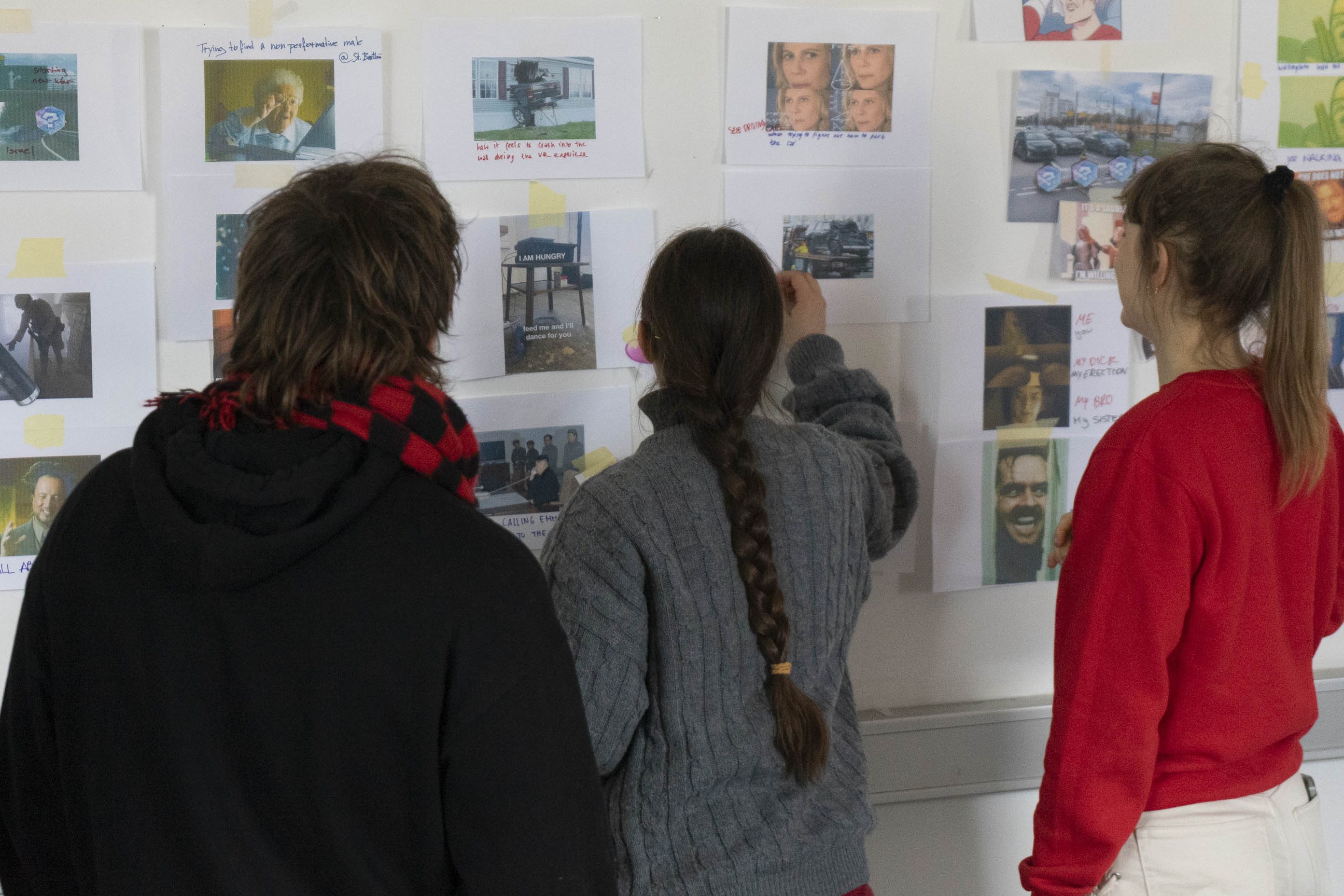
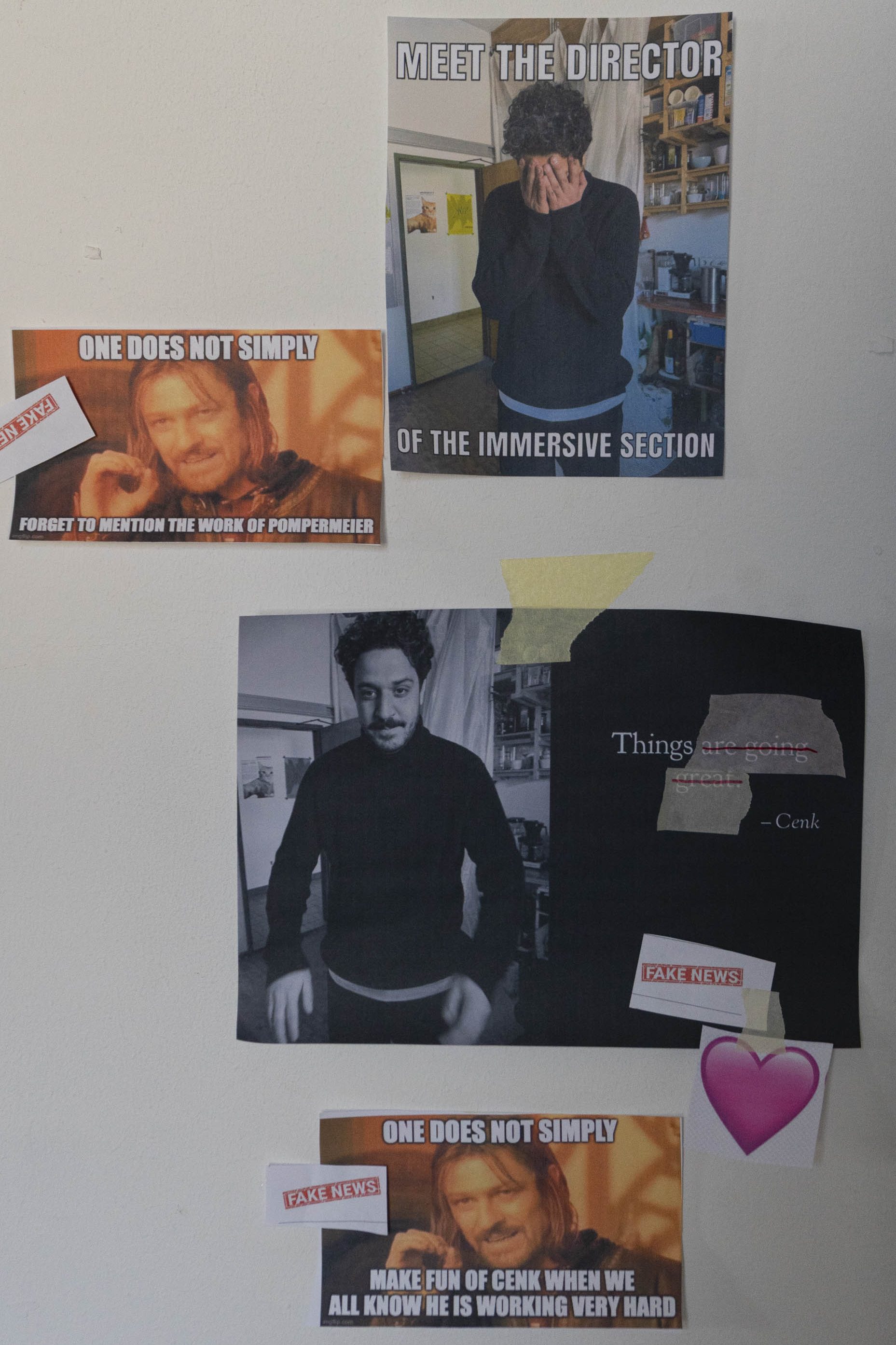
During the festival you also hosted a Meme-Making-Workshop by Emma Bexell. What role does storytelling play in your work?
Cenk: I think we live in a huge, everyday pool of very different forms of storytelling. If you look at Instagram, for example, much of what we receive as visual information is memetic expression. Even political communication uses meme logic — things are recontextualized to tell stories in a softer, cuter, hyper-normalized way.
For us it was important to realize that we don’t want to escape technology in order to talk about technology. Tech should be able to speak about its own problems. That’s why, for instance, we don’t use commercial VR headsets, but instead develop our own workflows to address technological issues through practice rather than rejection.
But to engage people, you also need storytelling — narrative design that can attract individuals or communities. As Valentina Tanni mentioned in the podcast, these are the new digital lores and myths of our time.
We are architects, so honestly we are not natural storytellers. Our work often operates more as research thinking. That’s why we rely on collaborators and guests who approach storytelling differently. It’s very inspiring to learn from them — for example having Emma here showed us new methods of thinking about story-building that we wouldn’t come up with ourselves.
Anna: Storytelling is also a powerful political tool. Right-wing narratives use storytelling very effectively to influence public opinion. With Liam Young we also talked about how left-leaning narratives often rely on fear or warnings. They tend to focus on what should be avoided. Right-wing storytelling, on the other hand, is often much simpler, more optimistic in tone, even when based on misinformation. It mobilizes emotions and beliefs very effectively. Therefore, storytelling is something progressive movements could learn to use more strategically.
Cenk: At the festival we showed the project LORECORE, which addresses exactly this issue — how myths and heroic narratives are constructed around tech elites.
In the context of DIAMETRALE, which focuses on experimental and absurd, humoresque film, where does immersive XR fit? Is there room for humor in these works?
Cenk: Yes, definitely — humor is very much present. It is part of the nature of immersive and interactive work.
If you look at LORECORE, how it plays with world-building and narrative design, the video performance Sons and True Sons by Total Refusal, or many of the VR pieces we showed, they all engage with humor in different ways. In the interactive section, for example in the works of Martina Menegon, there is also a playful quality — becoming a chimera in augmented reality, occupying the exhibition space. Because the medium is so embodied and physical, it already affects you on an emotional level — and that includes humor, sadness, and other emotional responses, even in very short experiences.
There is definitely humor, also in the sense of DIAMETRALE’s interest in the absurd — playing with ideas of apocalypse, like this year’s theme “Apokalypse LOL.” Many of the works we showed engage with this; they use humor to address the difficult and often disturbing times we are living in.
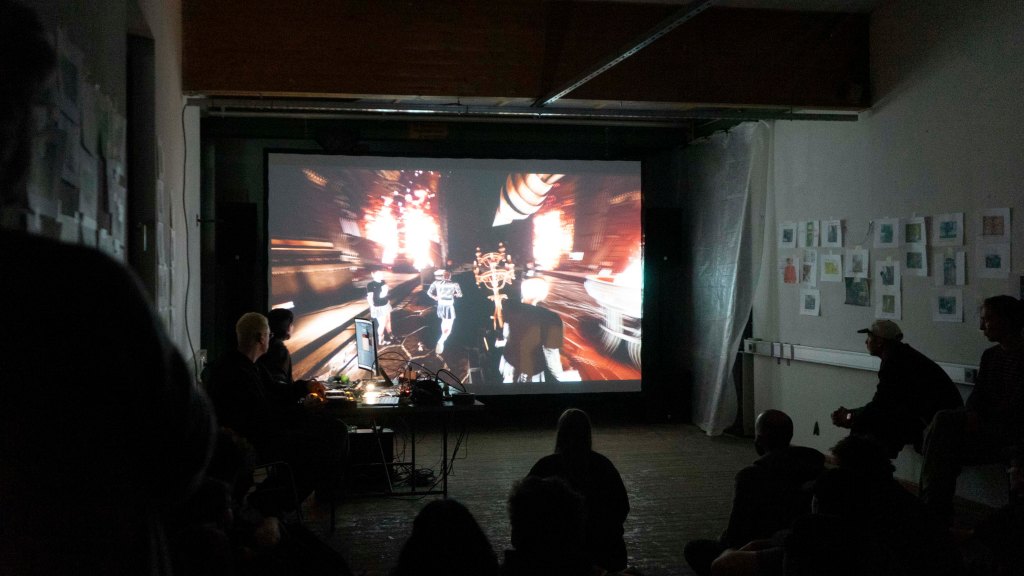
Cinema culture is traditionally a collective and social experience, whereas VR viewing can feel rather solitary. How do you perceive these differences?
Cenk: It is true that cinema is a collective experience, while VR is more solitary. But at the same time, VR can become very emotionally and socially intense in a short amount of time precisely because of this solitude.
There are ways of creating collective VR experiences, but it is also interesting that they remain experimental. There are examples like VRChat or projects we developed, such as Be My Guest, where multiple people — six or even thirty — can meet and share an experience together in mixed reality. But I think, VR does not need to replicate cinema. These are different formats.
Anna: I agree — even if we call them films, like the seven works we presented —, it is a completely different medium, they operate differently. VR is much more embodied and personal. Yes, you are isolated from others physically, but the experience itself is more intense in terms of embodiment. It allows for a different kind of cinematic experimentation.
Cenk: And each experience is highly subjective. Even in cinema, people take away different impressions, but in VR this becomes even stronger. It depends on where you look, how you position yourself in the space — each person has their own emotional experience.
Regarding cultural work more generally: How is the funding situation for your projects like the podcast or the XR festival? How do you finance the program and your work?
Cenk: Most of our cultural work is unpaid. Funding for this kind of practice in Austria is very limited.
We did receive support from the Pixel, Bytes + Film program by ORF and BMKÖS, which helped us realize the podcast. For the festival we work with very limited resources, relying on our own means and the support of friends. We also received some funding for the festival, and we appreciate the support, but it is not comparable to other XR festivals in Europe. We hope it will grow in the coming years, especially since we already have plans to expand the program. Without stronger financial support, it is difficult to develop further.
Anna: Seeing the interest and appreciation from audiences, we hope that in the future there will be more opportunities for better funding.
Would you say working in virtual environments has changed how you personally experience the physical world?
Anna: I think that exploring virtual environments makes you more aware of small details in the physical world. Your perception of materials and sensory qualities becomes more heightened. That is something I have noticed personally.
Cenk: It is an interesting question. The idea of virtual space has a long history, and it is closely connected to media culture, architecture, art, and theory. If you look back to the 1960s, for example to Austrian avant-garde architects like Walter Pichler or Hans Hollein, or to thinkers like Vilém Flusser or Jean Baudrillard, you can see that virtuality has always been part of broader cultural developments.
Looking at virtual environments historically and culturally shows that they cannot be separated from physical reality. Today, this connection is even more evident, as virtual spaces are increasingly politicized and used by large tech companies as tools of governance. Companies like Google, Meta, or Amazon operate in virtual environments in ways that directly affect physical space. So these two realms — virtual and physical — are deeply interconnected and cannot be understood separately.
This year, DIAMETRALE lived up to its theme “Apokalypse LOL.” What stayed with me after these experiences and conversations is a sense of fascination and unease at the same time. The speed at which technologies such as AI and immersive media are expanding feels overwhelming — especially if you are not directly working within these fields. There is a growing gap between those who actively engage with these developments and those who are excluded, whether due to lack of access, knowledge, time, or interest. And sometimes, it can seem more comfortable to just avoid this part of reality and ignore what is happening behind the screens.
Yet, the festival raised awareness of the responsibility to understand new technologies, and their political dimensions, which increasingly shape our social, cultural, and spatial realities. Therefore, initiatives like Me AndOther Me become more and more relevant. By sharing their research and knowledge, opening up critical discussions, and creating formats that reach beyond a specialized audience, they contribute to making these developments visible and, perhaps, also more collectively negotiable.
| Brigitte Egger
 komplex-KULTURMAGAZIN