
From June 30th – July 9th 2023, Kunstraum Innsbruck hosted the second edition of its Summer School, curated by Ivana Marjanović, Magdalena Saxer and Danijela Oberhofer Tonković. Throughout this period, places were opened to offer a space for various learning formats, ranging from artistic practices to critical knowledge reflections. We had the chance to participate in two events of the program: The course Common Landscape held by OPEN PLACE (YURIY KRUCHAK & YULIA KOSTEREVA) on Community, Co-creation, Visual and Oral Storytelling, Drawing and Linocut (in cooperation with openspace.innsbruck / The MAGIC CARPETS co-funded by Creative Europe)* and the artistic performance Circle – Theatre Essay by NEJA TOMŠIč / NONUMENT GROUP (in cooperation with Bunker, Ljubljana).
Individual expressions, a common landscape.
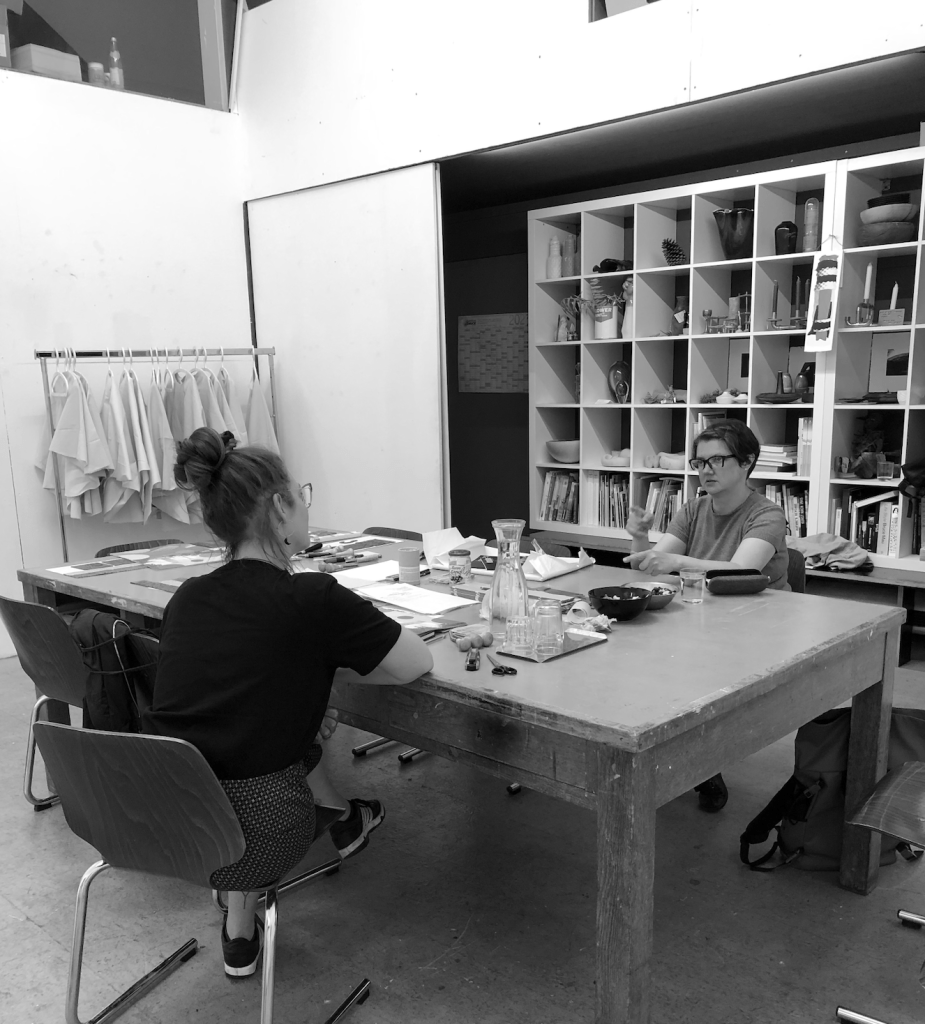
We find ourselves together at a large table in the center of the location openspace at Mentlgasse 12b: the artists Yulia Kostereva and Yuriy Kruchak, the curators Danijela Oberhofer Tonković and Charly Walter as well as nine participants – all of us representing different socio-cultural contexts and professional backgrounds, which seems to be a good basis for creating a ‚common landscape‘. In the background, Kruchak begins to prepare materials for the creative tasks, while Kostereva asks the participants to share personal thoughts about specific public places, about the problems these places face, and about groups of people they are surrounded by. Kostereva’s and Kruchak’s practice is at the interface between social and artistic work; they understand art as a communications platform that offers a space where people can meet. Therefore, it seems important that the participants exchange their personal ideas and get to know each other before they start forming a so-called ‚common landscape‘, expressed through the linocut technique – a technique that the artists find valuable because it not only offers the opportunity to focus one’s mind, but also allows for conversation during the working process. „It’s like sharing a meal at a common table“, says Kostereva. At the same time, the notion of landscape implies a non-hierarchical structure of relationships – something that can also stand for the raw surface of the linocut material before it is shaped.
„Landscapes play a role in forming the character and behavior of people, that is why it has become an important topic for displaced people in particular“, the Ukrainian artists say from their personal experience of war. “We observe that the context of art and culture is changing. In different times of our existence, we form different lines of community and of mutual existence.” Through a joint artistic practice, we are encouraged to create values together that need to be spread. But at the same time, we must not lose our own identities:
„Now we understand that individuals and individual expression are very important for a society, rather than trying to unify it – we need to build an identity that is not based on nationality.“
– Yulia Kostereva
Kruchak and Kostereva have been working together since they met at art school. Together, in 1999, they founded the collective OPEN PLACE, which organizes, among other things, nomadic art residencies. “The main task is to develop communication and interaction practices that take place at different levels, both within the group itself and with the outside world”.
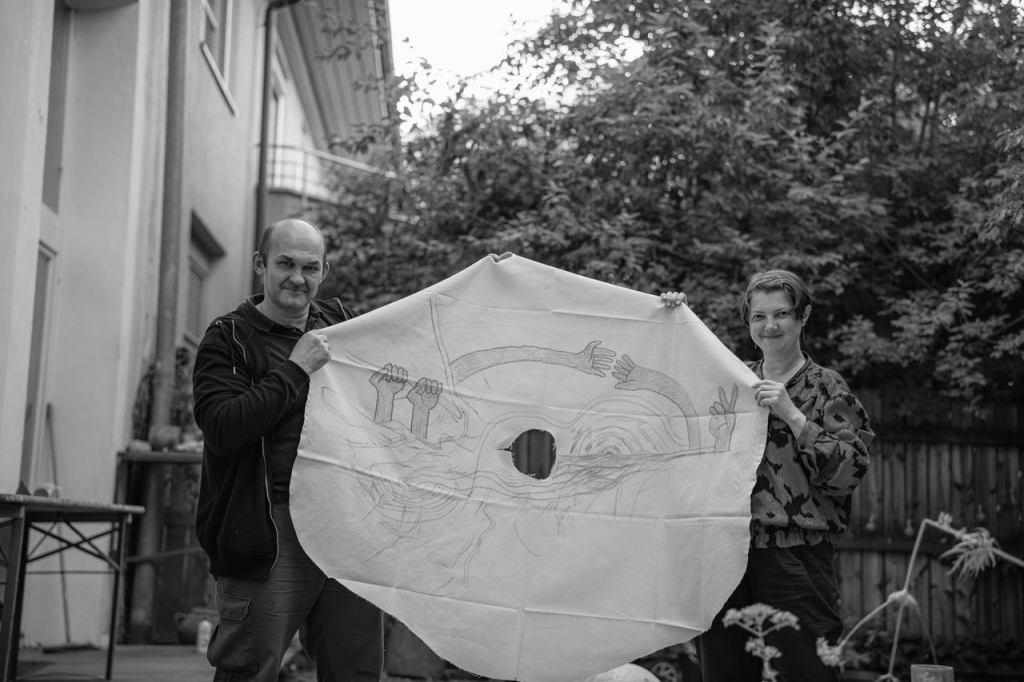
Recently, the duo has focused on the concept of mutual learning, developing workshop formats and sharing knowledge and skills with the community they have built. For this reason, they were also invited by openspace/Magic Carpets to take part in this year’s Kunstraum Innsbruck Summer School. “As curator of Magic Carpets, I’m always looking for themes that deal with coexistence, storytelling and togetherness. We want to create a platform for experimentation, exchange, and inspiring new ways of learning. Yulia and Yuriy are able to offer us everything we were looking for with the activities of this residency,” says Danijela Oberhofer Tonković.
Since the outbreak of war, Kostereva has been based in Warsaw, where she organized weekly community meetings for mutual learning – mainly for the Ukrainian community, but also open to people from Poland and other nationalities. She moderated various activities, workshops and text discussions for them. “We worked on new themes that emerged in culture and art contexts – which is important because before you speak out loud, you have to understand what is going on.” As an example, she names the issue of decolonization, which has only recently entered the discourse of Ukrainian cultural institutions. „When you suddenly have to engage in a conversation about such things, it is important to first get the chance to delve deeper into the topic in order to formulate your position,“ says Kostereva, who in her curatorial work focuses on gaining information, rethinking and reflecting. „But it’s also about understanding that you can always say ’no‘ if you don’t want to speak, that’s your right too.“
For Kostereva and Kruchak, art can be seen as a way to brighten perspectives and present things from different angles. And sometimes art has to cause clashes:
“It is only when we get people out of their closed bubbles that they are able to see differences and understand what can be learned from those differences.”
– Yulia Kostereva
What can be learned from their summer school course is that art is not just about the artistic production itself, but rather about encounters with people and perspectives – or as Oberhofer Tonković resumed: “I liked the fact that some of the participants stayed afterwards and talked to each other for an hour. They met, because the artists had created a meeting place for us – it was different landscapes melting into a common landscape. That was a very important and valuable exchange for all of us – to see how the artistic practice changed during the war, how it is to be an artist in times of war. We hope to see Yuriy and Yulia in their free country where they will continue to develop their important artist practice in peace”.
*The residency of Yuriy Kruchak and Yulia Kostereva was made possible through the support of Ukrainian Institut, Jam Factory Art Center (Magic Carpets partner organisation from Lviv) and Office Ukraine Shelter for Ukrainian Artists.
Stories and Histories, transforming places.
On July 1st 2023, Neja Tomšič held her narrative performance Circle at the Kunstraum Innsbruck Summer School. She is part of the interdisciplinary Slovenian collective Nonument Group, consisting of artists, theorists and architects. Their project Circle, a so-called theatrical essay, discusses public parks, which the collective understands as a space for different interests, ideas and policies. Through storytelling, visual art and sociological research, a live narrative of these common places is created, which also reflects on their changes throughout history – made visible to the audience through minimalist material structures on the stage.
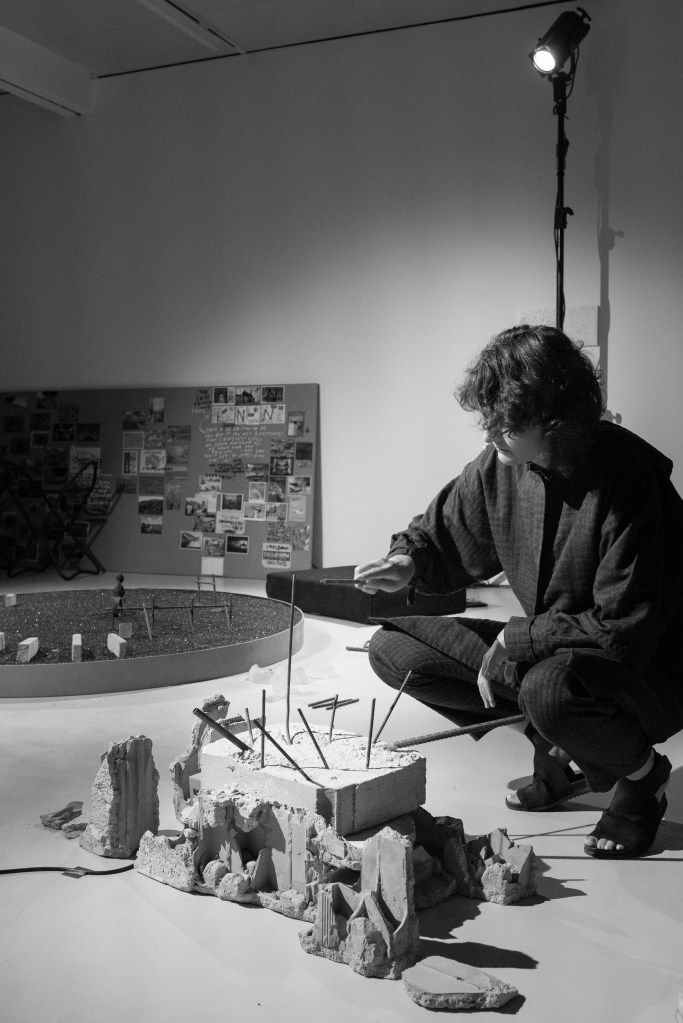
„In the 19th century, private parks were an expression of wealth and power. But walking in the park as a concept also derived from the inability to travel and the longing to experience something new. Humans invented parks to frame their views, to evoke memories and emotions, to immerse themselves into atmospheres, and to travel with their eyes.“
– Circle
It was not the first time that I witnessed this performance. One year ago, I attended its premiere at Mladi Levi Performance Festival, where it was performed in a place called Cukrarna – an old sugar factory in Ljubljana. Circle contextualizes time and place where it is staged. And comparing both presentations, it becomes obvious to what extent the atmosphere of a live performance is shaped by different architectures and historical contexts in which it takes place. In this case, even the narrative text of the performance was slightly adapted to the specific location of Kunstraum Innsbruck and the history of its building. After having watched Circle twice, the interesting and informative presentation still left some open questions which Tomšič answered via E-Mail:
komplex: The concept of your theatrical essay could be applied to different kinds of places – Why did you decide on parks? What makes them specific in comparison to other (public) places?
Tomšič: Parks as a form have an interesting history: they are places, carved out in urban environments, that offer urban nature. They are meant for social life on the one hand, and for an intimate conviviality of men with nature, for contemplation, on the other. In the 19th century, public parks were partly a tool for ‚cultivating‘ the working classes when they started migrating to cities with industrialisation and as a sort of a bridge between the rural and the urban environments. They were places of leisure, which often became sites of political activation and sites of protest. Public and green spaces are diminishing worldwide, and currently common green spaces are planned mostly in gated communities. The choice to look at parks as spaces of social change stems from my perception of the current state of the world, which is rather dark. I feel that we live in the ruins of a future once imagined. The park is such a brilliant space to talk about that: It is literally a space and a form of life in extinction, a brilliant form that is disappearing, something that we will have to fight for (something we already do fight for).
Your project is called „theatrical essay“ – How did you decide on this narrative format? Where do you see its potential (also when it comes to its effect on the audience)?
A theatrical essay builds both on performative elements and the essay form. My background is in visual arts, and my practice is research-based, and the (theatrical, video, visual) essay forms are forms I use most often, because they allow me to reflect on my research, and the visual or experiential aspects of it. The question behind the Circle was whether we can interpret a public park as a space through which the values of a society can be read, and – if historically public green spaces always reflected the society, in a way like allegorical paintings that in their form and content display the most important elements of a society, how can we interpret an abandoned park or the park which has become a ruin?
I see the potential of the theatrical essay in opening complex topics through text, but also through layering – of sound, light, visual elements, shifting between storytelling and reflecting, and also through activation of visual elements (in the case of the Circle, the sculptures and in the sandbox as well), but foremost, in the moment of the live experience – the moment of gathering. In Circle, my aim was to open up the stage and make room for the audience to find their own place – either by walking, resting, or following me.
How is creative storytelling intertwined with the production of history – in general and in the context of your project?
The Circle’s main premise is an encounter of a human with an erased, flattened, emptied out plot of land that used to be a park. Through a materialist reading, by looking at the remains, the soils, forgotten objects, the traces of its former plan, remains of urban furniture, an observation of wild nature, I try to construct a story, reconstruct the park’s history and reflect on it by reading it in parallel with social transformations. In this sense, the entry point is already highly subjective. In the Circle, while we are walking through a subjective experience of a ruinous park, we are at the same time learning about its history. Storytelling of course has the power to add layers of emotion, experience, sensual information to the factual base of history, and hopefully, through a performative setting, knowledge becomes embodied knowledge. But further from that, and most importantly, in these parks, a history is erased, a history that currently only exists in the form of memories. With every day that passes, the city changes, and the material erasure of the park diminishes the importance of its history, too. In the Circle, the audience can hear the stories of some people that lived in the Railway Workers Park in Cluj.
„Just like the Transilvania Smart City and the PataRât on the periphery are the conditions for the new park in the city center, the presence of crows in the waste dumps transforms the city center as well. One day in Cluj, my fiend Flaviu took us to the botanical garden, to one of its wilder corners. In the middle of a forest, we were suddenly walking on soil covered with solid white fluid. The tree leaves had gone dry due to bird excrement forming a sort of a forest wasteland.
Flaviu said that in the past five years, the crows started to migrate here during winters, spending their nights and finding shelter in the Botanical garden. They come to Cluj from Lithuania specifically to feed on the unsorted waste dump across the valley, between the PataRât ghetto and the New Smart City.
He said: watching the crows early in the morning has become a ritual. At dawn, we sometimes gather with friends, to watch these new crows cover the sky.“
– Circle
To what extent do the places, which you perform in, and their surroundings influence your performance?
With the Circle, we always address the location where we perform, because the narrative thread of the Circle is transformation: the story leads us through various transformations of parks and more broadly, cities. Nika Grabar and Miloš Kosec, who also perform, intervene into my narrative at a certain point – Nika speaks about the process of transformation (of destroying and building, of what is required for something new to appear), while Miloš reflects on ruins and the specific location we find ourselves in. The purpose is, on the one hand, to look at things through a broader perspective: that every place we find ourselves in, has undergone transformations, that change is constant and inevitable; on the other hand, to become aware that we do not find ourselves in a neutral space, a space without history or community. The theater or the gallery are often experienced as neutral or empty – just like an abandoned park that has been exhausted into a profitable plot of land – this is why a seam with the reality of the space we find ourselves in is necessary.
The aesthetics of the Circle-set up are quite minimalistic, but seem to have a strong effect – presenting different materials and shapes in their raw existence. At the same time I observed your rather gentle body-movements changing and shaping this material landscape. How do you see the role of the body in this performance and in general in the context of society and places/landscapes?
In the end of the Circle, I refer to a short story by Jorge Luis Borges, The Circular Ruin, in which the main character climbs up to a ruinous temple and sleeps there as much as he can in order to dream a man. I interpret it as a story that speaks about how showing up with our bodies in ruins can bring to life an alternative vision of our present, one that we can’t become aware of, unless we turn our attention to ruins. In the Circle, I speak about parks that are parks after they are boarded off, erased, flattened out, because people kept showing up for them. Body is also at the center of the idea of a park. A park is designed for a human body in a tamed nature, for its solitude and pleasure, but also for a social performance: to be seen, to perform a social self, and later on, for a collective experience, community, as a site of social fight. By establishing the scene as a sort of a park, I wanted to recreate this experience, and also to experiment with an artform: both an exhibition and a performance.
Can you tell us something about your collective Nonument Group – What does the name refer to? What’s your main interest and intention? Why do you think this initiative is of importance in today’s society?
The Nonument Group is a group exploring the processes of remembering and forgetting in space in different ways. On one hand, our actions encompass art interventions, on the other, creating a database of ‘nonuments’ used by the Group to explore, map and archive architecture, monuments, public spaces and infrastructure, whose meaning has transformed due to social and political changes. As opposed to the database, art interventions shed light on the dilemmas via an aesthetic experience of the present and by exploring the diverse artistic approaches question the importance of heritage in space. We are a group of two artists: Neja Tomšič and Martin Bricelj Baraga, and two architects: Nika Grabar and Miloš Kosec, but we collaborate with many others. The name of the group refers to ’nonuments‘ – public spaces, monuments, infrastructures that have undergone a shift in meaning due to political or social changes. We map, research, collect oral histories, organize field events on sites, symposia, and we intervene into these spaces. Personally, the importance of these activities stems from a question that I feel needs to be asked every time something is abandoned: What are we building? I think ‘nonuments’ are places that people have claimed for themselves and are willing to fight for them. They are spaces of activation, of collective imagination, and in the world shaped by extraction, exhaustion, subordination to capital and general chaos, bringing attention to these spaces, inhabiting them, makes space for the imagination of different worlds, shared worlds of communities – and this is crucial.
| Brigitte Egger
 komplex-KULTURMAGAZIN
2 Gedanken zu “Telling Stories, Transforming Places – a Visit to Kunstraum Innsbruck Summer School ”