
Wir sind aktuell einem starken Stimmengewirr ausgesetzt – in den Medien, in sozialen Netzwerken und im Alltag. Welchen dieser Stimmen schenken wir Gehör? Können wir uns das überhaupt aussuchen? Und sind wir in dieser Überflutung noch in der Lage, aufmerksam zuzuhören? Diese Fragen kamen im diesjährigen PFF Salon unter dem Titel „POLYPHONIE – Vom [Zu]hören in einer ‚messy world‘” auf. Der Salon fand zum zweiten Mal im Rahmen des Positive Futures Festival statt. Im vergangenen Jahr stand er unter dem Thema „Peripherien“, heuer rückte die Vielstimmigkeit in den Mittelpunkt – gedacht als musikalisches Prinzip, aber auch im Sinne politischer und gesellschaftlicher Verhältnisse.
Die Veranstaltung war eine Kooperation des Positive Futures Festival (PFF) mit dem Verein Wissenschaft und Verantwortlichkeit (WUV) und der Stadtbibliothek Innsbruck. Am Podium diskutierten die Autorin, Übersetzerin und politische Bildnerin Sam Zamrik, der Philosoph Andreas Oberprantacher und Michaela Senn vom Theater praesent. Moderiert wurde das Gespräch von Renate Plieseis (PFF).
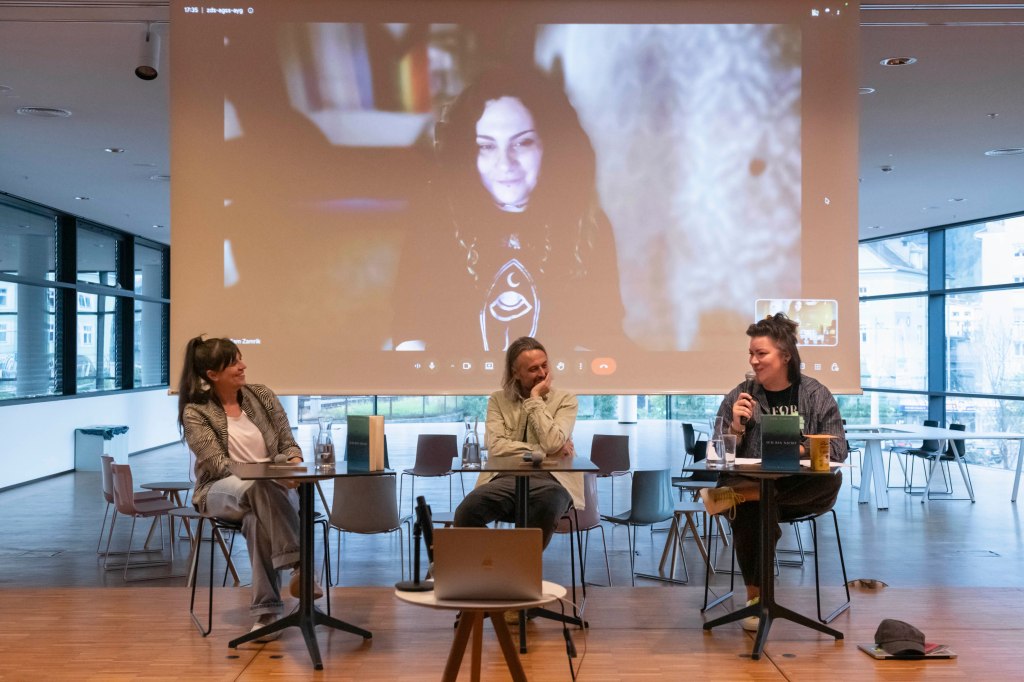
Sam Zamrik war online zugeschaltet. Sie konnte nicht persönlich nach Innsbruck kommen. Seit zehn Jahren lebt die Autorin in Deutschland, verfügt dort jedoch über keinen anerkannten Flüchtlingsstatus, sondern über subsidiären Schutz. Daher ist ihre Bewegungsfreiheit stark eingeschränkt. Renate Plieseis vom PFF schilderte zu Beginn der Diskussion, dass ihr zum Zeitpunkt der Einladung nicht bewusst gewesen war, dass Sam Zamrik nicht nach Innsbruck reisen könnte; sie erklärte aber auch, weshalb das für sie kein Grund war, die Einladung zurückzuziehen und stattdessen jemand anderen anzufragen: „Wir haben uns bewusst dagegen entschieden, weil das auch gegen die Agenda und die Policy von unserem Festival wäre.“ Jemanden zuerst einzuladen und die Einladung aufgrund solcher Einschränkungen wieder zurückzunehmen, sei für sie nicht vertretbar gewesen. Die Tatsache, dass Zamrik nicht persönlich teilnehmen konnte, offenbarte eine Realität, die schließtlich selbst zum Diskussionsthema über Freiheitsrechte und gesellschaftliche Teilhabe wurde.
Situationen wie diese verweisen auf jene globalen Ungleichheiten, die das Positive Futures Festival auch durch Musik und Programmkuratierung aufzeigen möchte: auf strukturelle Bedingungen, die darüber entscheiden, wer reisen, auftreten, und am kulturellen Leben teilnehmen kann – und darauf, wer schlussendlich gehört wird.
Renate Plieseis, die selbst ihren Hintergrund in der Renaissance- und Barockmusik hat, führt den Begriff der Polyphonie zunächst als musikalisches Prinzip ein: “Die Polyphonie bezeichnet eine Form der Vielstimmigkeit, in der Stimmen gleichzeitig erklingen, dabei aber ihre Eigenständigkeit bewahren”. Erst in ihrem Zusammenspiel entstehen dann Momente der Harmonie und der Dissonanz. In der Diskussion sollte dieses Prinzip als “Denkmodell für unsere vielstimmige Gegenwart” dienen.
Passend zum Salon-Thema las ich parellel Anna Löwenhaupt Tsings The Mushroom at the End of the World (2015), wo ich auf die Passage stieß, in der sie Polyphonie als Gefüge beschreibt: “Das polyfone Gefüge besteht aus den versammelten Rhythmen die aus welterzeugenden Bestrebungen resultieren, gleich ob menschlichen oder nichtmenschlichen Ursprungs.” Wobei sie den Begriff auch breiter fasst und ihn einsetzt, um auf die vielschichtigen Bedingungen der politischen Ökonomie hinzuweisen: “Je weiter wir in die Randgebiete der kapitalistischen Produktion wandern, desto mehr wird die Koordination zwischen polyfonen Gefügen und industriellen Prozessen zur Voraussetzung für den Profit.” Bei Tsing steht Polyphonie auch für eine Metapher, um die Welt in ihrer Vielstimmigkeit, ihren miteinander verflochtenen Verläufen wahrzunehmen und ihre Komplexität verstehen zu lernen.
Auch im Gespräch des PFF Salon ging es darum, wie die unterschiedlichen Stimmen unserer Zeit – mitunter auch die KI-Stimmen – nebeneinander stehen und gehört werden können. Sam Zamrik brachte in der Diskussion dazu ihre Erfahrungen mit Mehrsprachigkeit, Übersetzung und der syrischen Metal-Szene ein. Sie erzählte davon, wie ihre Persönlichkeit mit Polyphonie verbunden ist, und las ihr Gedicht „Bureaucracy” aus dem Gedichtband vor, das die Absurdität jener Situationen vor Augen führt, in denen Menschen immer wieder Auskunft darüber geben müssen, wer sie sind und woher sie kommen:
Bureaucracy
“… you have to tell them
to tell the others
to tell theirs to tell ours
to tell me to tell you
whether you can stay.”
“[…]”
“Tell theirs to tell them
to tell you to tell me
what they need to tell me,
To tell you what you want.”
“[…]”
Schließlich kam im Gespräch auch Édouard Glissants Begriff des „Rechts auf Opazität“ zur Sprache. Damit wirft der Schriftsteller und Literaturtheoretiker die Frage auf, ob das Unverständliche auch eine ästhetische und politische Qualität besitzen kann. Vielleicht muss es in polyfonen Kontexten nicht immer darum gehen, dass alles für alle verständlich oder zugänglich ist. Vielleicht reicht es, einzelne Elemente bewusst wahrzunehmen und diesen Spuren zu folgen.
Im Anschluss an den Salon habe ich Sam Zamrik noch einmal online getroffen, um einige Gedanken aus dem Gespräch weiterzuführen. Im Gespräch ging es vor allem um ihre Beziehung zu den Sprachen, darum, wie Polyphonie in ihren Gedichten zum Ausdruck kommt und um Bedeutung des Underground – damals und heute.
Brigitte Egger: Sam, you’ve mentioned that you studied English literature in Damascus and that English was initially a kind of secret language for you, a language of resistance. How did your relationship with the language develop?
Sam Zamrik: It actually started long before I studied English literature. I taught myself English. I started when I was a very young child, maybe seven or eight years old. I mainly learned through movies. We had one satellite channel that showed Hollywood movies with subtitles, so it was easy to follow along and imitate what was being said. Slowly but surely, I picked up the language. I didn’t get any tutoring or anything like that. I also learned a lot through music lyrics and the Internet.
In that sense, it was a secret language for me because I wrote my diaries in English from a very early age so they wouldn’t be easily readable to anyone in my family, since none of them spoke English very well. My dad and my brother did, but mostly only conversational English.
You are a co-founder of the Syrian underground project ‘New Wave of Syrian Metal’. What role did the English language play in the subculture scene?
At the very beginning of the Syrian metal scene, there was a need for slightly better English: to write lyrics and communicate with international audiences, record labels, media outlets, and for interviews. At the same time, the metal scene and the revolution began around the same time. This was preceded by large government crackdowns on the metal scene, which was very much “in your face,” so to speak. So, there was also a greater need for more complex, less accessible texts. The more opaque the lyrics and the way we presented the music, the safer it felt. The government couldn’t simply put the lyrics into Google Translate and get a full account of what we were actually saying or implying. That necessarily involved poetics and more specialised language, technical terms, and things like that.
This worked simultaneously as a way to convey depth to international audiences and as a safety mechanism against local dangers, from the government and from society. Even in our everyday interactions, we used a lot of English words because metal is an international genre. When you discuss a band or refer to lyrics, the language becomes woven into your subculture’s dialect.
This isn’t to say that people in Syria don’t speak English, or that it’s uncommon or difficult to understand. They do. We do. But you also start developing certain terms, even in Arabic, that show you who is part of the in-group and who isn’t. It becomes a kind of cultural code. It helps you identify who has been in the scene for longer, who is more familiar with its lore and with the genre. It becomes almost a sorting mechanism: who can speak our language, in that sense.
So, even if someone speaks conversational English or even academic English, the language of the scene is still not as readily accessible. Most bands’ lyrics were mostly in English. Depending on the genre, they also tended to use more poetic forms of English, like Early Modern English. Some of us were trying to imitate that elevated, poetic kind of tone that we heard from some local favorites like Opeth, Draconian, My Dying Bride, Deicide, Gorgoroth, etc…
Why did you focus on metal as a genre? What drew you to this particular subculture?
I discovered metal at an early age, when I was maybe 11 or 12. It’s outsider music, and being an outsider can be especially lonely. So, you try to find like-minded people who are into the same thing. That was the starting point for me reaching out to all these different people. There was also a lot of fear, because sometimes the government tried to infiltrate these subcultures and scenes. But ultimately, a few people meet, and a scene grows around them.
I was 13 or 14 years old when we co-founded the scene. So, while there were some political considerations, I wouldn’t say it was a campaign project, initially. The bands started the scene; I merely coined the term ‘New Wave of Syrian Metal’, and wrote articles, reviews, and interviews. My role as a co-founder was basically to connect people and bridge the gaps between scenes, support the bands with what they needed, because the scene was very fragmented and clique-y. I was a kind of organizer and manager, basically.
Each city had its own little pocket of metalheads, and there was somewhat little open communication because of the political situation in Syria, even before the revolution. But as soon as we began to come together as a scene, political considerations emerged. Many of the musicians were politicised by their experiences, even if their lyrics weren’t explicitly political.
At the beginning of the uprising, the demands were actually very basic: dignity, cost of living, things like that. After the crackdown, everything escalated and became more about militant resistance and demanding the fall of the regime.
We had people who were internally displaced and had to spend weeks sleeping on the floor in a studio, or trying to find somewhere to stay. Some had been arrested and tortured, some were facing abject poverty, and so on. Those were some of the realities. A lot of the music also tried to critique or explain the brutality and savagery of the government’s crackdown on the uprisings and the general hostility between different Syrian communities.
How did the scene operate under these conditions? Were there places where you could officially perform and host concerts, or did everything happen underground?
It was all underground. Performances in Damascus and Homs were very limited, mostly to cover bands, and required a lot of security clearances. In the old wave, it was different: some bands actually played original material in theatres, amphitheaters, and other venues. But that came to an end with a major crackdown on the Syrian scene in 2006. Then it more or less died away. Everything from 2011 onwards was very much underground.
Because the government was busy elsewhere, cracking down on the uprising and the revolution, we managed to create a little more room for visibility. Being dressed like a metalhead, or simply looking like an outsider, was also very dangerous. You could be arrested arbitrarily. And arrest meant torture and often death. So, it wasn’t just a matter of style. We managed to carve out a space for visibility where you could at least wear a band T-shirt and look for like-minded people.
What did ‘underground’ mean in Damascus, and how does that compare with Berlin, where you live today? Do you still feel a need for an underground scene?
In Damascus, it was underground in the usual sense: it wasn’t particularly marketable; it was its own subculture, with a certain opacity. But it was also literally underground, because our studio was in a basement. You had to go down several flights of stairs and through these really big, heavy doors.
For us, underground meant being an outsider, going against the grain. There were scarcely any economic considerations, because you couldn’t buy or sell any of the material. It was very much a communal DIY spirit. People gathered around it for the sake of expression, as an outlet, for community, or to make some kind of political statement or critique.
It was also underground on an international level, because people didn’t even know about it. For the longest time, people didn’t even know where Syria was, before the revolution and the waves of migration. That added another layer of undergroundness.
So, there was an economic aspect, in the sense that we couldn’t sell our material, and the music was very polarising for local sensibilities. Then, there was the international level, where metal from the region was completely obscure. Metal fans in the US or Germany, for example, would pride themselves on discovering a niche underground band from Syria, Lebanon, Jordan, or somewhere like that. And locally in Damascus, there was also the very literal sense of the word: the basement.
I don’t know. Coming from that kind of underground to a place like Berlin, it doesn’t feel as though there is a ‘real’ underground.
Here, there is an economic motivation: ‘I want to go on tour. I want to play these venues. I want to sell merch. I want to do this and that.’ For us, that wasn’t necessarily a possibility. Playing live music in Latakia or Aleppo was itself an act of resistance. Sometimes ISIS was, I don’t know, just 20 kilometres away, and you were playing a metal concert for a hundred people. The stakes were much higher for the underground there than they are here.
Is there a need for an underground? Yes. I think many of these subcultures – goth, techno, metal, punk – have been mainstreamed. Capitalism does what capitalism does: It has hollowed out many of the political, ethical, and resistant elements and the authenticity of these subcultures and separated them from their grassroots environments. They have become more of a fashion statement or a product to consume.
So, I actually think there needs to be more underground, in the sense that perhaps we should return to some form of low-level gatekeeping – not in an elitist way that scares or pushes away newcomers, but as a form of protection against corporatism and this all-consuming profit motive.
Your metal-band in Damascus was called ‘Eulen’. How come you chose that German name?
It was a complete coincidence. None of us thought, ‘Oh, we’re going to end up in Germany one day.’ That didn’t enter into the decision-making process at all. I just know that the other band members read a lot of German philosophy – not in German, but in translation –, so they were more exposed to this language in that sense. It brought that dimension a little closer. It was like, if we can’t do it in English, if we can’t do it in this language, then German is another option.
You speak several languages fluently. Which languages are they, and how do they shape the way you experience yourself? – There is this common idea that people experience themselves differently in different languages. Does that resonate with you?
It depends on how you count them. I usually say three and a half. Let me go on a little rant about how you count them, because in Syria we practise diglossia. In all so-called Arab countries, actually, there is a formal language for documents, news, textbooks, and so on, and then there is a spoken language. The two don’t necessarily always correspond. In fact, they aren’t always even mutually intelligible.
I speak Syrian Arabic in the Damascus dialect as well as the classical form, formal Arabic, if you will. I also speak English and German.
I have different personalities in general, due to a lot of mental illness. I don’t know how to explain that exactly, but I do notice a difference in communication, because a lot of my knowledge base is in English.
It’s the language I use most in my day-to-day life. Most of my relationships – romantic partnerships, friendships, and so on – have been in English. So it’s the language that comes most naturally to me.
Levantine or Syrian connects me to “home,” whatever that is. I just tend to speak much more idiomatically in that language. There are a lot of local folk sayings and many more swear words. Swearing in Syrian is delicious in a way that no other language I speak or have learned about can approximate. That whole dimension of transgression in the language is just so delicious.
German is my newest language, and it isn’t a language in which I can create or form any kind of emotional connections. The way I experience myself in German is strictly as a political being – not even as a human being, but as a political entity – because that was my introduction to the language. Those are the interactions I’ve had in it. My fluency in German was very much tied to existential questions involving paperwork, residence permits, and applications.
You also aren’t met with a lot of grace by native German speakers. There is always an inherent power dynamic when a foreigner speaks German with a native speaker. That is exacerbated by the political dimension. I don’t know how it is in Austria or other German-speaking countries, but the attitude here is very entitled. Regardless of how well I speak it, how I express myself, or how fluently and easily the language comes to me, there is always a lot of nitpicking.
That nitpicking seems to serve one purpose: to put you back in your place. No matter how well you speak the language, you will never achieve belonging, you will never achieve ‘Germanness’, so to speak. There is a lot of gatekeeping in these micro-interactions. For the sake of my mental health, I’ve decided to stop trying to pursue any kind of emotional or interpersonal connection in German.
It also doesn’t come very easily to me. As I said, most of my vocabulary in German is philosophical, medical, or legal. For the longest time, I used to sound like a book or an office clerk when I spoke German, and I don’t speak German as readily with native speakers.
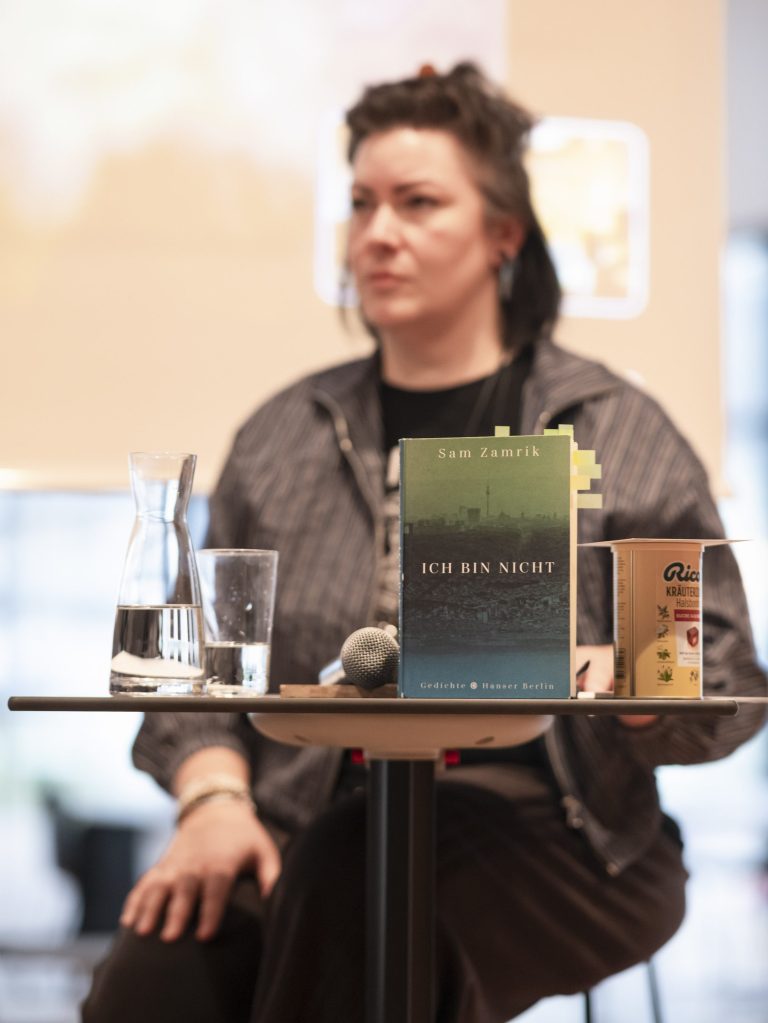
In your book ‚Ich bin nicht‘ (Hanser, 2022) are also some poems you wrote in German, although you describe it as a language in which it is difficult for you to form emotional connections…
Yes, I did, because I still wanted to. Conversation and writing are very different. Writing is a statement, a prepared statement that I can work on, where I can say exactly what I want to say.
I wanted to say it on my own terms, in a language that doesn’t need translation, so that native German speakers could grasp it immediately. It is a way of leveling the playing field, in a sense, and obtaining something I can’t achieve in everyday conversation. You’ll notice that many of the poems I wrote in German are much more political or defiant than the English poems, which are more introspective, emotional, or psychological.
Your book was published bilingually, in English and German. You translated the original German poems into English yourself, while several translators worked on the German versions of your original English poems. What was the thought behind this approach?
The book as a whole is written in many different registers. It moves through different styles and different subjects. In general, it is a kind of polyphony of voices, both in language and in form – form, content, and language.
It was the publisher who decided to bring in several translators. The idea was to reflect the multiplicity and the polyphony in the form and content of the original poems. For me, it was a very practical process. Each translator received the full manuscript and was then asked to choose the poems that were closest to their style, that resonated with them, or that they felt they could translate most effectively.
But you can never translate a text perfectly. It is always only a translation; you always have to compromise on something. So it was important to have native German-speaking colleagues do that kind of translation. I can imagine that their entire inner lives aren’t in German, either, but they have the ability to reflect what I’m saying in a way that works better for a German publication.
As for what it is like for me to read my poems in German: I like some translations more than others. But I like it when they reflect the sounds of the original poem. They don’t all feel the same, and that is what I like most about the process. It is also interesting to see where the compromises were made.
Some compromises were made in the form, some in the sound of the poem, and some in the actual wording. In some cases, there was a complete reinterpretation of the poem, using very different words to reflect something similar. It wasn’t a one-to-one translation. That was very thoughtful. It showed me what you can do with language and helped me improve my own capacity in German.
The discussion at PFF focused on polyphony, and that multiplicity of voices also comes through in your book, particularly in the translations. Was there a translation that especially surprised you or stood out to you?
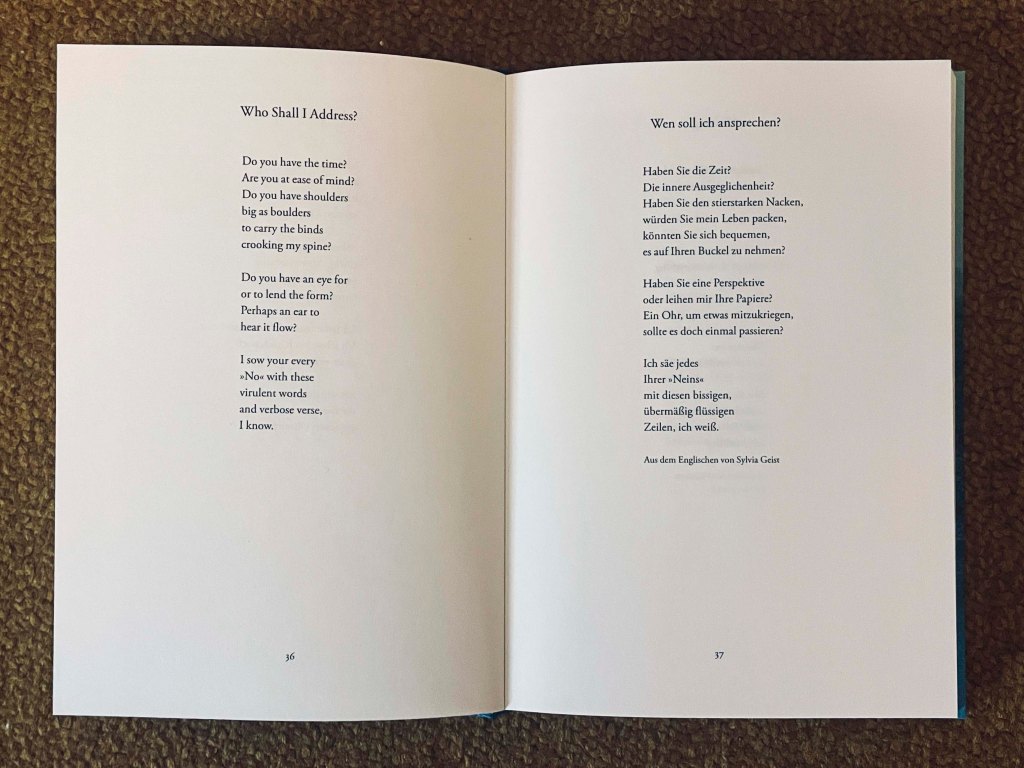
One of the poems… ‘Who Shall I Address?’ That is the one I consider a full translation of the poem, because the main idea of the English poem, its central metaphor, speaks from the perspective of a book, whereas the German version is more directed towards the reader.
The translator had complete freedom to do that. That is what stands out to me most.
But another poem I really like is ‘Patchwork’ – ‘Stückwerk’. That is the poem that started my career. It had to be translated in order to be published. It was one of the earliest translations made for the book. I think the translator worked very hard to preserve and reflect the poem’s sound, which I really, really appreciate.
I pay a lot of attention to the sound of a poem, and ‘Stückwerk’ feels good. It’s not a word I had used before.
What did you want to express with the title – how did it become ‚Ich bin nicht‘?
Sam: The original title I had for the book was ‘Sophistry of Survival’. I wanted to suggest that these poems are the lies you tell yourself in order to survive. Sophistry is like an empty conversation: something that doesn’t have much conviction behind it but still sounds good to the listener. It can make someone believe in something.
There is also the whole Greek sophistic tradition. There is a long tradition of sophistry in Greek culture, where the sophist is someone who teaches statesmen and other nobility in exchange for money. I wanted to bring together these two dimensions: multidisciplinary teaching and lying to yourself.
But then the publisher decided that we wouldn’t have an English title, and the translation of the title, ‘Sophistry of Survival’, wasn’t very marketable for some reason. So I was asked to find another title in German, which I still have some issues with. I chose a line from one of the books – It was from ‘Soliloquy/Selbstgespräch’.
The poem begins with ‘I am not. Another rules me.’ and ends with ‘You are not, I rule you’. It is a transformation of a statement. The idea was that the ‘I am’ is mostly a political person or political entity in German. There are many attempts to define from the outside what and who I am.
For example: Syrian refugee, this or that category, this or that legal status; you are a problem, or a fetish, you belong to this class, you are this, you are that. None of these are self-contained identifications or identities. So the title is a refusal of all of that, and the rest of the book consists of different attempts to find an identification that works.
Do you think polyphony also exists within identity?
Sam: For me, it can. I mean, I don’t know: Syrian, trans, queer, communist, multilingual, artist, political educator – these are very different identifications. Each one becomes a way of life in some sense. Some come into play in a moment of danger; some come into play in a moment of love, and things like that.
For me, polyphony exists in the interplay of identities, professions, and oppressions. You are never really just one thing. Even someone who is the most ordinary person is a different character at work. If they work in a corporate environment, there are rules they have to follow, certain codes or etiquette. And then, in their private lives, they are another version of themselves. I don’t think you can reduce a person to one thing, except perhaps their name.
That is why ‘Patchwork’ begins with ‘My name is the name’. That is the most encompassing thing you can say. You can never describe a person by their name but you can identify them. Once you start questioning the name, however, many things come up.
I saw on your Instagram that you’ve also posted poems in Arabic. Are these translations of poems from your book, or new work written in Arabic? And what has drawn you to writing in Classical Arabic and Syrian Arabic?
Sam: Both. Some are translations of poems from ‚Ich bin nicht‘, some for a future book. Others are original, because I’m trying to write in Classical Arabic. I feel quite distant from that whole world.
It is actually my weakest language. I speak German better than Classical Arabic, but I still speak it.
There is also a tradition of writing in our local languages, but that is mostly in songs and plays, and it is rarely written down. There is a lot of resistance to the idea that our local languages have enough value or power to write poetry. I find that very elitist, and I’m trying to challenge it.
I’m trying to write in Syrian Arabic to push back against that. But also, to get my foot in the door, I write in more classical forms first, as a way of establishing credentials. Then I try to work with more experimental things.
In the discussion, you spoke about Édouard Glissant’s idea of a ‘right to opacity’. What does opacity mean to you today – personally and politically?
Yes, that is a very important theme in everything I’ve said. At first, it was a matter of survival: the more opaque the language was, the safer it became. Then, in relation to the underground – our little conversation about the underground – this is what I mean by some form of gatekeeping. It means making something slightly more opaque so that it resists marketability and corporate interests, so that it isn’t immediately and readily picked up and exploited.
And then there is identity. We should be able to live with a certain amount of ambiguity. Not everything has to be identified, labelled, and resolved. That is where opacity comes in. I wouldn’t compare it to a mystery. A mystery always invites scrutiny: ‘Oh, you want to discover the mystery.’ Opacity is more about sitting with ambiguity and accepting it as it is. It is a refusal of reduction.
So that is the common thread between the personal and the public, personal identity versus collective identity, subcultural identity versus mainstream structures, and opacity versus mystery. The taxonomisation of everything.
Is there anything I didn’t address, which was a topic in the discussion, or anything else you would like to add?
Sam: I just want to thank you for highlighting languages and processes more than identity. That is often what comes up first in reviews of the book, in previous interviews I’ve done, and with audiences. If you look at the headlines, it is always “the refugee” first. Or, ‘Look what this refugee has done.’ It always begins with a preconceived idea or a judgment. It is never the poet, the political educator, or simply the name.
That comes much later, if at all. It feels as though they are attributing value or a certain quality to the work itself, and imposing a perspective on how people should look at the texts, based on these identity factors. They are giving you a ready-made lens through which to read. Then people approach the work with curiosity about that specific framing, instead of looking for an emotional connection, a meaning, or an artistic quality in the texts. And I’m not saying that this identification is always irrelevant. Sometimes, if you’re writing about Palestine or Syria or some other place, and that is your main subject, then of course it can matter. If you’re writing about Syria, it can give you some additional credibility. But not always. Not every Syrian is an expert on Syria; not every Palestinian is the spokesperson for all Palestinians, and so on. There is a time and a place for these identifications. It can become dangerous when the content itself has nothing to do with that, but the work is overidentified with one aspect of the author rather than another. So, thank you for not focusing on that. It is a breath of fresh air.
| Brigitte Egger

