
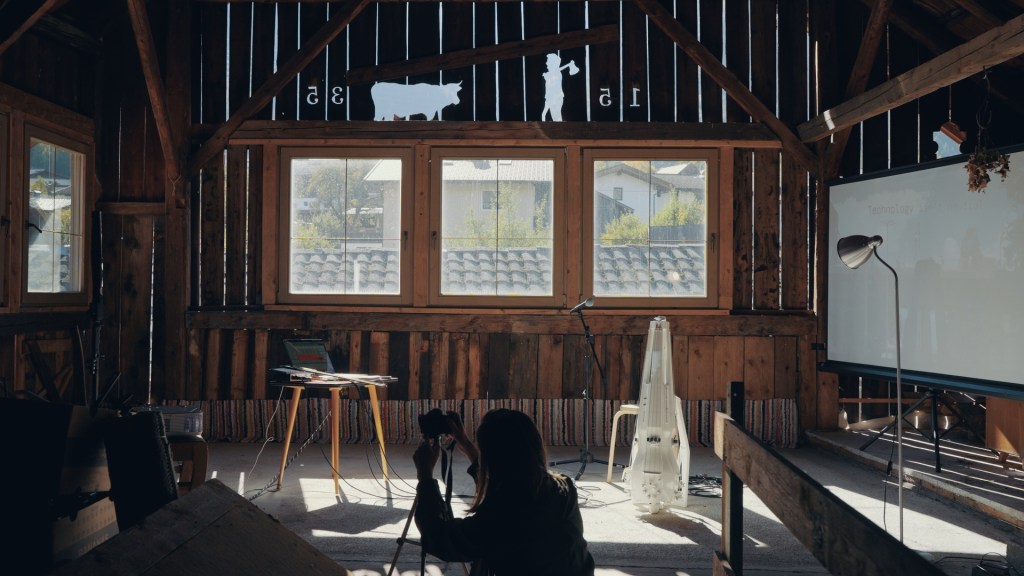
1. About Rafaele, her thoughts and her artist residency in Tyrol
For a little over three weeks in October 2026, Brazilian composer, performer and instrument maker Rafaele Andrade was based at GRUND1535 – a cultural association in Rietz, Tyrol, dedicated to the promotion of art.
The residency programme, Peripheral Grounds – Resonant Centers: Sound & Performative Residency, was awarded to Rafaele through an open call in May 2026. For the first time, the annual artist residency was organised in collaboration with the Positive Futures Festival. The project Rafaele elaborated on in Tyrol was called New Inventions. During her stay, Rafaele presented two events: Ears of the Margin: Listening to Brazilian Sound, Ecology & Resistance, a lecture and listening session at GRUND1535 on 21 October, and a film essay with live music and voice recordings at the Positive Futures Festival in Innsbruck on 23 October. Both events included live passages played on the Knurl, her self-built instrument.
Born and raised in Curitiba, Brazil, Rafaele first developed her creative practice there. Since 2017, however, she has been living in the Netherlands. Her work moves between composition, performance, creative coding, instrument design and audiovisual production. These different practices explore a shared question: How can music, sound and instrument-making respond to the political and environmental struggles in Brazil?
Rafaele initially studied composition and conducting alongside the cello. But the structures of classical music education did not always leave room for the freedom she was looking for. So she began to build her own system. For around eight years, she has been developing the Knurl, an electroacoustic instrument that continues to evolve with her practice.
Creating rather than merely maintaining. Innovating rather than inheriting. This idea also shapes her view of art. The future as one fixed direction feels strange to her. Perhaps art does not always have to change the future or prove something. It can simply exist for a moment. It does not need to justify itself through scale or mainstream recognition. What, after all, qualifies as something big?
Technology and innovation play an important role in Rafaele’s work, but she does not see them as automatic signs of progress. She questions the idea that technical creativity must lead to commercial success or constant improvement. Instead, she is interested in using these tools to address social and environmental questions and create new forms of artistic exchange.
Brazil remains at the centre of this thinking. Rafaele describes herself as a bridge between Brazil and Europe, reflecting on her own experiences while connecting artistic worlds that often remain separate. A bridge carries culture from one side to the other. It is also a place where ideas meet, change and sometimes clash. For Rafaele, culture is diverse, constantly changing and impossible to describe through a single perspective.
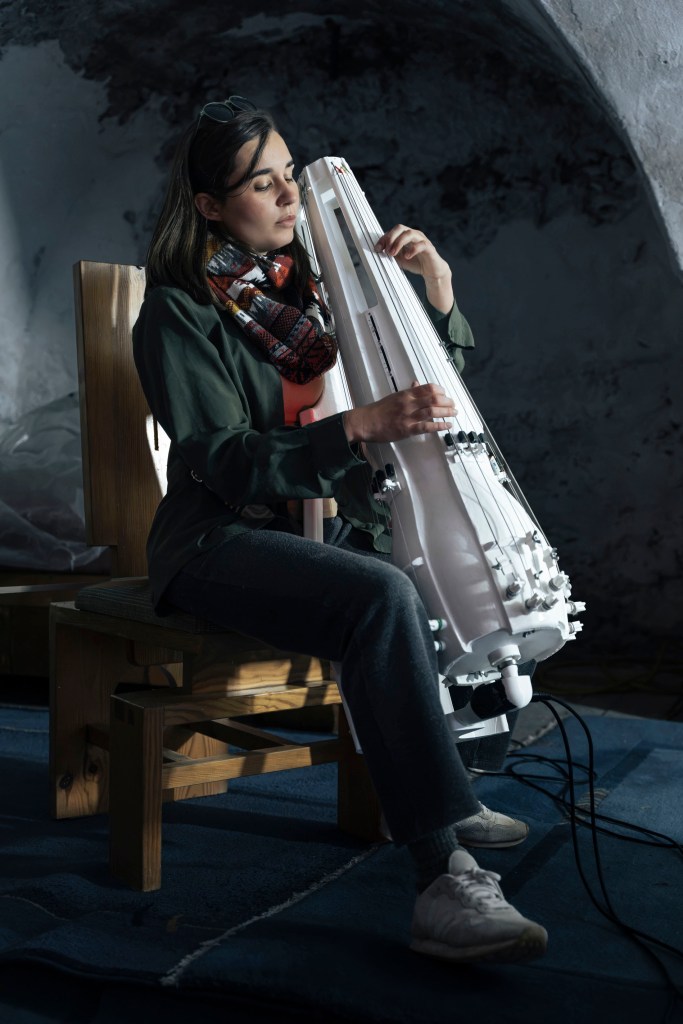
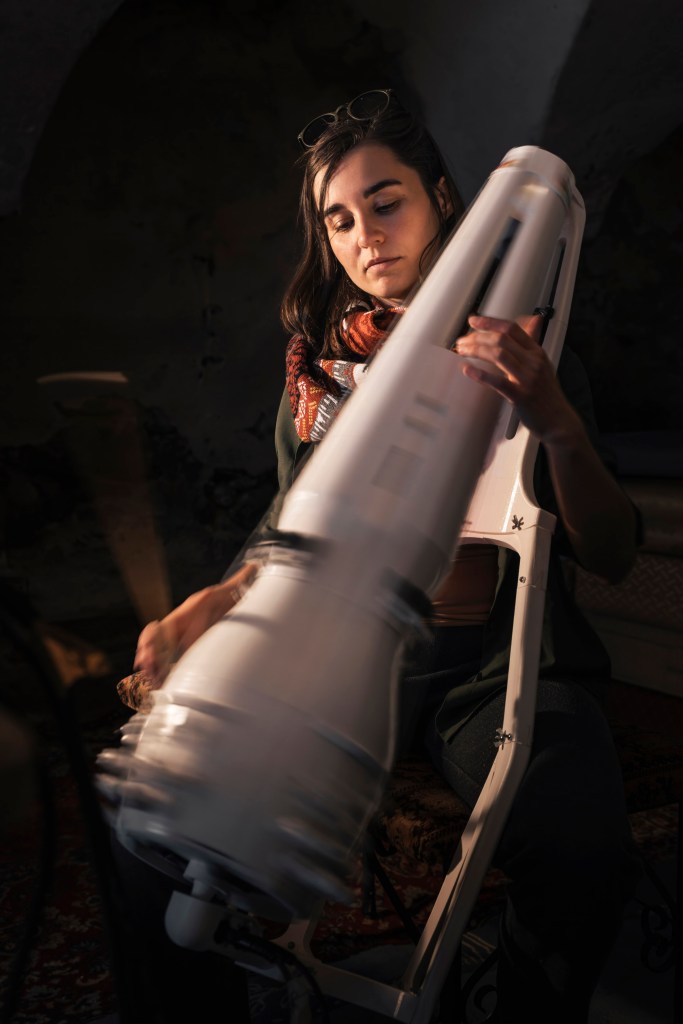
Rafaele Andrades self-made instrument Knurl | photos: Framed by Motion
2. The Knurl: Building Another System
The Knurl looks back towards the cello while moving into a different technological world. It has sixteen strings, built-in electronics, sensors and a computer-based sound system. Some of the strings share the same tuning, creating different ways to interact with the instrument. Its body is 3D-printed from recycled biodegradable plastic. Rafaele designs both its hardware and software herself.
The Knurl is not a finished object – it is an instrument that keeps changing through the act of playing. Rafaele built it in the Netherlands and brought it to Brazil for the first time in 2024, when making the scenes for the film she showed at the Positive Futures Festival.
Each string is connected to a sensor, allowing it to work as a “button”. Rafaele calls these interfaces “buttons”, although they are not buttons in the usual sense. Touching a string can trigger a sound or musical action. From there, she can choose a pattern, change its speed and work with synthesised sounds and loops. A sound design like Dive offers a particular sound world within the instrument’s wider sonic language.
There is also rotation. A small component inside the instrument, called a slip ring, allows the Knurl to turn while keeping its electronic connections intact. Physical movement becomes the starting point for something else: a string is no longer just a string, but an entrance into a whole range of possible sounds.
The physical act of playing thus becomes part of the composition itself.
Even the name carries a reference to this idea. Knurling is a manufacturing process in which a pattern is pressed or cut into a surface to make it easier to grip. It creates texture through repeated contact. In Rafaele’s instrument, the word becomes a fitting image for a system shaped by movement, touch and tension.
The idea behind building the Knurl was, above all, to have more artistic freedom and autonomy. Rafaele wanted to “be owner of my own system and to finally create my own sounds and bring them alive”. She wanted to confront what concepts such as innovation, accessibility and artistic freedom mean in her own artistic practice and make them part of her reality. Having her own instrument gives her the space to work in her own way.
But building the Knurl was also a way for Rafaele to reflect on what the cello means to her. It is an instrument that embodies 400 years of history. Yet she began asking herself what this instrument reflects about her personal sound interests, and which characteristics of its sound fascinate her.
Her music is closely connected to her personal experiences. Each composition holds something of a particular moment in her life. “I make music to express feelings and emotions I felt at a certain time,” she says. However, these moments and the feelings attached to them cannot simply be repeated whenever she wants.
Hence, in her live performance, improvisation allows her music to remain responsive to its surroundings. An idea can return without being repeated; a composition can change without losing its history.
Here, the boundary between composition and improvisation begins to loosen. The question is no longer simply what has been decided in advance, but how music responds to the present. The Knurl allows Rafaele to design her own sounds, and then to meet them again as if for the first time.
3. Listening Otherwise: Peripheral Sounds
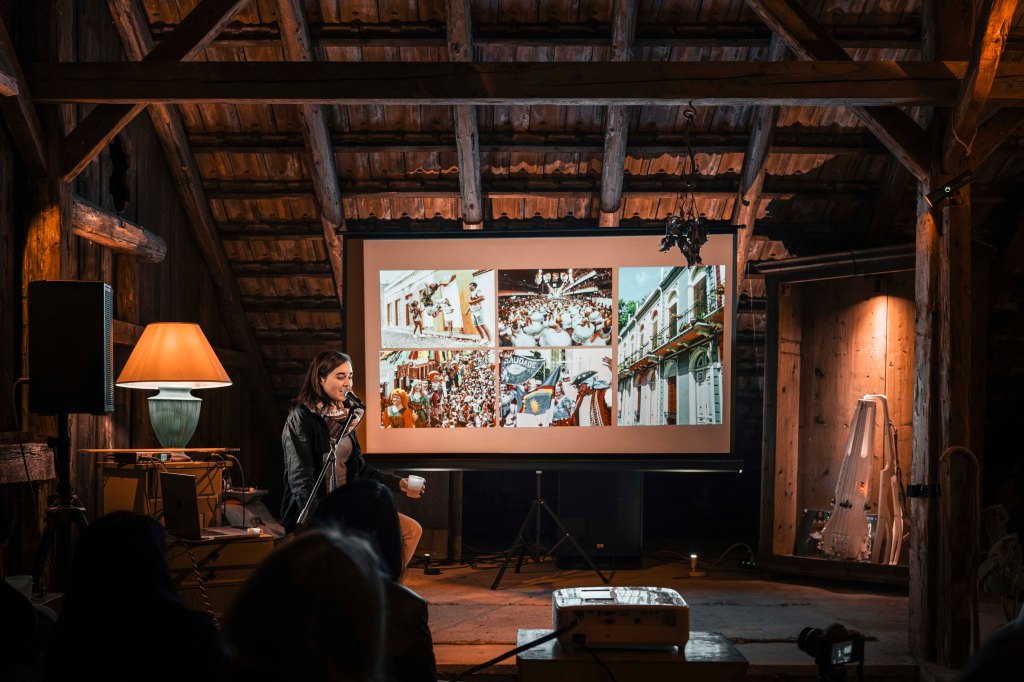
At GRUND1535, Ears of the Margin was more than a performance or a demonstration of the Knurl. It was an invitation to listen differently: not only to Rafaele’s sounds, but also to different Brazilian artists.
Alongside her own music, Rafaele spoke, showed images and videos, and introduced the work of fellow colleagues in the field of art. Maps situated them across Brazil’s vast geographical expanse, highlighting the diversity that a single national label can conceal. The selection moved between Indigenous music, experimental sound practices, and other artists working with self-made instruments.
The Brazilian group Uakti, for instance, built instruments from everyday and repurposed objects, including recycled pipes and bicycle parts. Their work challenges conventional boundaries between object and instrument, craft and composition, technology and improvisation.
Rafaele also introduced Indigenous artist Iba Sales Huni Kuin, discussing how breath, wind, and sound can carry cultural and spiritual meanings, including associations with protection and the expulsion of harmful spirits.
These artists, and many more whom she introduced, offer different ways of understanding how sound is made and situated in the world. Rafaele is careful to distinguish visibility from recognition: the artists she presents are not undiscovered talents awaiting European validation, but already recognised within their own communities. Her aim is simply to bring their work into conversation.
The margins are not just distant territories waiting to enter the centre. For Rafaele, creating a platform does not mean giving artists a voice they already have. It means creating opportunities for their work and using her own art as a tool to have a positive impact on other artists too. “I feel like kind of a bridge between Brazil and Europe,” she explains. Her position gives her access to spaces and audiences through which she can connect artistic communities across geographical and cultural boundaries.
At the Positive Futures Festival on 23 October, her film essay took this idea further. Through recorded commentary and footage, Rafaele once more brought their work into dialogue with her own. Live passages on the Knurl accompanied the film, bringing recorded images and sounds together with the presence of a live performance. As she puts it, these connections form “lines in between the worlds”.
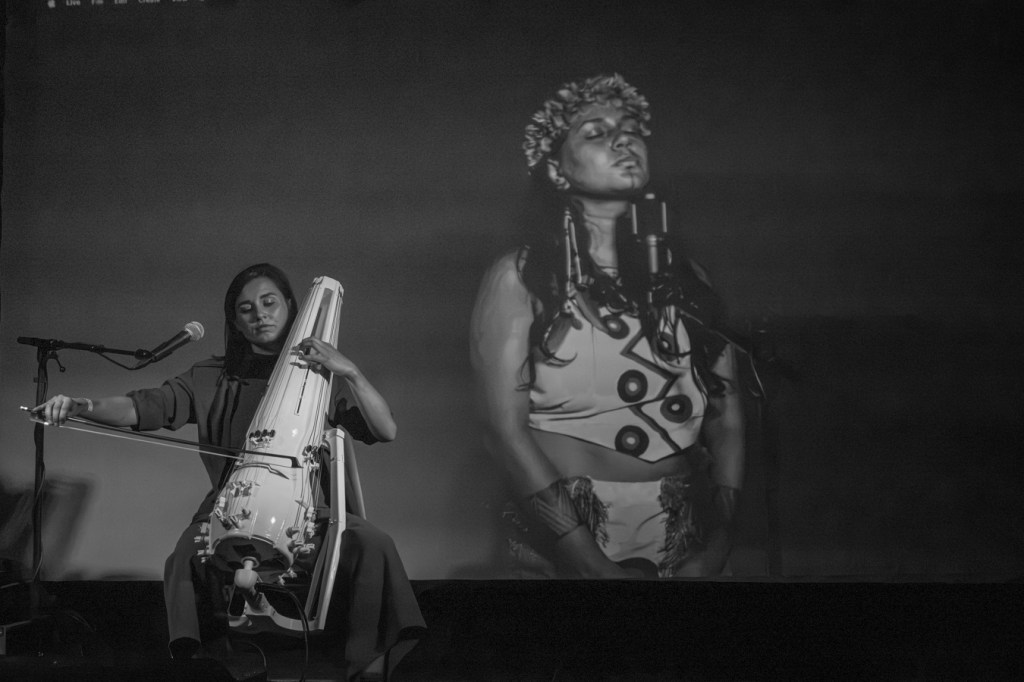
But the film also asks a more personal question: What does it mean to create, in a world that constantly demands something new? We seem caught in a cycle of “making more and listening less”. The desire to create slowly turns into pressure to produce, reinvent ourselves and keep up. Honest curiosity becomes an expectation, and the newly opened world can sometimes leave us feeling uncertain. As Rafaele reflects: “I cannot let go of the urge to create, even when I doubt what nourishes me.” Here, Rafaele refers to the technical possibilities of our modern world.
How can we respond to this tension? Perhaps the answer lies in slowing down. In listening instead of constantly producing.
The Knurl embodies an approach to artistic responsibility. By building her own instrument, Rafaele challenges established ideas about musical creation and the technologies that shape it. In her listening sessions, the instrument becomes part of a wider exchange, bringing her music into conversation with the sounds and stories of others.
Rafaele wants her art to have a positive impact on the world. Through the Knurl and her engagement with other artists, she shows that this can begin with something as simple, yet significant, as choosing to listen.
| Lena Mittermaier

