
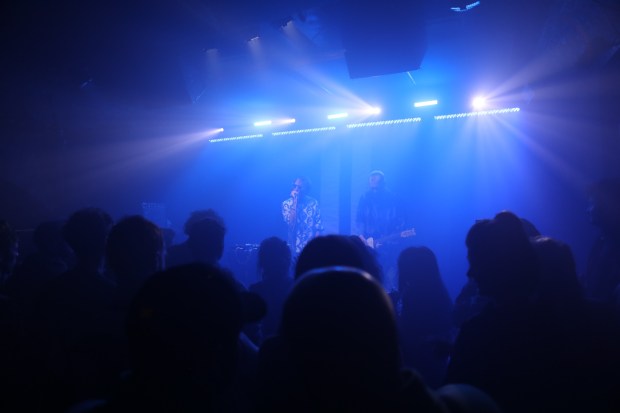
On April 28, the guitar-synthesiser duo HALAL HARDCORE played at Kramladen in Vienna, delivering an intense and energetic set to a tightly packed crowd. The atmosphere inside the venue was loud, chaotic, and deeply engaging. Blending post-punk ritual, hypnotic electronics, DIY hardcore ethics, and playful cultural symbolism, HALAL HARDCORE is building a sound self-described as “Keta Wave.” Formed in 2022, the Viennese duo combines sequenced synth basslines, live-looped guitars, and immersive performance aesthetics that feel somewhere between a club set, a noise performance, and a ritual.
Seeing HALAL HARDCORE live felt less like watching a traditional band and more like being pulled into a carefully constructed trance. A continuous wave of sound that grew denser, louder, and more hypnotic as the set unfolded.
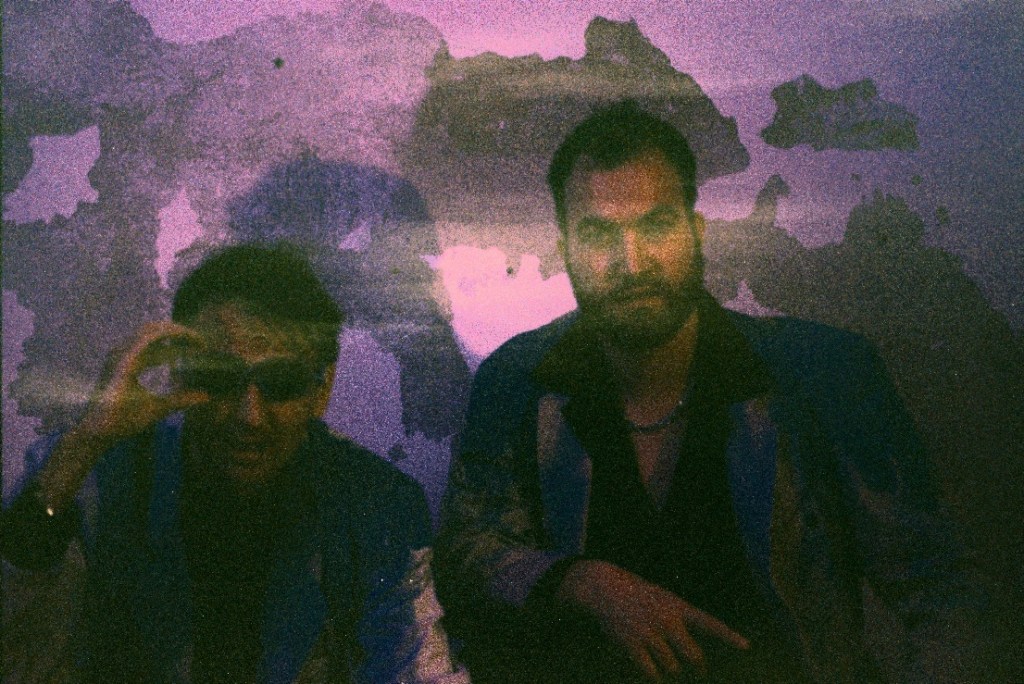
The following week after the concert, I met the members of HALAL HARDCORE — Maximilian Facchin and Tobias Klinger — in Top Kino Café to discuss the origins of their name, the philosophy behind their live shows, and how their upcoming material pushes their sound into more complex, dynamic territory while staying true to the hypnotic intensity of their genre. Beneath the irony, playful provocation, and genre invention lies a deeply serious approach to music-making, in which songs evolve slowly over months of rehearsal, experimentation, and obsessive refinement.
The Origins
Raya Sotirova: How did the two of you meet, and what was the first sound you bonded over?
HALAL HARDCORE: We met in Tobi’s gallery. At the time, he had an ambient synth project, while coming from a garage rock background. We started experimenting together in a rehearsal room and quickly found a sound that felt natural. We also bonded over a shared love of ‘90s alternative and noise rock — especially bands connected to the Steve Albini universe. We both care a lot about live music, which is why our setup is fully live, without backing tracks.
What was missing in Vienna’s scene that made you start Halal Hardcore?
We didn’t start the band to fill a gap intentionally, but we realised there weren’t many acts combining electronics and guitar the way we do. Years ago, I [Tobi] was really inspired by bands like Ratatat and wondered why there weren’t more bands with that kind of setup. Even now, it’s hard for us to find support acts with a similar vibe or approach.
Which artists influenced you most?
A lot of Sonic Youth, Dinosaur Jr., Boards of Canada, John Frusciante and especially Die Nerven. Die Nerven are a huge inspiration live — their energy on stage is incredible.
Where does the name “HALAL HARDCORE” come from, and do you get misconceptions because of it?
It started as a joke during a phase when we weren’t drinking alcohol, which felt “very halal” to us. But the name also plays with opposites: “halal” suggests rules and restrictions, while “hardcore” sounds freer and more chaotic. At the same time, hardcore has its own strict codes and scene traditions, so we’re also gently mocking that world a bit. We also liked using the word “halal” in an everyday way — similar to how people casually use “kosher.” The reactions are funny though: some people think we’re making fun of Muslims, others assume we’re deeply religious. Especially in Germany, people often project a lot onto the name. People misunderstand the name all the time. They ask if we’re Muslim, and when we say no, some think we’re appropriating the term.
Your music is often described as hypnotic. Are you aiming for a physical or psychological experience?
Mainly psychological, but achieved through physical elements. Heavy bass and a powerful sound system definitely affect the body, but the bigger goal is to draw people into a kind of trance or ceremony.
We use elements like incense, seamless transitions between songs, and a flowing, live structure to create immersion. We don’t stop to talk much during sets — the idea is that the audience slowly sinks into the sound and stays inside that wave. Unlike harsh noise acts that focus on pure volume, our aim is more emotional and atmospheric. The idea is that the music takes you somewhere psychologically.
Behind the concept
What is “Keta Wave”? That’s something you came up with, right?
Yeah, kind of, it plays a bit with genres like stoner rock and dark wave. We have elements of wave music, but we don’t see ourselves as traditional dark wave, which often feels rooted in nostalgia and ‘80s aesthetics. Our music feels more contemporary to us, so “Keta Wave” was meant to sound modern, fresh, and slightly provocative. It also connects to the idea of creating an altered mental state through music — whether at a live show or listening to the album loudly from start to finish.
Would you be okay with other bands using “Keta Wave” as a genre label?
Definitely. Everyone should play Keta Wave. That’s partly why we named the record that way — to kind of define a new genre from the start. It’s a pretty bold move for a debut album, but we liked the idea. So far, we haven’t heard another Keta Wave band yet, but we’re waiting for one to appear.
Your music mixes cold synth precision with organic guitar textures. Was that contrast intentional from the start?
At first, everything was very open. We didn’t even know if we’d become a proper band or just experiment together for a while. But pretty quickly, we realised the combination of electronic rhythms and guitar worked really well as a duo setup, so that contrast became intentional very early on. The sound also evolved fast. In the beginning, the guitar setup was much simpler — fewer effects, no looper. Over time, the pedalboard and layering techniques grew, and the balance between synths and guitar became more refined.
Did your previous bands shape the sound?
Definitely. We both came from punk, post-punk, garage rock, and experimental music backgrounds, so combining guitars with synthesisers felt natural. One side wanted to push more into synths and drum machines, the other into experimental guitar textures and effects. Those ideas fit together immediately.
In a way, we were also learning our instruments through the project. One of us moved from bass into guitar-focused playing, the other from guitar toward synths and drum machines. That gave the band a very fresh and less traditional approach.
Is everything performed live?
Yes, completely live — no backing tracks. We use loops during the set, but every layer is played and recorded in real time. That’s important for us because it keeps the performance intense and unpredictable. Every show can sound slightly different, and there’s always the possibility of mistakes, which we actually like. It makes the concerts feel alive rather than perfectly programmed.
What’s the biggest risk in your live setup?
The whole system depends on sequencing, looping, and precise timing. If a sequence is programmed wrong or a loop comes in at the wrong moment, the entire song structure can fall apart. The guitar loops are especially risky because they’re recorded in real time during the set. If the loop isn’t captured perfectly on the first take, everything can drift out of sync very quickly. Sometimes we can recover by extending a section or adapting the structure on the spot, and occasionally those accidents even create something interesting.
Our music is very structured, with abrupt transitions and tightly arranged changes, so mistakes can be harder to hide than in a traditional rock band, where you can just stay on the same groove for longer. At the same time, we like the risk. Playing fully live without backing tracks creates tension and energy. There’s always the possibility that something unexpected happens, and that makes the performance feel more alive.
Do you improvise much on stage?
Not really. The music is actually very rehearsed and tightly arranged, even if it sometimes feels improvised. We spend a lot of time in the rehearsal room shaping the structures. What changes from show to show is more the energy, timing, or length of certain parts. Mistakes and spontaneous reactions can shift the flow a bit, but the core compositions stay quite precise.
Imperfections remind people that this is really happening live, in the moment. Sometimes, audiences even think they’re hearing a new unreleased version of a song because something changed accidentally. That’s what we like about live music: it’s happening right now. If you make a mistake on stage, that mistake belongs to that exact moment. It makes the performance feel real and grounded. And when a whole set works perfectly without backing tracks or safety nets, the feeling afterwards is incredible — because you know you actually achieved it live. That sense of risk and reward is something you probably don’t get from a playback show.
Composition and Evolution
Tobias writes the lyrics for HALAL HARDCORE. Musically, though, it’s very collaborative. He mainly works on the rhythm side — beats, basslines, and overall structure, while Max focuses more on melodies and guitar parts. Usually, the music comes before the lyrics. Oftentimes, Tobias prepares beats or basslines at home, then they meet in the rehearsal room and start building on them together. Max improvises melodies over those structures, and they record a lot of those sessions. Later, Max goes back through the recordings and develops certain melodic ideas further. Then, everything comes together again in another stage, where the song really starts to grow into its final form. The writing process happens in layers: first the rhythmic foundation, then improvisation and melody, and finally shaping everything together into a complete track.
How do the lyrics come together? Are they sincere, ironic, or both?
The lyrics take a long time to develop. Usually, it starts with a single phrase or chorus, and then the text slowly evolves over two or three months. The lyrics also change once they’re sung in rehearsal with the full band — rhythm, repetition, and phrasing become important parts of the process too.
The lyrics are actually very sincere. Even though there’s irony or humour in concepts like “Keta Wave” or the band name itself, the lyrics deal with serious themes. There’s definitely a playful or camp aspect to the presentation, and if you’re familiar with certain music or art references, you might catch extra layers in it.
The metaphors aren’t meant to be impossibly obscure, but there’s usually a kind of “key” to unlocking them.
What’s the relationship between the “Jetstreams” EP and “Keta Wave”?
They were basically part of the same recording process. The Jetstreams EP was released first as a kind of teaser for the full album Keta Wave. The songs from the EP also appear on the LP. At the time, we were already playing a lot of shows and wanted to have something physical people could buy and take home while waiting for the vinyl album to be finished. Both releases share the same recording setup, production team, visual aesthetic, and overall sound.
What’s changed between the earlier releases and the upcoming album?
One big change is the lyrics. On the earlier releases, the texts were much shorter and more fragmentary — more like repeated phrases. The new material is becoming more narrative and detailed. The compositions have also grown more complex, partly because we’ve simply become better musicians over the last few years. We’re more confident now in stretching songs out, adding new sections, and letting ideas develop longer. The core sound is still very much HALAL HARDCORE — still “Keta Wave” — but there are new textures and more depth. On the guitar side, there are lots of new effects and different approaches to melody writing, with an effort not to repeat earlier ideas.
There’s also more attention to dynamics now. Earlier songs were often very dense and intense throughout, whereas the newer material leaves more space: quieter, more reduced passages that slowly build back into heavier sections.
The band also wants the next record to feel more blended between instrumental and vocal elements. Before, songs often leaned clearly toward either instrumental tracks or lyric-driven tracks. Now the two approaches are merging more naturally, with long instrumental passages inside vocal songs.
Will the production change too?
Yes. The next album is planned more as a proper studio production, so the sound will probably feel more polished overall — better vocal recordings, more refined production details, and a wider sonic range — while still keeping the same identity and atmosphere as the earlier releases.
That doesn’t mean we want “more simplicity” necessarily. We still experiment. For example, there will definitely be new guitar effects on the next record, so there will be fresh sounds and textures. But fundamentally, it will still sound like us: distorted guitar, synth-like effects, delays, and the same overall atmosphere.
There are also no plans to add permanent new instruments. If we want to explore different sounds, we already do that through side projects. For example, Max plays in an Austrian post-punk band with German lyrics, and I also play bass in other contexts. That’s where we experiment more freely. But with this band, the sound is kind of intentionally fixed. Our goal is to further define and refine what this project already is. Our mission is really to develop our own musical world and aesthetic.
You toured in Taiwan. How was this experience?
The whole process was really smooth. People were very welcoming, and there are a lot of cool venues in Taiwan that support live music. In the end, we played five shows in one week, which was pretty intense. We travelled all around the island by train and bus, ate lots of amazing food, and met many great people.
It was also exciting because we sing in German, and of course, most people there didn’t understand the lyrics. But somehow that made it even more interesting and enjoyable. It was fascinating to see how audiences in Taiwan reacted to our music compared to audiences in Austria.
We also got to meet a lot of Taiwanese musicians and see what kind of music they were making. There was one radical noise duo with two female musicians — one played drums while the other used what seemed like a no-input mixing setup, creating extremely loud and intense sounds. Another artist performed ambient music, and there was also a modular synthesiser act. The local support acts were all really impressive.
Did the adventure inspire any new music?
We’ve been thinking about that while working on the new album. Maybe some melodies or impressions from the tour will find their way into a song, but we’re not sure yet. The record itself probably won’t be heavily inspired by Taiwan, at least not directly. For us, the biggest inspiration was simply experiencing our music in a completely different environment and seeing how it connected with people outside the usual scene in Austria. It was interesting to watch how different audiences reacted to our performances. We also had a few days off during the tour, which was amazing. We visited hot springs, swam in the Pacific Ocean, and generally enjoyed life a bit. It was really energising.
Where do you see the band in a few years?
We definitely want to remain a duo. Maybe we could imagine occasional guest appearances — perhaps a singer for one song, live drums for an outro, or even a saxophone somewhere in a set — but only as additions to the existing sound, not as a fundamental change. We really like the dynamic we currently have and don’t want to complicate things with more permanent members. Touring and organizing already become much harder with larger groups.
In terms of the future, we’d love to play showcase festivals, attract more attention, maybe find a label, and especially a booking agency. Right now, we do everything ourselves: booking, organisation, management, promotion.
Would you ever expand the visual side of the band?
Definitely, but not with projections. We really dislike projections on stage. They’re often too bright and distracting, almost like being in a cinema. We think the focus should stay on the music and the performance itself. But generally, we prefer atmosphere through lighting, fog, stage design, colours, and styling rather than moving images. Visual identity is already a big part of our concerts. We carefully coordinate the backdrop, lighting, colours, and outfits.
For the next album, for example, we’re already working with a designer on new stage outfits. So the visual world of the band will definitely continue evolving.
If the band grows bigger in the future, we’d love to invest more into customised lighting setups and maybe work with a dedicated lighting technician.
What’s something you haven’t tried yet but would love to do?
One dream is definitely having our music featured in video games. We’d love to contact game studios and see if our songs could become part of a game world or level design.
We’d also love to collaborate more with guest artists or do a feature with another musician.
Maybe we could even make a song with a children’s choir. It sounds funny, but we genuinely think it could be beautiful if it fits the right song. Maybe one day it will happen.
| Raya Sotirova
Halal Hardcore
is a guitar-synthesizer duo formed by Maximilian Facchin (guitar) and Tobias Klingler (monosynth, drum machine, vocals). Founded in Vienna in spring 2022, their music combines the coldness and precision of sequenced synthesizer riffs with the immediacy of a looped electric guitar. Life-affirming lyrics lead through the beat-heavy, spherically noisy compositions.
HALAL HARDCORE unleash a fusion of guitars and synthesizers on stage that take you deep into the hypnotic world of the Keta Wave. Every performance is a spontaneous sound journey, where nothing is predetermined and everything seems possible.

