
The Austrian Alps have long been trapped in a cage of postcard-perfect romanticism, a pristine, static myth of green meadows and patriarchal tradition. Melanie Thöni’s Diplom exhibition Gib mir kua acht at the Academy of Fine Arts in Vienna (June 23 – July 5) is a vibrant rebellion against her homeland’s curated nostalgia, blending traditional Tyrolean dialect with hyper-saturated, digital-inspired layers. Sitting down with Thöni in front of the Academy, we discussed challenging the male gaze in landscape art, the friction between rural roots and urban life, and why the mountains need to be disruptive.
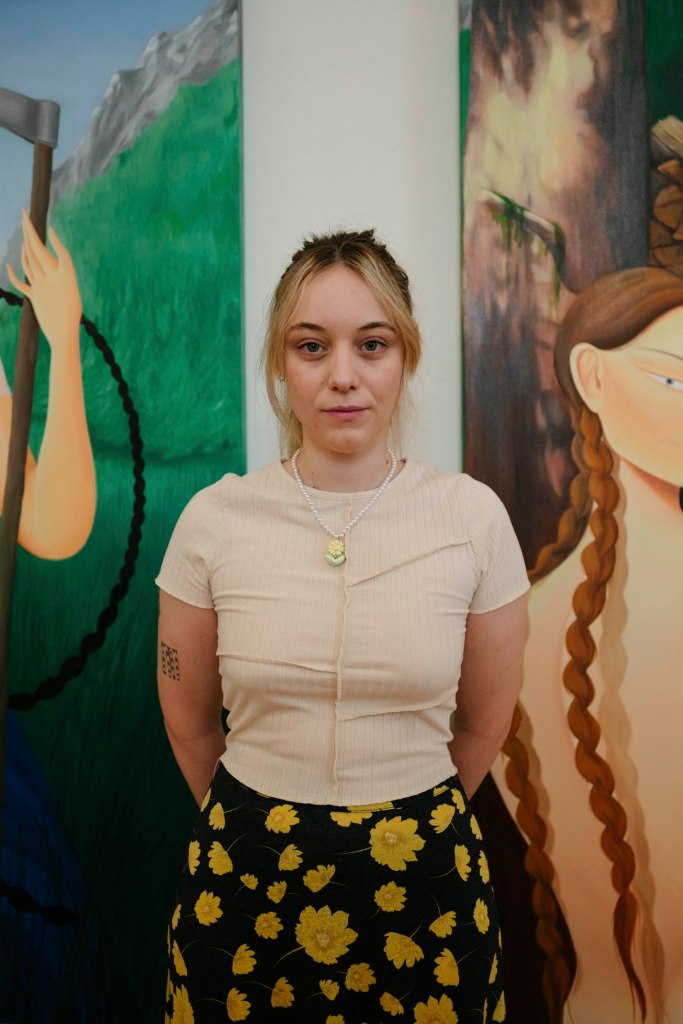
Raya Sotirova: Moving to Vienna gave you the distance needed to look back at Tyrol. Does the city feel like a blank canvas for your memories, or is it a separate world that quietly sneaks into your paintings?
Melanie Thöni: In the beginning, Vienna felt like an entirely separate universe. I remember spending my first few days just walking through the streets, completely overwhelmed by the sheer scale of everything and by the sudden wave of anonymity. I grew up in a tiny Tyrolean village of 300 people where everyone knew your entire life story, and later moved to a slightly larger one of 2,000 where the same rules applied. In a small village, you aren’t allowed to make mistakes; there is a rigid set of unspoken rules to follow, right down to how you carry yourself at church on Sunday.
Vienna offered a beautiful, liberating anonymity. Suddenly, you are one person among millions, and that freedom gives you the power to create things you would never dare to attempt at home. Yet, that physical distance completely transformed how I look back at Tyrol. I began to see both the magic and the flaws of my homeland clearly for the first time.
During my studies at the academy, I painted a piece depicting a traditional Almabetrieb (the annual cattle drive down from the alpine pastures) and emblazoned the cow with the phrase „Huam iatz – Tyrolean dialect for “go home now.“ A classmate from Iceland looked at it and asked what it meant, and I realised: Where do I even begin? To explain the artwork, I had to unpack my dialect, my language, and the heavy weight of these regional traditions. Distance forces you to re-examine everything you took for granted.
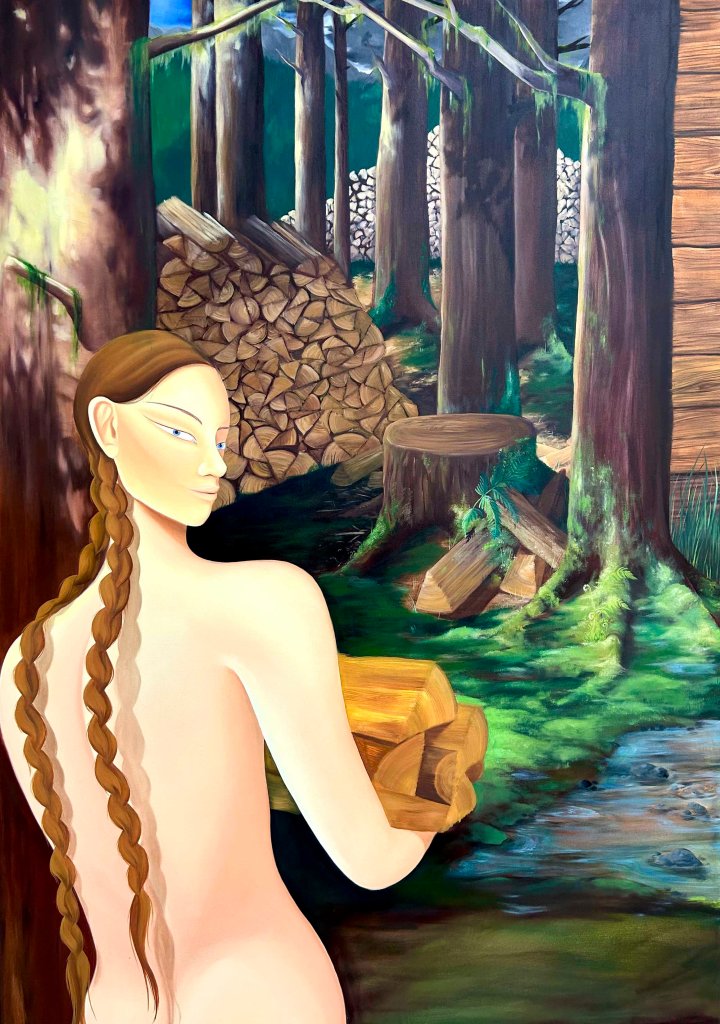
Your work borrows from the visual language of classic, conservative Alpine painters, but you re-contextualise them through a critical feminist lens. How do you balance honouring the history of your homeland with tearing down its patriarchy?
It is a delicate boundary, but one that needs to be crossed. In Austria, and particularly in Tyrol, we grew up surrounded by painters like Franz von Defregger, Alfons Walde, and Albin Egger-Lienz. Their canvases are dominated by men doing „important“ things, or wrapped up in the mythos of freedom fighter Andreas Hofer and the Bergisel battles. Women fought in those historical battles, too, but they were systematically erased from the visual history. We see the same erasure in our living traditions today. It infuriates me that women are still barred from participating in certain local customs. How do we explain that to a five-year-old girl today? „You can’t join in simply because you are a girl?“ It raises so many questions. By inserting contemporary female figures into these historically male spaces, I want to see how the imagery shifts and how the public reacts.
Defregger painted women strictly as idealised mothers; Walde painted them as Madonnas. That historical art combines with modern tourism brochures to create this flawless, picture-perfect illusion of Alpine paradise, where nature is pristine, and life is uncomplicated. I want to look behind that carefully constructed curtain. I often design my compositions like a theatrical stage set, exposing the fact that this wholesome, perfect „tradition“ is actually a staged performance.
Playing with traditional Tyrolean dialect can be a double-edged sword, as regional customs are often associated with conservative ideals. How do you reclaim these words and turn them into something light, political, and expansive?
When I first moved to Innsbruck, I realised people there couldn’t understand my specific village dialect, so I had to adapt. When I moved to Vienna, the Viennese couldn’t understand my Innsbruck dialect! That linguistic displacement made me look closer at the words themselves. Living so close to the Italian border, we speak a beautiful hybrid dialect, sprinkled with words borrowed from Italy. It is incredibly unique to our geography.
In my diploma work, I used a phrase from the legendary Tyrolean playwright Felix Mitterer. Writing in the 1970s, he was already criticising how overtourism was consuming the landscape. I love playing with those heavy concepts, sometimes even blending English phrases with deep dialect to create an entirely new cultural friction.
In Austria, traditions and the very concept of Heimat (homeland) are frequently weaponised by right-wing political parties to exclude others. That is exactly what I want to re-own. To me, Heimat isn’t a closed door or a negative boundary; it is something vast that can be carried with you, even from far away. It should be a safe, welcoming space for everyone.
If you had to pick one Tyrolean tradition that you genuinely love, and one that absolutely infuriates you, what would they be?
The tradition I deeply love is the Marent – our version of an afternoon Jause. Around 4:30 PM, everything stops. You sit down to fresh bread, coffee, local cheese, and Speck. It is beautiful because it establishes a communal rhythm to the day. It breaks up the labour, and everyone accepts that it is time to sit together, talk, and just exist as a family or community. Those rhythms structured my childhood: waking up, the 9:00 AM breakfast, lunch exactly at noon, and finally, the Marent.
What infuriates me is the historical sexism baked into things like Schützenscheiben (traditional painted wooden shooting targets). In the 1800s, target shooters would shoot at targets painted with images of women – often the prettiest girl in the village. The act of shooting at her image was culturally framed as a form of „flirting.“ It is a disturbing literalization of the male gaze and the targeting of women, wrapped up in the guise of local heritage.
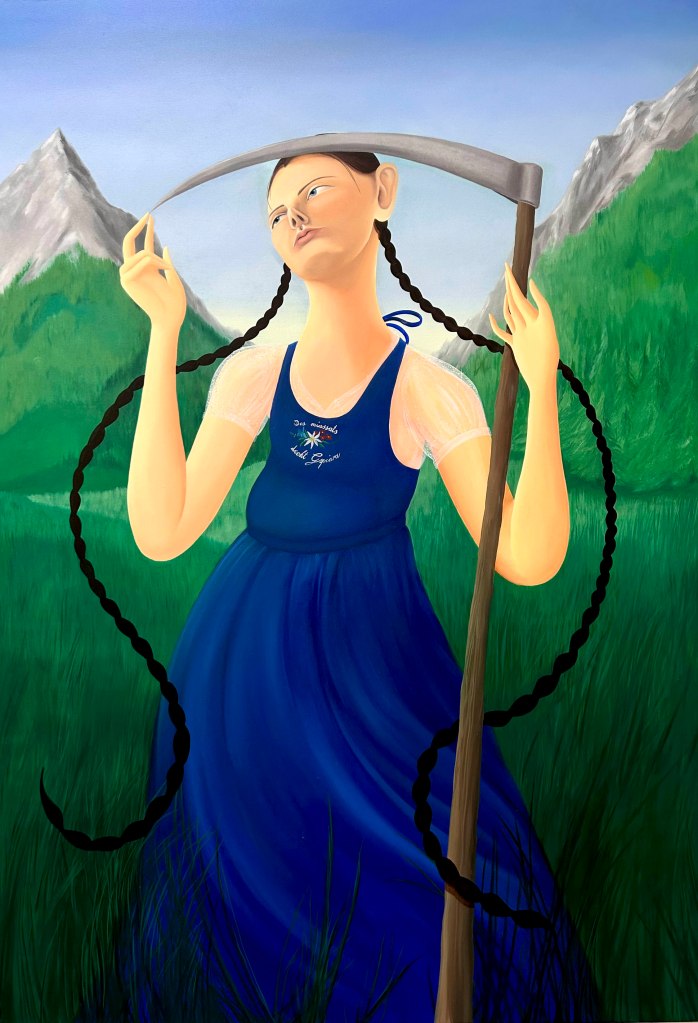
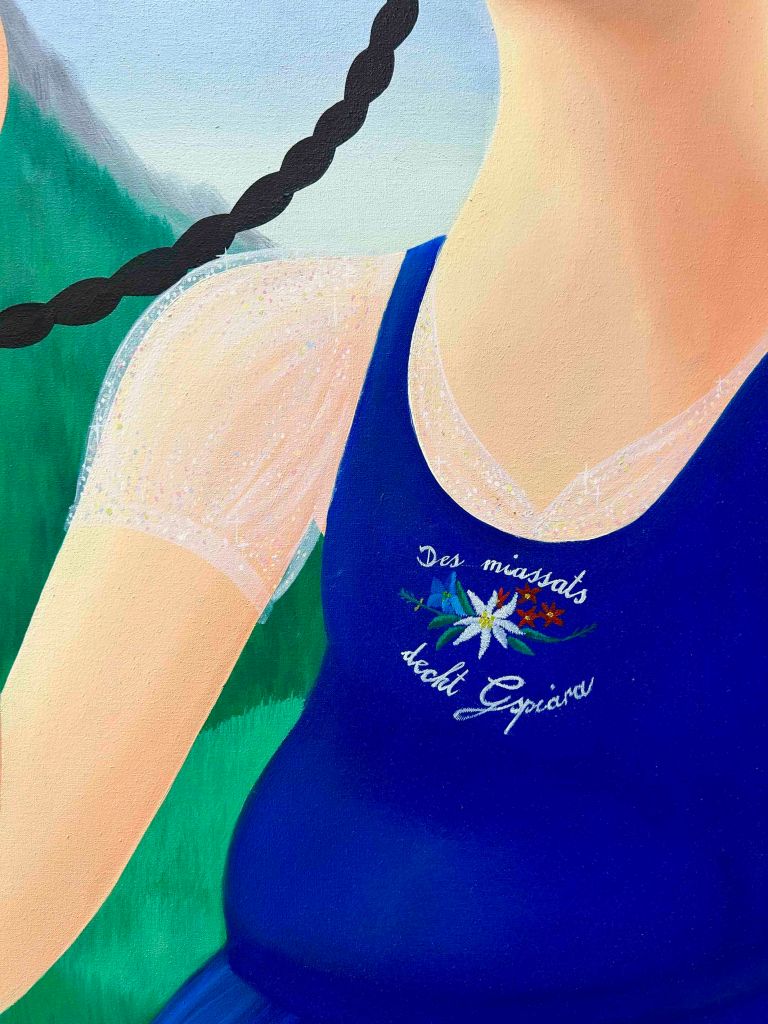

Instead of the quiet, earthy tones usually associated with traditional mountain landscapes, you use intense, clashing colours. Is that on purpose?
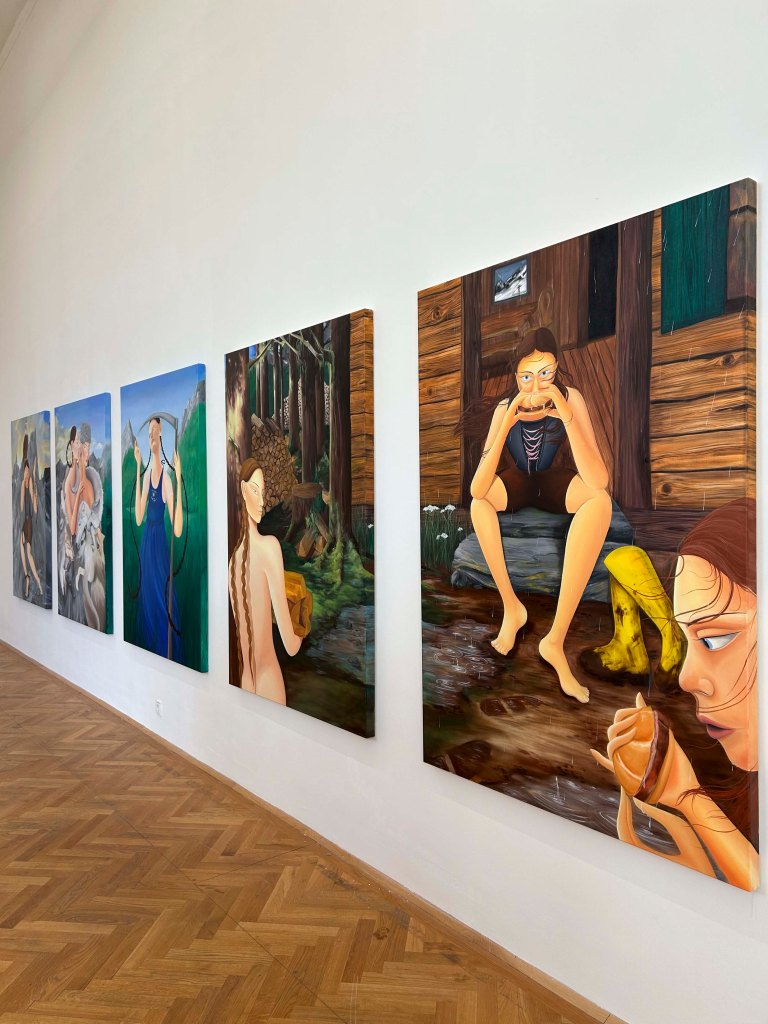
That contrast is the core of my practice. I build my paintings using transparent layers. Because the paint is translucent, the layers catch the light and create a saturated, high-voltage glow when stacked together. Visually, this technique borrows from the digital world – it mirrors the way you build an image using adjustment layers in digital software. At first glance, the figures look flawless, but when you step closer, the illusion cracks: a character might have impossibly long fingers, missing fingernails, or two left feet.
We live in a social media culture where everything is filtered into impossible perfection, hiding our flaws. This exploration is deeply personal for me; I have struggled with severe acne and neurodermatitis my entire life. You grow up longing for that flawless skin, looking for it everywhere, while social media feeds young women a constant stream of distorted, unachievable reality. By painting these figures with hyper-perfect, glowing skin but structural anatomical glitches, I push the image to a breaking point where the real world collides with the digital uncanny.
Do you consider yourself a perfectionist, then? Does that intensity ever drive you crazy in the studio?
I am an absolute perfectionist, and for a long time, it was a battle. When I began my art studies, I painted in a highly photorealistic style. Eventually, it bored me because I knew exactly what the final piece would look like from the very first brushstroke. I spent three years intentionally breaking away from that rigidity, experimenting wildly just to lose control. But ultimately, I realised I needed that precision as it is vital to my execution. Now, I combine the two: a disciplined, perfectionist technique used to create surreal, imperfect worlds.
It absolutely drives me crazy. I get so deeply detached from reality while painting that when I finally step out of the studio, I experience a wave of derealization. I’ll look around at the street and think, My God, where am I? Is this the real world? You pour so much of your consciousness into the canvas that the boundary between the painting and reality completely dissolves.
How long did it take you to create this whole exhibition?
About six months, which is incredibly fast for the density of these paintings. It’s only possible because my process is highly calculated. Once I have the initial sketch, the execution is almost like mathematics. I have to map out the drying times of each translucent layer. I apply one layer, wait twenty-four hours for it to cure completely, and then lay down the next.
When I am in the zone, I lose all track of time and will easily paint for twelve hours straight. It’s a beautiful, terrifying state of flow. I’ll finally step away from the easel after hours of silence, and suddenly all my basic human instincts will violently switch back on: Oh my God, I’m starving, I need water, I haven’t used the restroom since sunrise. To prevent total burnout, I enforce strict weekends off. I go out into nature or head back into the high Tyrolean valleys to decompress. The physical scale of the mountains provides an irreplaceable creative recharge.
What is the story of the characters in your Gib Mir Kua Acht exhibition?
I am deeply inspired by the old Alpine myth of the Salige – a legendary community of wild, autonomous nature spirits or wise women who lived protectively in the forests and cliffs. I like to imagine my painted characters as part of that mythical female collective. In my mind, when the studio lights go out, they are sitting together in their surreal universe, braiding each other’s hair, gossiping about the day, and keeping watch. They represent a collective desire for a space where women can live authentically, on their own terms, free from the constant, unexpected interruptions of the patriarchal world.
You have developed a highly distinct visual style. Anyone who sees your characters instantly recognises them as yours. How did that evolve?
It is wild to hear that, because finding my style was an agonising process. In the beginning, I had no defined aesthetic; I was just throwing paint at the canvas. People kept telling me, „Don’t worry, you’ll find your voice, you’ll develop your style,“ and I remember feeling completely lost, wondering how that magic was supposed to happen.
The breakthrough came from pure, repetitive discipline. For nearly two years, I attended a life drawing course every single evening for two hours. Drawing real human bodies night after night built a profound muscle memory and a deep security in my draftsmanship. It bridged the gap between the images in my head and my hand on the canvas. Once that technical freedom was locked in, the characters began to emerge naturally from fast, instinctive sketches. My advice to anyone struggling with style is to never force it. Focus on experimentation, figure out what brings you genuine joy, and let the technique mature on its own time. I prioritise quality over quantity; I don’t paint quickly.
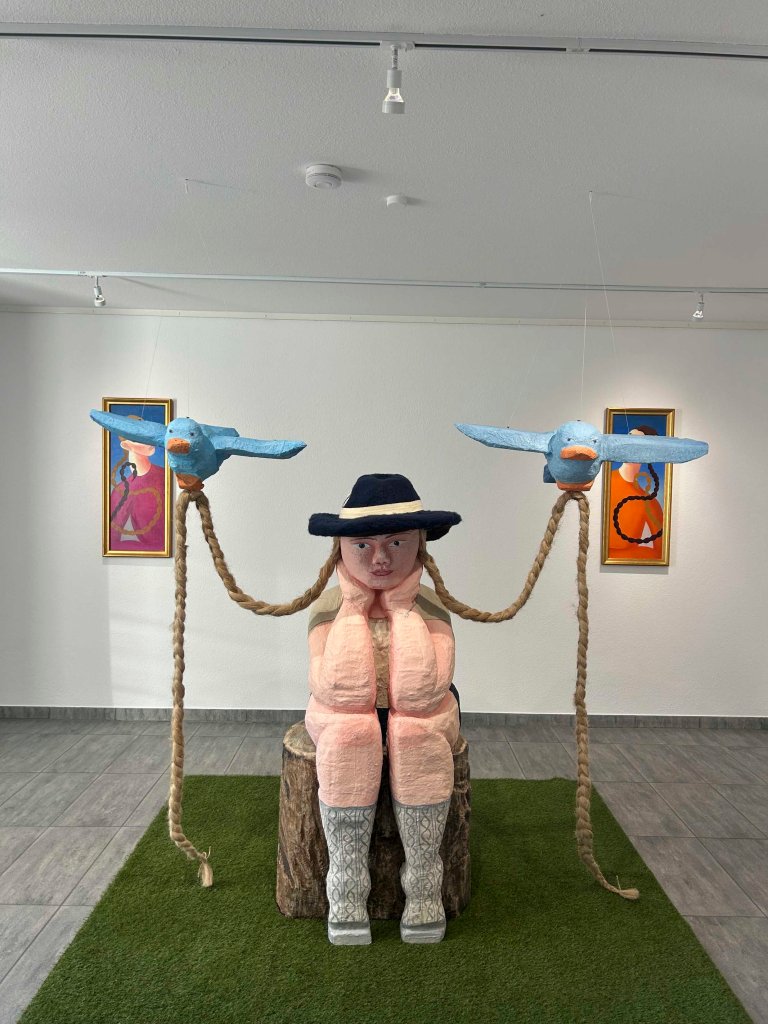
You recently holed up in your parents‘ garage in Tyrol to create your very first sculpture from Styrofoam with a chainsaw. What was it like to trade the precision of a fine paintbrush for the raw, violent energy of a power tool?
It was wild! I wanted to challenge myself with something entirely outside my comfort zone. I know exactly how to paint; I know how a canvas will behave. But with sculpture, I was a complete novice. I stood in that garage thinking, Where do I even start? How do I structure this, and how do I know when it’s finished?
Working with Styrofoam is an absolute nightmare. When you cut it with a chainsaw, the static charge makes the tiny white beads stick to absolutely everything. It was chaotic and messy, but emotionally liberating. A paintbrush requires you to hold your breath, stabilising your entire body to execute a single, flawless, microscopic line. A chainsaw demands raw, physical force. Holding this heavy, buzzing, slightly terrifying machine gives you an incredible surge of power. It allowed me to rip my characters out of the two-dimensional plane and drag them violently into the physical world.
It was a hilarious lesson in logistics. My dad was trying to help, shouting advice about heavy-duty foam glues. When you are used to living in Vienna, you take for granted that you can buy any artistic material you need just around the corner. Out in the valley, I’d suddenly realise, „Oh my God, I forgot the structural glue!“ That meant dropping everything, driving thirty minutes to the nearest hardware store, and driving thirty minutes back. Losing an hour of daylight to a supply run changes your entire workflow.
What happened to the sculpture after?
The resulting sculpture was first shown in a solo exhibition, and it is currently on display in a medieval castle in Tyrol. But my next big project is bringing her to Vienna. I have been awarded an Artist Statement room at the Parallel Vienna art fair, located in the historic Otto Wagner Hospital complex. That sculpture has never seen the capital, and it’s time she did. I want to see how the urban environment changes her, just like it changed me. It’s a massive piece, so getting her there will be its own adventure.
If a director were to narrate a documentary about the women living inside your canvases, what would he say? What are your actual cinematic inspirations?
It would be a stylised 90s coming-of-age movie! It would follow an autonomous girl group who are having the time of their lives, fiercely protecting one another without a care for the external world.
Cinematically, my touchstone is Rob Reiner’s 1986 film Stand by Me. It beautifully captures that bittersweet space of childhood: a group of friends embarking on a weird side-quest during their last collective summer. It balances a sense of endings and mortality with the lightness of youth.
Your grandfather used to secretly place tree roots in the forest for you to discover as a child. If you could secretly plant one of your paintings somewhere in the Tyrolean mountains for a hiker to stumble upon, where would you hide it?
Without a doubt, right at the summit of a mountain peak. Imagine hiking for hours up a rocky trail, completely exhausted, finally reaching the top, and finding a glowing canvas of an alpine girl staring back down at you. Reaching a summit is an incredibly spiritual, solitary moment. Encounters with contemporary art should feel just as unexpected and breathtaking.

Let’s talk about your studio soundtrack. What music fuels the creation of these traditional alpine figures?
Music is vital to my art-making; the energy of the sound dictates the brushstrokes. I have this dream of staging an exhibition where every painting is paired with the exact track I listened to while creating it. My studio is usually blasting 90s techno, high-tempo hyper-pop.
What lies on the horizon for you now that this exhibition cycle is closing?
This summer, I am packing up my studio and heading to Carinthia for my very first two-month artist residency. It features an open-studio format, meaning collectors and visitors can walk directly into my creative space while I’m working. I am incredibly curious to see how a new landscape and that level of public vulnerability will shift my practice. I suspect it might lead to smaller, more intimate, and perhaps even stranger paintings. The evolution continues.
Ultimately, ‚Gib mir kua acht‘ is more than an exhibition. Thöni’s work proves that you can love a place while fiercely dismantling the myths that restrict it. By filtering the rugged terrain of her youth through an unapologetically modern, digital lens, she gives the Alps a new, breathing identity – one that is loud, chaotic, and fiercely feminist. This bold reimagining of tradition is also on display at the Heidi Horten Collection in Vienna, where Thöni’s work is featured in the ANIMALIA exhibition running until August 30th.
| Raya Sotirova

