
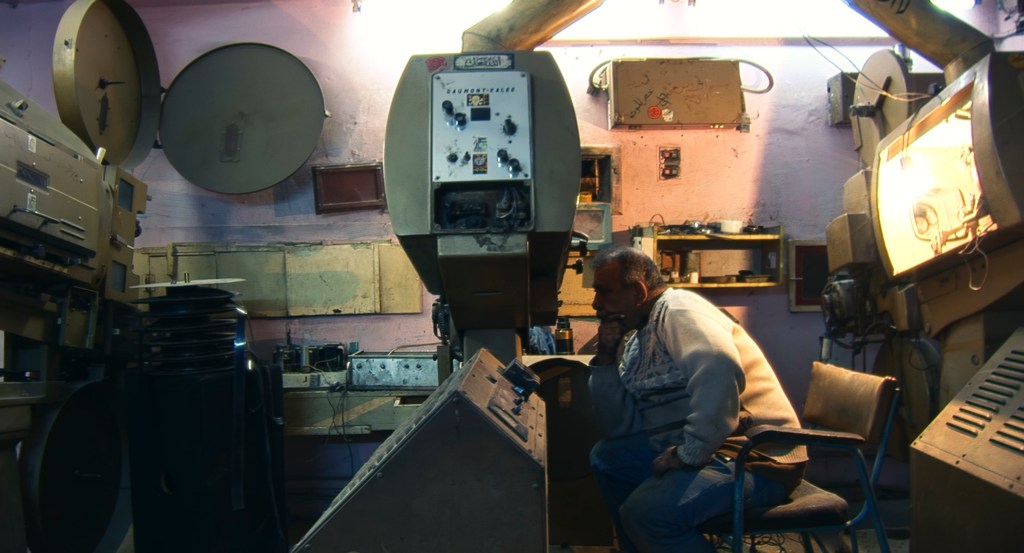
Before attending any screenings at this year’s IFFI – International Film Festival Innsbruck, I spent some time exploring the festival program. One film immediately stood out to me: Habibi Hussein (2025) by Alex Bakri. It is a documentary that follows Hussein, a longtime projectionist at the former Jenin Cinema in Palestine, while also reflecting on the significance of cinema and filmmaking itself.
The screening took place at Leokino Cinematograph, an independent cinema in Innsbruck that is part of a network of cultural spaces facing increasing pressure to survive. In Europe, we are still in a relatively fortunate situation: many independent cinemas can continue to exist because they receive public support and have audiences who value them. But what does this look like in other parts of the world, where there may be little or no cultural funding for independent spaces?
Places like independent cinemas are important because they create room for critical perspectives and for stories told from different points of view. They can help people understand other cultures, but also reflect on their own society. This question becomes even more urgent when thinking about Palestine, a place that has been shaped by long periods of conflict and instability. In such circumstances, what role can a cinema play? There are, of course, many needs that must be addressed before art and culture can seem like a priority. Yet through his film and our conversation, Alex Bakri offers insight into why cultural spaces still matter in Palestine and why preserving them remains important.
Habibi Hussein emerged from material connected to the Cinema Jenin reconstruction project, which aimed to renovate and reopen the historic cinema in Jenin, in the West Bank. Alex Bakri worked as a cinematographer on Marcus Vetter’s documentary Cinema Jenin (2008), documenting the restoration process and the people involved in it. Years later, Bakri returned to this material and edited his own film from it, focusing on Hussein as protagonist. It shows how, despite his 40 years of experience and deep connection to the cinema, Hussein was increasingly pushed to the margins of the project. Habibi Hussein presents the story from a different perspective and places the project in a new light. The film offers a counter-narrative that reflects on power imbalances and raises questions about the practices of Western aid projects.
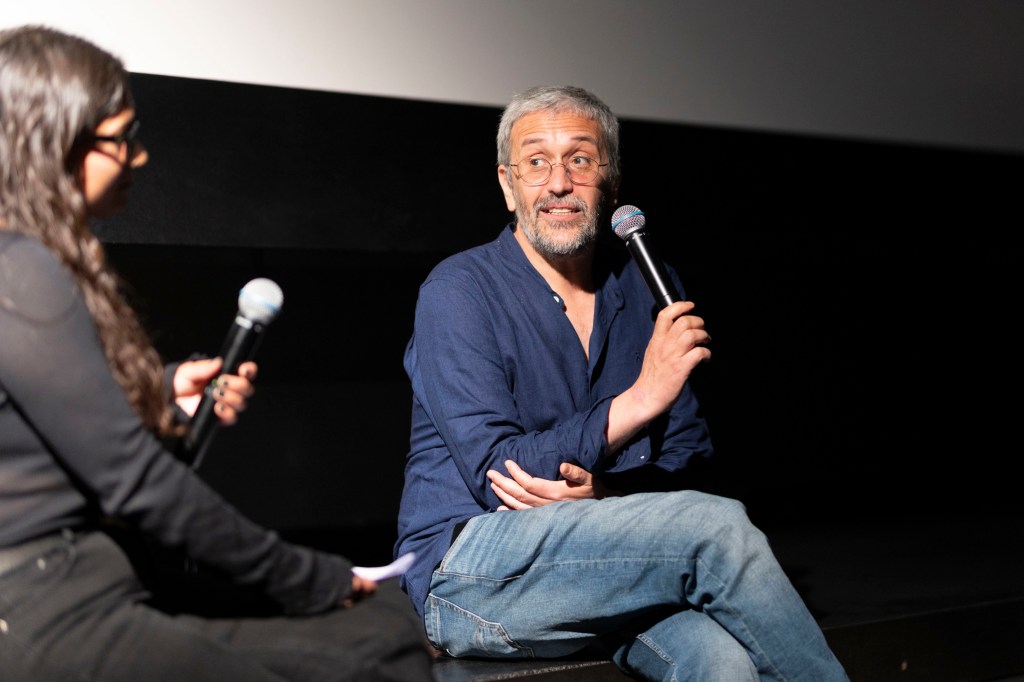
In the following interview, Alex Bakri speaks about the making of the film, the role of cinema in Palestine, the craft of film projection, and why spaces for storytelling remain essential.
Brigitte Egger: First, a biographical question: What brought you to the medium of film and filmmaking?
Alex Bakri: As a teenager, I lived in a small village in the Galilee. When I went to high school, I moved to Haifa, which is a much bigger city. I moved there in ninth grade because commuting by bus took about an hour and a half each way. My father found me a place to stay with a couple of other students from different villages. We lived together in a small apartment, and I received a weekly allowance.
The first time I arrived, a friend said, “Let’s go to the cinema.” We started watching films, and I completely fell in love with the experience. After that, I went to the cinema every day, spending almost all of my allowance on movie tickets. That was basically my high school life.
I became deeply passionate about film from a very young age, and I already knew back then that this was what I wanted to do. At first, I wanted to become an actor, but once I understood what filmmaking actually was, I realized that I didn’t want to act—I wanted to make films.
Was there a particular film you watched as a teenager that inspired you?
Alex Bakri: I remember one film in particular, even though I didn’t see it in the cinema — The Deer Hunter [Michael Cimino, 1978]. When I was younger, I mostly watched blockbuster films in theaters, but later I began exploring films at home and discovered a completely different world beyond Hollywood. At first, I wanted to become an actor after watching Robert De Niro’s performances in films like Raging Bull and Taxi Driver. Through him, I discovered American cinema of the 1970s, which eventually led me to the French New Wave, Italian Neorealism, and other movements. That journey is really how I became interested in cinema as a whole — it opened up an entirely different world for me.
You did both fiction and documentary. At the festival we watched your documentary film Habibi Hussein—do you mainly make documentaries now?
Alex Bakri: Actually, I always loved fiction. From the beginning, I wanted to make fiction films. Documentary came almost by accident.
At the same time, I started working a lot as an editor. That’s how I make a living, and as an editor I work on both fiction and documentary projects. Although I started making more documentaries, I think my fiction mentality still influences the way I look at documentaries and the way I edit them.
In the Q&A you mentioned that you were actually part of the NGO project. What’s the story behind that? How did you become involved?
Alex Bakri: I had worked before with Markus Wetter, the founder of this project. He’s also a filmmaker. I worked with him on his previous film, Heart of Jenin, which tells the story of a father who donated his son’s organs to Israeli children as a gesture of peace.
At first, I accompanied him to Jenin as a translator. Later, I started assisting with many other aspects of the production. After the film was finished, he discovered the old cinema in Jenin through one of the people featured in the film. He told me about his idea of creating a project there.
I thought it was a wonderful idea, especially the idea of reopening the cinema. That’s how I became involved. As the NGO gradually grew, my role became more focused. From the very beginning, I wasn’t deeply involved in the NGO’s organizational work because I had already started filming. My role was to document the entire process and make a film about it.
What kind of city is Jenin—did you already know the city before?
Alex Bakri: Everybody knows Jenin. It’s considered the capital of the Palestinian resistance, so it’s a very well-known city. It’s also very close to where I come from in the Galilee, in northern Israel/Palestine. People from our area often go there to shop or visit the market.
So yes, I knew the city, although I didn’t know it intimately.
What role did the cinema play historically for the city? How did it shape Jenin?
Alex Bakri: The cinema was located right in the heart of the city. It stood next to the main shuttle taxi station. The station is still known as the „Cinema Garage.“
Everything around it was named after the cinema: the Cinema Bakery, the Cinema Barbershop, and many other businesses. Even today, after the building has been demolished, people still use those names. That’s how central it was to the city.
The cinema opened in the late 1950s—I think in 1958—during the Jordanian period. At that time there was no television, no internet, and hardly any other form of entertainment. The cinema was the main social and cultural meeting place where everybody gathered.
Inside, there were different seating areas. There was a balcony, and in the front there were private booths. These booths were often reserved for families or for engaged couples who wanted some privacy. Sometimes the cinema was even used for community events—people occasionally held weddings there.
It really was the cultural and social center of the city.
Your film has the impression to be a critique of the NGO sector in general, not only of this particular project. Could you tell us a bit about that? At what point did your perspective on the project change?
Alex Bakri: It was a gradual process. My perspective didn’t suddenly change. I simply started noticing certain things over time.
I came to the project with good intentions myself. Even as a Palestinian, I thought, „This is a good project for the people.“ At the beginning, I didn’t question it. Looking back, I think the first mistake was that nobody really asked the local people what they actually wanted or how they imagined the project.
Many NGO projects begin with good intentions, but certain structural mistakes are built in from the start. Then it becomes like a snowball. It grows, funding structures take over, proposals have already been written, and suddenly you can’t go back anymore—although nobody asked the community in the first place.
For me, though, the film was never intended as a critique. I was originally filming for the project itself, making a documentary about the project. It was also the first documentary I had ever made, so I was still searching for my cinematic language.
How did your personal experience of the project influence your filmmaking process?
As I said, I come from fiction. I wanted to make something that was really about cinema—not simply a documentary about a building. I kept asking myself: What is the visual language? How should I film this? What is the film actually about? I wasn’t interested in making a film only about funding, renovation, painting walls, or the bureaucratic obstacles. That didn’t feel very cinematic to me.
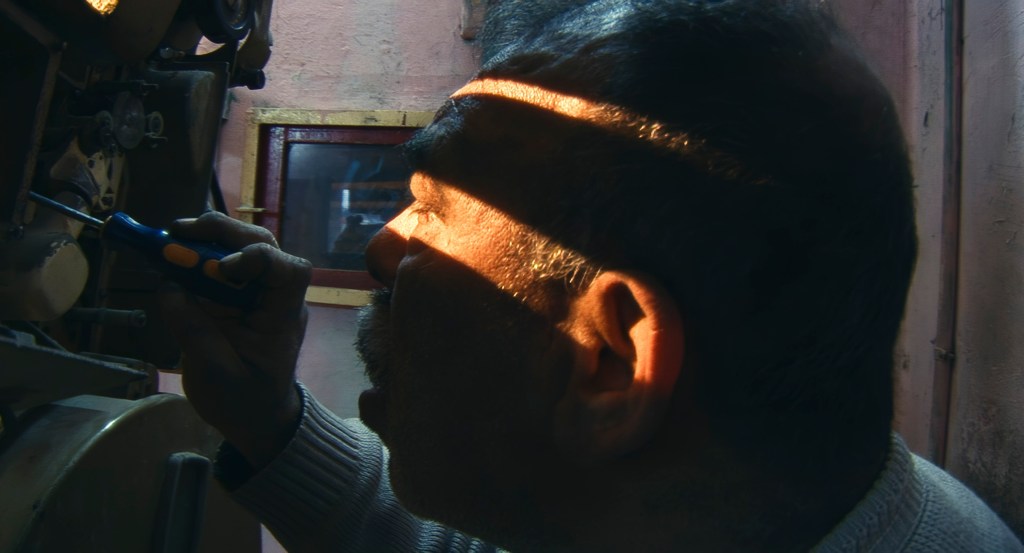
Then Hussein appeared. He created that beam of light with the projector, and in that moment everything became clear. The projectionist was the obvious way to tell the story.
When I met Hussein, I immediately felt that he was an extraordinary character. I started following him because my original idea was actually to make a film about him. I imagined a story in which an NGO comes to town, starts this project, and the old projectionist returns to the work he loves.
As a filmmaker, you wear two hats. On one hand, you hope everything will work out because you want people to benefit from the project. On the other hand, documentary filmmakers are always drawn to conflict. I didn’t really know that at the time.
Following Hussein, things simply happened in front of the camera. I wasn’t searching for problems—they unfolded naturally. My goal while filming was simply to stay as truthful as possible to whatever happened in the moment.
It’s fascinating how the same material can result in two completely different films and perspectives. This demonstrates how strongly documentaries are shaped through editing. How did your approach to filming and editing influence what ended up in the film?
Of course, the first thing you do as a filmmaker is frame the image. Whatever you frame becomes the center of your story. You can never show everything. But my understanding of documentary at that time was simply to capture reality as it happened.
I didn’t even know that people sometimes recreate scenes or ask someone to repeat an action if they missed the shot. When I first saw filmmakers doing that, I thought, „Why are you asking them to do it again? Then they’re acting.“ So I tried to capture everything exactly as it happened.
I also tried to think ahead while filming, imagining what I might need later in the edit. That’s why some scenes in the film remain uncut for a long time. I wanted to stay with the moment as much as possible.
When the first version of the film was finished, Hussein only had a very small role because I wasn’t involved in the editing process of that version. That was the moment I realized that this wasn’t my story. It wasn’t the story I had experienced, and it was told from a completely different perspective.

What made you recognize Husseins importance for the film? Why did you see potential in telling the story focusing on him?
Alex Bakri: From the moment I saw him bringing the old projector back to life by putting the carbon rods together and creating that beam of light, I knew there was something magical about him. That was the moment I decided to follow him and see where his story would lead.
As a filmmaker, I was simply looking for a character through whom I could tell the story.
When I continued following Hussein, I began asking myself why he wasn’t getting his job back. Maybe his technical expertise no longer matched the new equipment or the contemporary standards. But for me, that wasn’t the point. The project was supposed to serve the local community, and Hussein was the local community.
He didn’t have to meet European standards. He only had to fit the needs of his own community, because that was supposedly what the project was for. He had managed the cinema in the past—why shouldn’t he be able to manage it again?
That was the moment I started asking myself: if this project isn’t for Hussein, then who is it actually for?
Despite the criticism, do you think the project also had positive effects?
Alex Bakri: Absolutely. I remember that period very well. For almost two years there was an incredible energy in the city. It created hope. People came together, local residents volunteered, and many friendships were formed that still exist today. Some people have remained in contact for years.
NGOs in Palestine are a complicated subject. It’s really a minefield.
On the one hand, they’re absolutely necessary because many public institutions simply don’t exist or cannot provide essential services. NGOs fill that vacuum. On the other hand, they often fill it from the outside, and that’s where certain problems begin.
So yes, many NGOs are genuinely needed in Palestine.
At the end of the film we see that the cinema no longer exists because it was demolished to make way for a shopping mall. Since so many years passed while you were editing this second version, was the demolition one of the reasons why you decided to finally release the film?
Alex Bakri: People often ask me why I released the film now. The truth is that I actually tried to finish it ten years ago—long before the cinema was demolished.
The first obstacle was funding. Whenever I approached funding bodies, they told me, „There was already a film about this project a few years ago. Why should there be another one?“ Since people already knew the story, it was difficult to convince them that another perspective was necessary.
Without funding, I couldn’t hire an editor. At that time I also didn’t know how to edit myself, so I had to teach myself editing.
That became a long learning process. I had to learn how to edit, then become an editor in order to edit my own film. At the same time, I also had to become the scriptwriter and, in many ways, direct the film again during editing.
When you’re both director and editor, you’re constantly arguing with yourself. I had also shot all the material, so I knew exactly what had happened during filming. Normally an editor has the advantage of distance. They only see the footage in front of them; they don’t carry all the memories of what happened on set. As an editor myself, I know how valuable that distance usually is. Editors often ground directors because directors sometimes remember things that aren’t actually visible in the footage.
I didn’t have that distance. I had to negotiate with myself constantly, and that made the process incredibly difficult.
Fortunately, friends and fellow filmmakers helped me from time to time by watching the material and offering fresh perspectives. But most of the time I sat alone in the editing room. At the same time, life continues. You have to pay your rent, so you work other jobs. Whenever I had a free weekend or a little bit of time, I opened the project and continued working. Progress was slow.
Then the COVID pandemic arrived. Everything shut down, and strangely enough, that gave me the opportunity to finally concentrate on the film. In that sense, it also had one positive aspect.
Hussein passed away before the film was completed. Did he at least have the chance to see parts of it?
Alex Bakri: Yes, he saw parts of it.
The first section of the film had already been edited many years earlier. His journey to find the carbon rods and bring the old projectors back to life—that material already existed, and he watched those scenes. He often asked me how the film was progressing and when it would finally be finished. Whenever I completed a scene, I sometimes invited him to watch it, so he was able to see parts of the film during the editing process.He was really looking forward to seeing it.
Was the film ever screened in Jenin, perhaps in another cinema or venue?
Alex Bakri: Not yet. I’m planning to go there now. I want to travel there this summer. I’ve been in touch with Hussein’s family. I originally wanted to visit earlier this year, but I couldn’t. First the war started, and after that something always happened that delayed my trip. At one point I thought about simply sending them a link to the film, but they told me, „No, come. We want to watch it together with you.“
So now I really want to go this summer and organize a screening in the city. There is still the Freedom Theatre, and hopefully we can show it there properly—not just on a laptop.
Cinema and art are often described as a luxury. What role do you think cinema can still play—especially also in the context of Palestine?
Alex Bakri: In Palestine—at least in the West Bank, because Gaza is obviously a completely different situation after everything that has happened—there are very few cinemas left. There is one cinema in Ramallah, and another one that was opened in Nablus during the period of this project. The cinema in Nablus is mainly commercial, showing Hollywood films. The cinema in Ramallah is more of an arthouse cinema that also screens Palestinian and Arab films.
One of the biggest problems is that Palestinian films often find their audiences in Europe rather than in Palestine. There are simply very few places where you can screen films for the very people the films are about. As a result, many Palestinians are actually less familiar with Palestinian cinema than they are with Egyptian cinema, simply because Egyptian films are much more accessible.
That’s a strange situation. Having cinemas is important because they connect people to the culture that is being created within their own society.
So, cinema also has an important political function?
Alex Bakri: Exactly. It is also essential for the development of Palestinian cinema itself. Right now, much of the dialogue between Palestinian filmmakers happens outside Palestine rather than with Palestinian audiences. Things are improving. There are more filmmakers today, and there are more audiences than before, but it’s still not enough.
If you look at countries like Germany or Austria, people know their filmmakers, actors and films. There are festivals, theatrical releases, and a public conversation around cinema. It becomes part of the country’s cultural identity, almost like a national football team.
In Palestine, there is still a gap between filmmakers and audiences. Closing that gap is extremely important.
Do you also see your film in relation to the current political situation between Israel and Palestine?
Alex Bakri: Everything is connected to it. I always say that even if a Palestinian filmmaker makes a film that seems completely unrelated to politics—even if it’s simply about your grandmother—it is still political. Our entire existence in this place is political. Every aspect of daily Palestinian life is shaped by the occupation and by external political forces. Whatever Palestinians do is influenced by that reality. You simply cannot escape it.
Even in this film, the occupation is only mentioned directly in one scene, when Hussein tries to obtain a permit to enter Israel. Apart from that, the occupation mostly remains in the background. But in reality, the entire premise of the film depends on it. The reason this project existed in the first place is because of the occupation.
Why is foreign aid necessary? Because there is no fully functioning sovereign state that can provide these services. The Palestinian Authority exists, but in many ways it functions as an administrative contractor under the conditions of the occupation. It cannot provide enough services on its own. That is why international aid becomes necessary. The problem is that aid often addresses the consequences of the occupation rather than the occupation itself. It treats the symptoms but not the root cause.
For many Western governments, aid becomes a way of feeling that they are helping. But there are other ways to support Palestinians—for example, by placing sanctions on Israel or by refusing to sustain the occupation through arms deals and other forms of political and economic cooperation. Aid creates a situation in which governments can maintain good political and economic relations with the occupying power while also easing their conscience by supporting the people living under occupation.
I’m also curious about your current projects. What topics are you interested in at the moment? Are you working on a new documentary?
Alex Bakri: At the moment I’m mainly working again as an editor on other people’s projects. At the same time, I’ve started writing here and there, but this time I want to return to what originally made me fall in love with cinema: fiction.
I have several ideas, and I’ve started working on all of them, but eventually I’ll have to choose one and fully commit to it. Wherever you live, there are always certain subjects you want to talk about. At the same time, I don’t want to get stuck in one category. Very often I’m introduced as a Palestinian filmmaker. That adjective is always placed in front of my profession.
For me, I’m first of all a filmmaker. Yes, I’m Palestinian, but I don’t want that to become my entire definition. Of course, some of my films deal with subjects connected to my identity, but I also want the freedom to make films that are not directly about that.
Naturally, your identity and your experiences shape the stories you tell, but they don’t always have to be addressed explicitly.
I often ask myself this question in the context of journalism as well: What effect does labeling people through identities or nationalities actually produce? To what extent is that kind of labeling necessary—can we ever escape it?
Alex Bakri: I think it’s often done to provide context. For example, if you watch something on YouTube and it says it’s produced by Al Jazeera, which is funded by Qatar, you immediately start interpreting what you’re watching through that information. You think, „Okay, if it’s funded by Qatar, there may be certain interests behind it.“ It’s a way of contextualizing what you’re reading or seeing.
The same applies to journalists. Someone may be described as an Austrian journalist, but perhaps they only have an Austrian passport and actually grew up somewhere else. Identity is always more complex. At the same time, these labels create pressure. After a while, you start behaving the way you think other people expect you to behave.
As a Palestinian filmmaker, people may expect me to make films about checkpoints or the occupation. But I don’t have to. I could just as well make a love story set somewhere in Europe. I’m a filmmaker—I should be able to make whatever film I want.
That’s something I’m constantly trying to figure out for myself. I ask myself: What really speaks to me? Of course, themes like displacement, estrangement, or living away from your hometown naturally appear in my work because they’re part of my own life. But I don’t want to be put into a box that defines what I’m supposedly allowed or not allowed to make.
Looking back at your film, were there any audience reactions that were especially meaningful to you?
Alex Bakri: Yes, there were several. One particularly memorable moment happened during a screening in Istanbul. A young Palestinian woman from Jerusalem was in the audience. She’s in her early twenties, so she never experienced the old cinema in Jenin herself.
During the Q&A she told me that she often visited Jenin with her family and always went to the shopping mall that now stands where the cinema used to be. The mall is still called the Cinema Mall. She said, „I never understood why everything around here is called ‚cinema‘ when there isn’t one.“ Watching the film was the first time she understood what had once existed there and what had happened to it. She also told me that she had always felt a strange emotion whenever she visited the mall, but she had never been able to explain it. The film gave her that missing context.
Another response that meant a great deal to me concerned Hussein himself: One of the biggest challenges while making the film was doing justice to his character. I immediately recognized something special about him, but in filmmaking that isn’t enough. Just because you see something while filming doesn’t automatically mean the audience will see it too.
Often, during editing, you have to completely restructure the material in order to reveal what first moved you about a person. I sometimes think that editing is, in a way, „lying in order to arrive at the truth.“ My goal was to portray Hussein as I had experienced him and to give him the recognition I felt he deserved.
The most meaningful reaction for me has been seeing how audiences respond to him. People genuinely love him as a character and as a person. They see him with the same warmth and affection that I felt while filming him. That means more to me than anything else.
It’s a pity that Hussein never got to see the finished film. I’ve seen documentaries in which the main protagonists come from worlds completely unrelated to cinema, and then suddenly they find themselves travelling to international film festivals, being on stage, meeting international audiences… It can completely change their lives. I imagine that would have meant a lot to Hussein as well.
Alex Bakri: Yes. I really wish he could have been with me at the festivals and experienced the audience’s reactions. That would have been the greatest recognition he could have received. It’s a real shame that Hussein never had that experience.
Sometimes I think about it differently, though. Throughout his whole life he stood behind the projector, creating the light and projecting films for others. After his death, it’s almost as if he himself passed through the projector beam. Now he is the one appearing on the screen. There’s something deeply moving about that. In a way, he has transcended into the image itself. Now someone else projects him.
In Innsbruck I also met the projectionist, Dietmar. His son works with him, and together they still project 35mm films. I asked him whether they still had the equipment, and he said, „If you want, come tomorrow morning and I’ll screen a film for you.“ So I came back the next day. He projected a film, and I filmed him a little while he was working. It immediately brought me back to Hussein. That’s what makes this character so universal. You find people like him everywhere.
Projection was a craft. With digital cinema, that craft is slowly disappearing. I think it’s important to preserve it because it combines immense technical knowledge with physical labour. Film is also something deeply tactile. Losing that physical relationship to film stock means losing a certain sensual dimension of cinema.
Projectionists don’t just create an audiovisual experience—they contribute something through touch, craftsmanship and material knowledge.
I could really sense that while watching the film. Some of the most impressive scenes are the ones where very little happens on the surface. You spend time observing the technical details, often in long takes, and that really communicates this idea.
Alex Bakri: Exactly. When I looked at Hussein’s hands, they almost felt like an extension of the machine itself. There was something incredibly intimate in the relationship between him and this piece of iron. Although it’s simply an object, it became a source of intimacy. That’s why I was so interested in filming all those small details.
What will be the next step regarding the distribution of Habibi Hussein?
Alex Bakri: Screening the film throughout Palestine. My producer runs a mobile cinema project that travels from one place to another. We had the idea of visiting old cinema buildings across Palestine—even those that are no longer functioning—and screening the film there. That way, we could reach the audiences the film was originally made for.
Earlier, we talked about the lack of cinemas. As filmmakers, we also have to ask ourselves how we can reach audiences despite that reality. Travelling from one former cinema to another with the film somehow fits its subject perfectly. I think it would be a meaningful project.
There are still cities where old cinema buildings remain standing. In Nablus, for example, the old cinema is still there—it’s even bigger than the one in Jenin. I find the idea of opening those spaces again, even temporarily, very exciting: simply cleaning away the dust and bringing people back inside. It could also remind people of the cultural value of these places and encourage them to preserve them.
Maybe it would also remind people of the cultural value of these places and encourage them to preserve them.
Alex Bakri: Exactly. And it would also reopen a conversation about cinema itself and reconnect people with this medium in the places where they live.
| Brigitte Egger

