
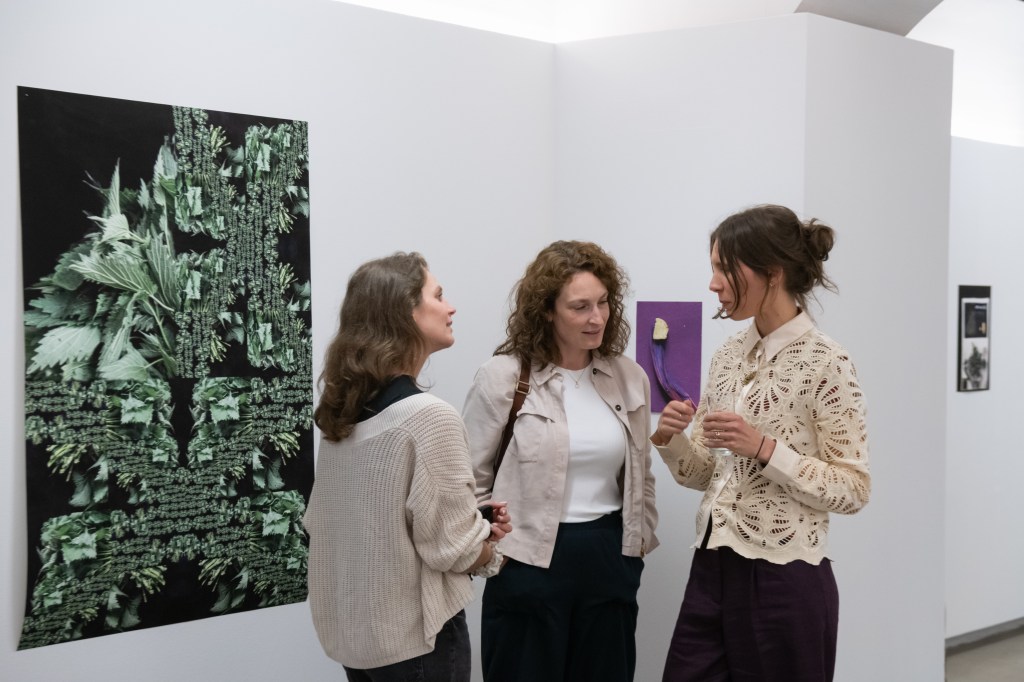
Stephanie Stern is a fine artist working mostly with photography and drawing. Her latest exhibition, Under Pressure. ΔS — Orders of Glass, curated by Bettina Siegele at the Neue Galerie in Innsbruck, is running until 8. August 2026. The exhibition marks a major milestone for her, blending her signature photography with original drawings and high-tech photolithography.
The artistic approach is rooted heavily in the process of material translation. These mirrored surfaces dynamically shift their colours based on the viewer’s movement within the gallery, demanding an unmediated bodily and sensory experience before intellectual analysis can occur. It is a dense, rhythmic experience that challenges how we look at the ordinary objects around us and, more importantly, how we look at our screens. Meeting her in her studio in Vienna, she shares more about her artistic approach to everyday objects, photography as a non-fixed truth and the role that artists play in society.
The Genesis of a Bouquet: Disrupting Still Life
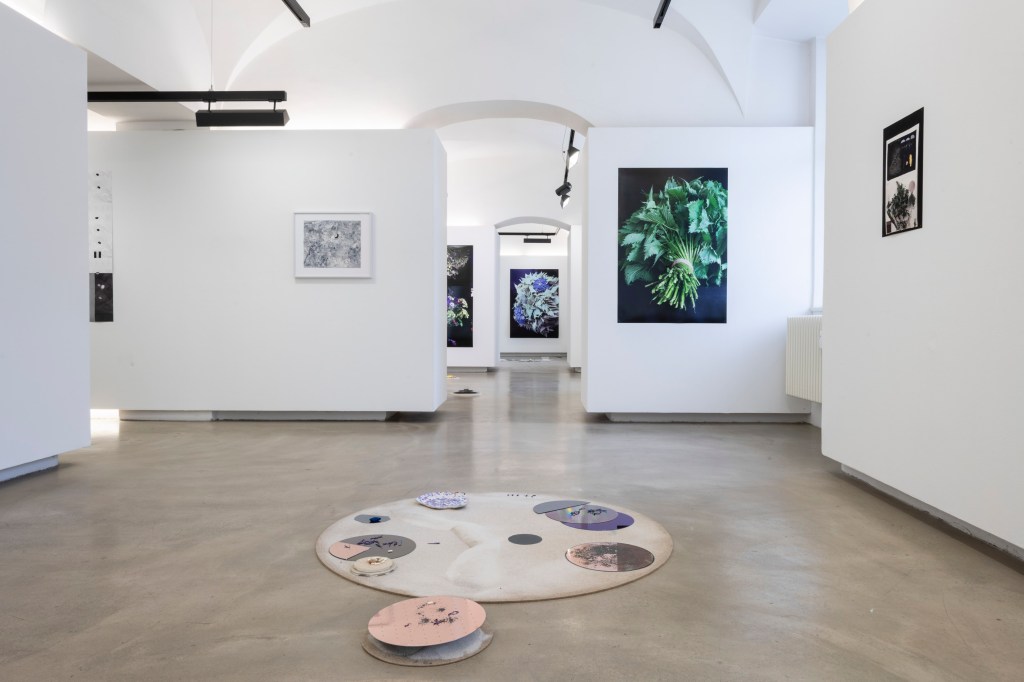
For Stern, the road to Under Pressure began not with a conceptual framework, but with an intuitive sensory flash. She was struck by a vision of specific colours, which she immediately sought to anchor within the classical tradition of still life. Her entry point was a common, yet entirely unfamiliar botanical choice: the stinging nettle.
„Still life itself was always a genre which was considered not important, but for me, it’s a cultural approach to how we order things. How we set a table, how we pour water, how we make a bouquet. In those little everyday actions, we reveal our entire relationship to the material world.“
Seeking out a local florist in Hitzing, Stern commissioned a bouquet composed entirely of nettles – a proposition that was met with excitement. This unconventional arrangement became the foundation for a fluid, evolving studio process. After documenting the initial bundle, Stern systematically deconstructed and rearranged the nettles alongside various other flora, tracking the shifting visual landscape of the composition.
„A flower has something invisible, something safe about it. People have an emotional approach to flowers. Making a bundle of them is a ritual that spans across human cultures. But when you look closer at what I’ve done, it reveals something more complex. Image-making for me isn’t rational. I suddenly get an image of a nettle bouquet in my head; I follow it, and when the final image looks back at me, I’m often surprised. It reveals how you look at the world – and that isn’t always comfortable.“
By leaving the interpretation open-ended, she ensures that the exhibition functions as a tapestry of distinct narrative entry points, depending entirely on what the viewer brings to the room.
Raya Sotirova: How would you describe your artistic approach?
Stephanie Stern: I see my artistic practice as an ongoing process of inquiry and discovery, allowing the work to emerge through making. Therefore, I take a direct approach to image-making by engaging with the technological processes involved. In particular, I’m interested in how alternative visual languages emerge when digital photographic images are translated into other media — most recently photolithography, as used in semiconductor fabrication. Every technique has its own logic and its own way of organising information; by translating images between these systems, I try to reveal the design decisions and forms of thinking embedded within the technologies themselves.
This interest in how systems order and organise carries over into my work with digital and analogue photography, particularly still life. The genre makes visible what is usually overlooked: the relationships between materials, culture, class, time and the act of looking — how human culture itself is shaped by acts of ordering, classification and display, and how this speaks to intercultural exchange and the material foundations of everyday life.
Drawing, by contrast, is a more internal, process-oriented practice for me. Rather than working towards a preconceived motif or composition, I let the movement of my hand guide me — resisting any single, fixed point of view. While some drawings are created spontaneously and quickly, the most recent pieces in the exhibition took several weeks to develop.
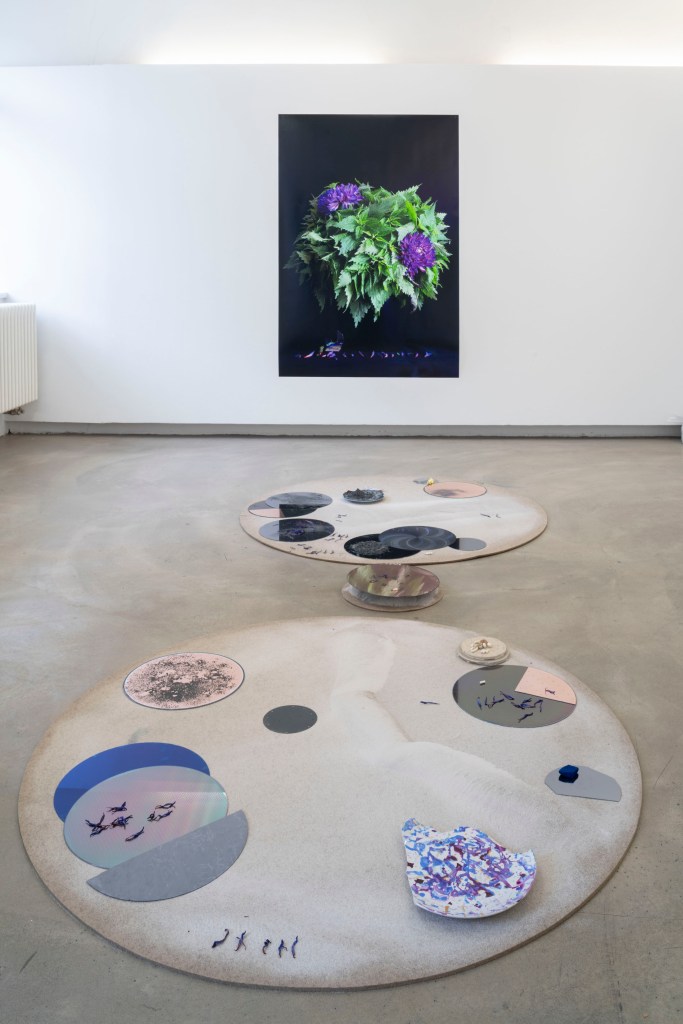
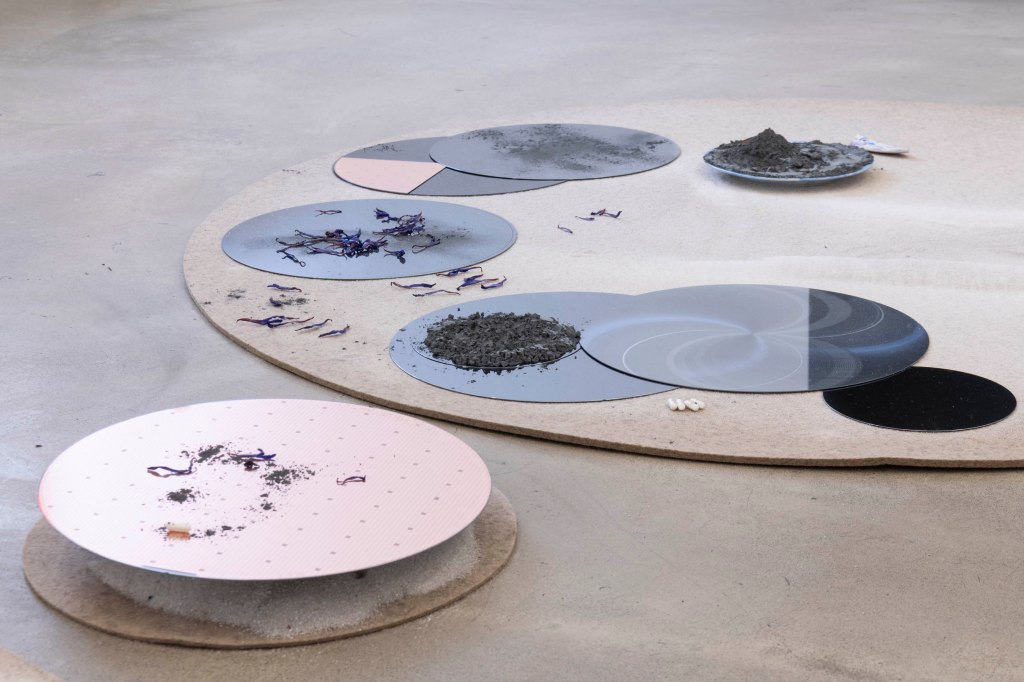
The assemblage is different again. I understand it as a collaborative space in which I bring together works by different artists, as well as materials, objects, colours and found elements, allowing them to enter into dialogue with one another. In this exhibition, the assemblage includes materials from the photolithographic process itself: blank and patterned silicon wafers, and molybdenum. It’s a material widely used in semiconductor manufacturing — and, notably, also found in trace amounts in the human body, animals and plants.
What does a typical day in your studio look like?
Although there isn’t really a typical day for me, drawing is the one constant. I draw almost every day, wherever I am. It’s the most direct part of my work.
I also spend a lot of time observing, gathering and arranging materials — everyday objects, food, plants, industrial materials — into still lifes. Often I photograph these compositions repeatedly as they slowly change, decay or shift over time. Alongside that, I test materials and translate images between media, such as from photography into photolithography, following a process of digitising and rematerialising — playing with scale and different papers and materials along the way.
Many of your works seem to function like visual languages. What interests you about systems of communication?
Many of our image and communication systems share surprising origins. The Jacquard loom, for example, introduced programmable pattern-making using punched cards — a concept that would later become fundamental to early computing. I’m interested in how different technologies encode, organise and translate information, and much of my work involves moving between these systems: what survives, what gets lost, and what transforms into something entirely new. I’m also drawn to experimenting with these techniques, and to intervening directly in the design process itself, rather than staying purely observational.
What can photography do that language cannot?
Working with photography forces me to look outward, toward the world and the conditions of seeing and recording — while language unfolds sequentially, the photographic image is present all at once. Every photograph reveals a position: what is included, what is excluded, where the camera stands. Through shifts in scale, framing and mirroring, it can unsettle habitual ways of seeing and reveal relationships that are difficult to put into words.
How do you think meaning is produced in an artwork?
I don’t believe meaning can simply be imposed on a work of art — it’s relational, discovered through an encounter with looking, listening and reading, rather than fixed in advance. I can carefully compose the materials, the process and the formal structure of a work, but I can’t determine how it will be read. In the assemblage, for instance, the same arrangement of silicon wafers and found objects will be read completely differently depending on what a viewer brings with them — their own memories, references and ways of seeing. For me, meaning unfolds through that relationship rather than existing as something fixed in advance.
Your work often passes through multiple stages of digitisation and transformation. Why is that process important?
In my work, the image rarely passes through just one translation — it often cycles through several rounds of digitisation and rematerialisation. Having a fine art printer in my studio, for instance, gives me a lot of room to experiment with the photographic image directly — in size, colour and different papers. Each conversion loses, compresses or distorts information, but something new is gained too. What interests me most is what actually survives these repeated transfers.
How has digital technology and AI changed the way you think about images and authorship?
Digital technology hasn’t made me distrust images — if anything, it has sharpened a scepticism I already had, by making clearer what they actually are. A smartphone photograph is not a neutral record but a highly processed computational image shaped by sensors, algorithms, software, and countless technical decisions. Working closely with digital imaging techniques constantly reminds me of that. AI hasn’t fundamentally changed this understanding — it has simply made these processes more visible. But it has changed how I think about authorship — authorship that is now distributed across tools, materials, algorithms, technological systems and companies. That’s why it is important for me to engage directly with the technologies themselves — not simply to use them, but to understand how they shape the images they produce and the ways we engage with them.
Are you interested in creating order or disrupting it?
I’m interested in both. Creating order, and how that order relates to disorder. Quartz sand already has its own order, its own crystal structure. To get to the silicon wafer, that structure has to be broken down—melted—before a new order can emerge: pure silicon, its atoms arranged in an almost perfect crystal lattice. That’s actually the idea behind ΔS, the title of my show in Innsbruck: ΔS is the symbol for the change in entropy, so the title isn’t about order or disorder as fixed states—it’s about the transition between them. Order and disorder aren’t opposites; they’re coupled and connected.
Much of your work explores the boundary between image and reality. Why does that question matter today?
We are constantly surrounded by images, especially on social media, many of which show an idealised version of the world. It seems that we increasingly shape our bodies, homes, art and travels to match these dominant standards. But what are these standards based on, and against what — or whom — are we measuring ourselves? I’ve noticed that many people now either no longer trust images or respond with indifference. This troubles me.
Perhaps we never simply believed what we saw; perhaps we always partly saw what we believed. There’s a book I keep coming back to: David Levi Strauss’s Photography and Belief, which addresses this question.
For me, a photograph reveals my own highly subjective perspective, influenced by my background, privileges, position, ability to travel and what I choose to include or exclude. This is why the question matters to me — not only whether something is true or false, but whose reality these images construct and whose remains invisible.
Is the camera more of a witness, a translator, or a collaborator?
I think it sits right between a translator and a collaborator. I understand a photograph as a process of translation and selection. Light reflects in all directions at every moment, and choosing a specific angle means translating one exact path of light through the camera’s own grammar.
But it’s not only translation — the camera also collaborates. The lens distorts, the sensor decides what light it can even register, the depth of field cuts things away that my eye would have kept. So the final image is not just my choice of angle — it’s a negotiation between what I want to see and what the camera’s own technical nature allows me to see.
You often focus on texture and material surfaces. What can materials communicate that words cannot?
Materials communicate through direct physical experience. Whether I am looking at a highly engineered silicon wafer or a raw material such as sulphur or molybdenum, their surfaces respond differently to light and movement. Even before I begin to think about them, my body has already responded to their scale, texture, and presence.
At the same time, materials carry histories that words often cannot fully convey. They embody geological time, technological development, labour, and cultural values. Silicon is not just a material; it is part of a global technological infrastructure. I am interested in how materials communicate through their physical properties, but also through the systems, histories, and forms of knowledge embedded within them.
What do you hope viewers feel before they begin analysing your work intellectually?
I hope people have an experience first, before reaching for an explanation — the shift of colour on a wafer as you move past it, the weight or texture of a material, before any of that becomes a concept. I’d love visitors to come without too many expectations, open to looking rather than immediately interpreting. If the work can slow down our habitual way of seeing and make us pay attention to what usually remains overlooked, then interpretation can come afterwards. It doesn’t have to happen immediately.
What is the most surprising interpretation someone has offered about your work?
During my first solo exhibition, Wine and Hot Water at the Gabriele Senn Gallery, I exhibited a series of deep blue photographs showing miniature toy animals. I had thought a lot about their psychological presence, and expected viewers to focus on the relationships between the figures. However, almost nobody mentioned the animals. Instead, people spoke almost exclusively about the colour blue itself — the atmosphere it created, the sense of depth it gave and the way the matt glass absorbed the light — and many described the work as dark or melancholic. The colour, light and material qualities of the photographs had a much stronger impact on people’s experience than I had anticipated.
In retrospect, I believe these interpretations also reflected the context in which the exhibition took place. It took place during the pandemic, when many people were experiencing isolation, uncertainty, and fear. However, in recent years, I’ve noticed that viewers increasingly describe the same works as calm, beautiful or deeply moving, and many also point to their surreal quality. The works themselves haven’t changed, but the context in which they are viewed has.
This has reminded me that artworks are never experienced in isolation. We always bring our current situation, emotions and expectations to them.
Were there any pivotal moments that changed the direction of your career?
One major turning point was moving away from a purely conceptual mindset. During my studies in Vienna, which I completed in 2018, I believed that art had to be rigidly conceptual to be taken seriously — and for a long time, I struggled with that idea of what art should be. Over time, I gradually distanced myself from it. Embracing drawing as a daily practice, and allowing the material itself to inform my thinking rather than a fixed concept, completely transformed my work.
Another important shift came during a residency in southern France, where I met the artist Rozafa Elshan. Through our collaboration and conversations there, my sense of material and form became more sensitised, and it later grew into collaborative assemblages. We were also part of a mentoring programme focused on photography together, where I developed a much deeper understanding of the camera and photographic practice. At the same time, I received a great deal of encouragement to take seriously the drawings I was making then — drawings closely connected to handwriting and asemic writing, which I had never quite trusted as „real“ work before. Deciding to take them seriously was one of the most crucial shifts in my practice.
More recently, travelling to Yogyakarta, Indonesia, and Kyrgyzstan to meet artists there has had a profound impact on me. Many of the artists I met work with a strong focus on eco art, communal practice, and a different relationship to material — shaped by an artistic practice embedded in society in a way that felt quite different from what I was used to. Seeing that challenged many of my own assumptions about what an artistic practice can look like, and about who it’s made for and with.
Which artists have had the greatest impact on your thinking?
That’s a difficult question because there have been many influences over the years. If I had to name a few, Agnes Martin, Vera Molnár and Hanne Darboven have probably had a great impact on my thinking. Although their work is very different, all three can be placed within systems or serial art — they developed visual systems from simple, repeated elements: a grid, a line, a number — and explored the possibilities within those self-imposed structures. That resonates strongly with my own practice: I’m interested in developing, exploring and manipulating systems, and their possibilities through repetition, variation and subtle shifts, rather than constantly adding more.
Another ongoing source of influence is the still life tradition itself, particularly the women involved in it — in the Netherlands, but I look for this elsewhere too. Their often overlooked contributions shape how I think about my own still life work. I’m also drawn to Art Brut, for the independence of artists who trusted their own way of seeing outside institutional frameworks. Further, writers and scientists have influenced me just as profoundly. Working with photolithography at the moment, I’ve found myself reading more deeply into information theory again, and it continues to shape how I think about translation between systems.
Beyond these, there are countless other influences — close artist friends and physicists — whose conversations and work continue to shape how I think, even if I can’t name them all here. Together, these influences have shaped the way I approach my own work: moving between visual art, literature, science and technology, while always remaining grounded in materials and the process of making.
Do artists have a responsibility to society?
In a way, yes. I also see it as a form of resistance and resilience. Art provides an alternative way of engaging with the world and offers a space in which to slow down and process our experiences through colour, form, rhythm and materials. This provides temporary relief from the constant demands of language, images and visual standards. However, this space is never truly outside of these systems, which is precisely why I believe artists have a responsibility to understand their position.
While I don’t believe an artwork has to be explicitly political, I do think it’s important to be aware of your position. We all work within political, economic and technological systems — from social media platforms to our mobile phones and the software we use. To me, being aware of how the tools you use to create shape what you make, and of the visual standards you reproduce, is part of that responsibility.
What conversations in contemporary art excite you right now?
Ongoing conversations about critiques of technology have shaped a lot of my thinking — particularly how technologies are designed, and the assumptions and priorities built into the tools we use every day. Cultural change interests me too: which technologies we choose to adopt and which we resist, and how these choices gradually reshape everyday life. In recent years, the discussion around new materialism has also drawn me in, particularly the idea of engaging with materials rather than treating them as passive matter. My own work often begins with a particular material — such as flowers, silicon or photographs — and considers how materials, tools and processes can actively shape images and meaning. This is also why I’m drawn to the renewed focus on craft and collaborative forms of creation — practices that convey knowledge across cultures and generations through hands-on work and the materials themselves, rather than through language alone.
Surrealism is something I keep coming back to — not as a historical style, but as a way of thinking that feels highly relevant today. Its history as a transnational movement rooted in resistance to the nationalist and authoritarian currents of its time, challenging fixed and singular ideas of progress and modernity, feels especially relevant right now. In an era where AI is increasingly blurring the boundaries between reality, fiction and imagination, many of these issues feel strikingly important.
What advice would you give emerging artists navigating today’s art world?
Don’t worry too much about trying to fit into a specific commercial identity or market expectation. Instead, try to find your own references and context — get in contact with artists and thinkers you’re genuinely interested in, and be encouraged to step outside your comfort zone, even just moving between neighbourhoods, cities or scenes. Keep an open mind about different ways of making art; it can change how you think about your own practice fundamentally.
I’m constantly surprised by how diverse the art world actually is — even within a single city like Vienna, you’ll find different art scenes, each with its own vocabulary, values and ideas about what art can be. I wonder if there’s no shared understanding, right now, of what art should be or what the role of the artist is. That has its upside — you don’t have to force yourself into one version of it — but it also means artists across these scenes don’t always support each other, or even talk to one another.
What concerns you about the future of visual culture?
I am concerned that we are losing our ability to look at the overlooked. Increasingly, we travel, consume and photograph to reproduce a handful of standardised, pre-programmed views — the same filters, the same angles, the same recognisable spots that everyone else has already photographed. And yet, at the same time, we trust these images less and less. We let ourselves be guided by them while quietly no longer believing in them.
What advice would you give young artists trying to develop their own voice and style?
Don’t worry too much about trying to fit into a specific commercial identity or market expectation. Instead, try to find your own references and context — get in contact with artists and thinkers you’re genuinely interested in, and be encouraged to step outside your comfort zone, even just moving between neighbourhoods, cities or scenes. Keep an open mind about different ways of making art; it can change how you think about your own practice fundamentally.
Even within a single city like Vienna, you’ll find quite different art scenes, each with its own ideas about what art should or can be. It doesn’t feel like there’s just one single „art world.“
Instead of being empty and minimalist, the room feels full and alive, mirroring the complex mix of technology and environmental clutter in our modern world. Ultimately, Under Pressure. ΔS — Orders of Glass doesn’t force a single lesson onto the audience. It creates a space with many different stories, where the camera acts as a partner and technology is unmasked to show the real, physical materials hidden behind our flat screens. Stephanie Stern explores what happens when ordinary objects, language, and digital technologies collide, creating works that challenge how we perceive reality itself.
| Raya Sotirova

