
There is an ongoing joke among cinephiles that to be a „true“ movie lover, you must obsess over obscure, micro-budget gems and declare them your absolute favourites. If you wear that badge with pride, the Pillusion Film Festival is your spiritual home. Held from August 26-29, 2026, in Pill, a breathtaking village in the Tyrolean Alps, Austria, the festival celebrated its 5th annual edition.
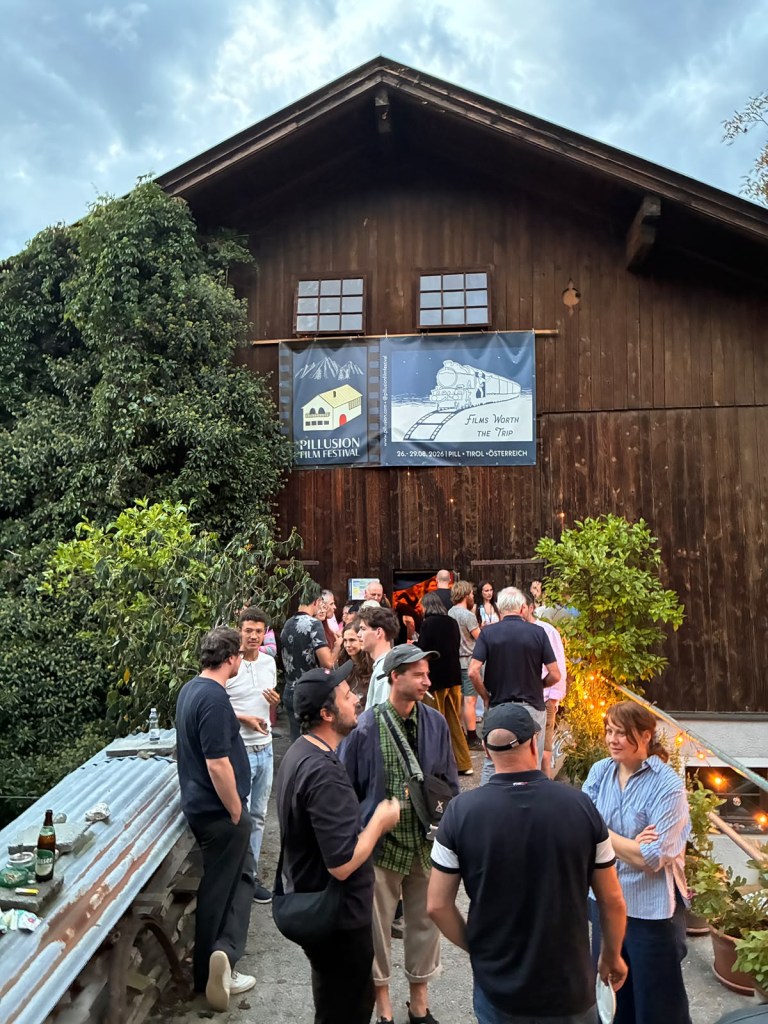
Founded by husband-and-wife filmmaking duo Leo and Marina Decristoforo, Pillusion offers a rustic alternative to glossy, commercial film events. It serves as a vital cultural oasis for surrounding mountain communities while providing a tight-knit residency for international artists, complete with free room and board right on the farm.
The venue itself reflects this spirit: screenings take place inside a converted 30-seat historic barn, creating a unique contrast between high-end digital projections and rugged Alpine wood. Pillusion also keeps analogue craft alive, offering hands-on workshops in 16mm shooting, hand-processing, and large-format photography.
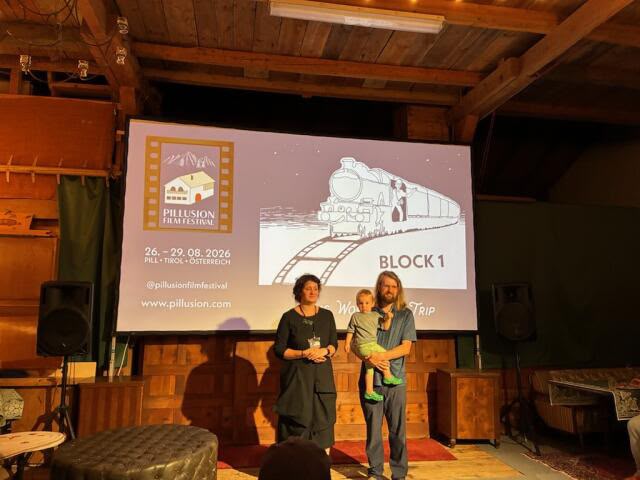
The thematic anchor for 2026 was „Parallels“, challenging filmmakers to explore literal and figurative dualities through split perspectives, overlapping timelines, and contrasting cultural realities across five award categories.
The initial screening block on Day 1 set a high bar, immediately pulling the audience into diverse cinematic worlds. Opening the narrative short film section, set a compelling tone with three emotionally grounded stories examining the heavy physical and psychological loads we carry – Burden, Displacement, and Systemic Bias:
The Courier (Dir. Levan Birkadze | Georgia/Italy, 2026 | 6 min)
Levan, an optimistic Georgian immigrant in Italy, tries to build a new life delivering newspapers by bicycle. When his bike is stolen, his world collapses into a frantic search. Echoing silent-era influences like Charlie Chaplin, this fast-paced, black-and-white film relies on zero audible dialogue to land a poignant punch. It reveals how fragile the immigrant dream can be when anchored to a single tool of survival.
The Weight We Carry (Dir. Christoph Kaar | Austria, 2024 | 16 min)
Driven by unspoken guilt, a father abandons his family to scale a mountain with a wooden chair strapped to his back, seeking a moment of quiet rest at the summit. Visual metaphor at its finest – set against stark Alpine landscapes, the literal weight of the chair brilliantly mirrors internal remorse, delivering an eerie, haunting reflection on escaping responsibility.
Tarik (Dir. Adem Tutić | Serbia, 2025 | 25 min)
The standout of the block, Tarik, delivers a harrowing examination of prejudice and youth displacement in modern Serbia. After standing up to a classmate who religiously and racially harassed him in Lazareva, young Muslim teenager Tarik is expelled. Instead of receiving systemic protection, he faces institutional punishment: banishment from his devoted single mother, Marija, to live in Novi Pazar with his estranged father, Safet, and his new family.
Director Adem Tutić handles anti-Muslim discrimination with devastating restraint, relying on claustrophobic close-ups and natural soundscapes to capture Tarik’s inner turmoil. The young lead delivers a masterclass in unspoken rage, most notably in a heartbreaking scene where he repeatedly hits his head against a moving car window, conveying helpless isolation over aggression.
The jury awarded Tarik top honours, praising its narrative efficiency:
„Tarik demonstrates with incredibly successful compression how hate shapes individuals and societies. Tarik, victim and perpetrator at once, stands at the beginning of an escalatory spiral that his father is already ending. Between the son’s silence and the adults‘ eloquence, the film portrays the intricate situation in the former Yugoslavia while creating a direct link to current world events. That this complex subject finds its place in just 25 minutes is a major achievement.“
When the festival jury and audience selections were revealed, the winning films from the whole festivals stood out as a perfect masterclass in exploring the „Parallels“ theme across different genres, mediums, and worldviews. Awards were presented to these standout works:
- Audience Award (Best Narrative Short) | IUS of Time (dir. Roberto F. Canuto & Xu Xiaoxi)
A poignant centrepiece of the festival, this narrative short set in rural Spain beautifully draws a parallel between environmental sustainability, local tradition, and queer identity. Watching this story of small-town resilience inside an Alpine barn immediately drew a parallel between the Asturian countryside on screen and our Tyrolean surroundings. - Best Narrative Feature | One of Us (dir. Stefan van de Graaff)
Taking home top honours in fiction, this feature explores identity, community, and belonging, showing how shared human struggles bind us even when we feel isolated. - Best Feature Documentary | Unspoken (dir. Maciej Adamek)
A quiet, devastatingly honest documentary that explores the unspoken parallel realities within relationships, capturing subtle emotional currents that run beneath everyday interactions. - Best Short Documentary | Hydra (dir. Tobias Berghaus)
Using documentary observation to trace complex, multi-layered systems, this film mirrors its mythological namesake by showing how one central historical or social issue splits into several parallel consequences. - Best Experimental Film | The Rough Skin of Angels (dir. Emma Fride)
A visually arresting, poetic entry that pushed the boundaries of traditional narrative. Blurring dream states and physical realities, it used abstract textures and soundscapes to create two mirrored planes of existence.
Together, these awarded films proved that whether through documentary observation, surreal experimentation, or sharp narrative drama, the concept of „Parallels“ is universal, touching every corner of human experience. By pairing cutting-edge independent storytelling with rural mountain hospitality, the Pillusion Film Festival continues to prove that cinema doesn’t need red carpets to leave a lasting impact. Just a barn, a projector, and stories that hit home.
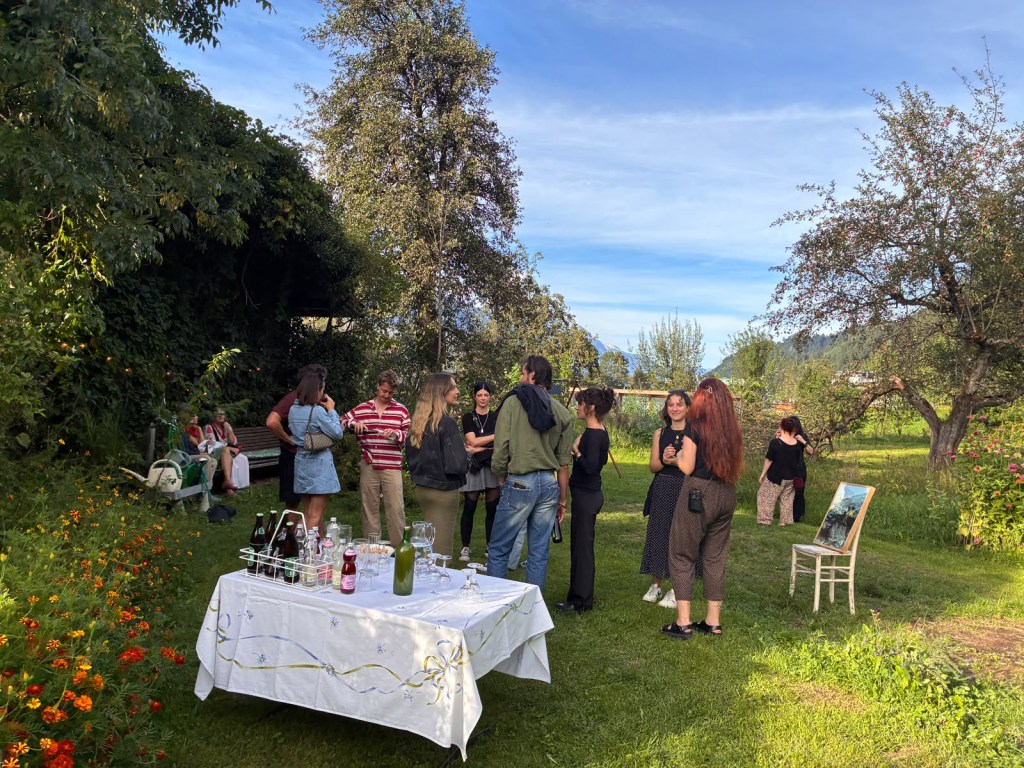
The atmosphere between screenings was as memorable as the films themselves. Filmmakers and audience members naturally mingled on the lawn outside, trading thoughts under the evening mountain sky. It created a rare, communal space where the barrier between creator and viewer completely dissolved.
Perhaps the most astounding achievement of the Pillusion Film Festival was how seamlessly it connected a quiet village in Tyrol with the wider world. Pill, with its modest population and tranquil rural backdrop, managed to draw an extraordinary gathering of international directors, actors, and industry guests from all across the globe. This unexpected international footprint didn’t just add prestige; it brought the theme of „Parallels“ directly to life right in front of us. Seeing filmmakers from vastly different continents and cultural backgrounds sitting together on simple wooden chairs in an Alpine barn created a living metaphor for the theme. It showed that, despite geographical distance, independent storytellers often wrestle with the same human questions. You could find yourself discussing character arcs with a director over a coffee or sharing a table with lead actors after the screening. The juxtaposition of hyper-local Tyrolean hospitality with globally minded cinematic art reinforced how parallel lives across the globe intersect when brought together by shared art.
| Raya Sotirova

