
We met sound artist Louis Naudin / Überkeine in the very first hour of his residency in Innsbruck. It was June 11, probably around 10 pm, when he arrived directly from Paris at Halle 6 in St. Bartlmä, where the Zunder Festival was taking place at the time. This industrial site also became his base in the following weeks, as he worked from a temporary studio in Halle 1. His residency was part of SLASH Transition, a Creative Europe project exploring the role of sound artists in places and communities undergoing change, curated by Danijela Oberhofer Tonkovic and hosted by Openspace Innsbruck.
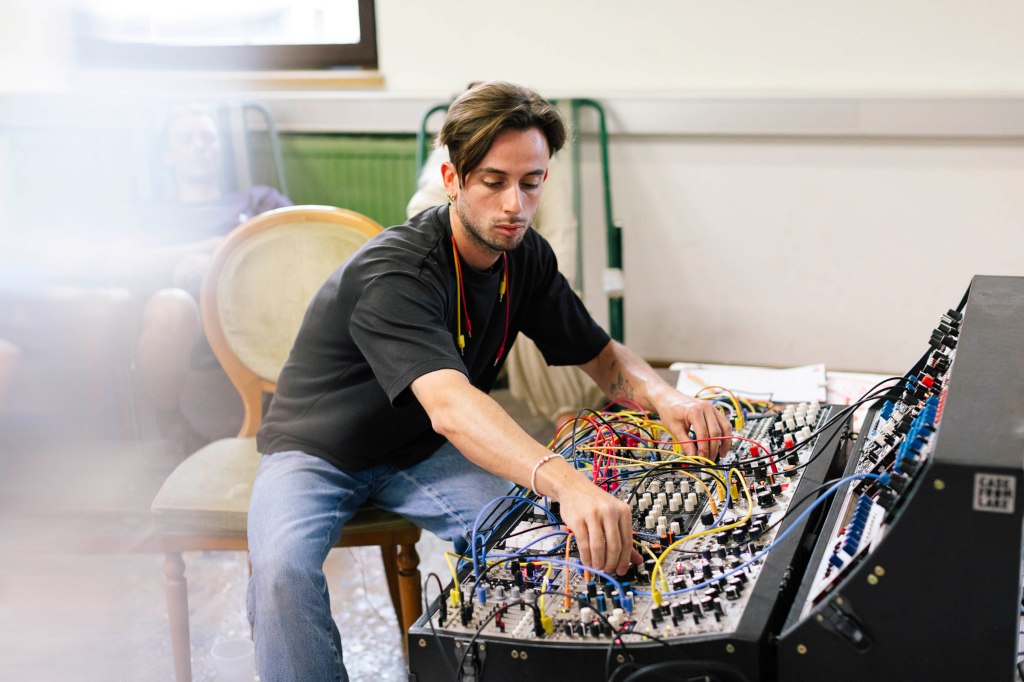
In the self-organised cultural space of St. Bartlmä, Louis collected field recordings and electromagnetic signals, spoke with people from the local community and experimented how he could turn the history and the current situation of the site into sound. During his residency, he developed Collective Commotion, a site-specific audiovisual installation created in collaboration with the local artistic and architectural duo MeAndOtherMe, as well as David Christian and Luca Guarino. The installation combined Louis‘ sound work with a responsive visual environment and huge transparent pillows filled with fog that were hanging from the ceiling — a metaphoric reference to the foggy uncertainty regarding the future of the St. Bartlmä area.
The project was presented at Openspace Innsbruck on 9 July, followed by an artist talk and discussion about sound, community and places in transition. A few days later, Louis returned to St. Bartlmä for the Listening Session at Bartibae, where, together with Journey Program, he shared music that has influenced his artistic practice throughout the years and presented his self-built modular synthesizer to the audience.
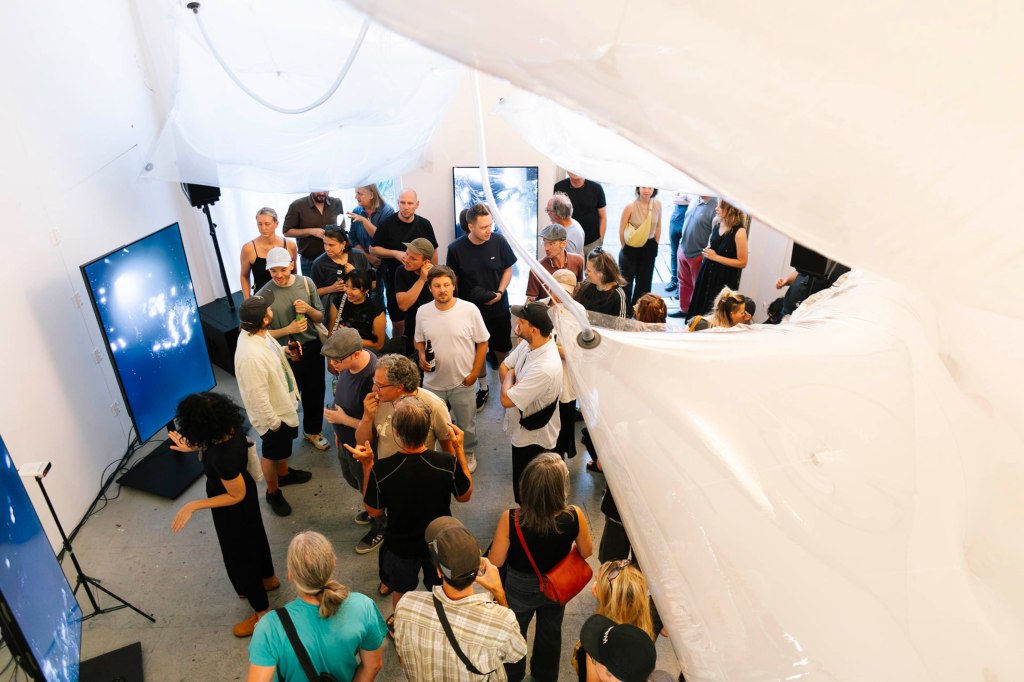
One month after the residency, we met Louis again online to reflect on his artistic process, his time in Innsbruck, and about what stayed with him after leaving.
komplex: My first question is, why did you choose Überkeine as your artist name? What does it mean?
Louis Naudin: I wanted to find a name that has no relation whatsoever with who I am. And as you know, I don’t speak German that well, so I found that it was a fun joke. I really like the sense of it, which means “above nothing/nobody.” So it’s just something that exists, and that’s it.
And why did you choose a German word and not from another language?
Louis Naudin: Well, as I love techno, it makes sense in a way.
How did your passion for techno start?
Louis Naudin: I think I started playing piano when I was like 13 years, and I really liked this music, but then I was a bit bored by the fact that when you play the piano, it’s always the same sound. So I tried to understand if there was any instrument with which you can change the sound, and I bought my first synth, which was a German synth called the MFB Synth II, which was like a little blue box. I loved it.
I played with it for like six months, and then I went to the UK, to London, and visted the Rough Trade record store. At the end of the shop, there was this big wooden box, like a small room of six square meters. There was this big glass and there were two dudes with their heads banging and, as a matter of fact, they were playing with a modular synth, which by that time I didn’t know what it was. And I saw it and I was like, “I want to do this.” And it all started.
I think a month after that, I bought my first module and my first case and I started to build my own synth. I was 18 years old.
Why was it important to you to build your own instrument?
Louis Naudin: With electronic music, I thought it was smart to build my own synth, to have my own sound. So I’m the only one in the world to have this instrument, and I thought it could be easier, in a way, to have this particular sound of mine.
And I think it worked and it still works because I can make new music that I haven’t heard anywhere else. Not saying that it is better, but it’s just different.
Creating your own sound has also to do with your main profession as a Foley artist, right? How did you end up in this profession?
Louis Naudin: Well, I was born into it because all of the guys in my family, even my grandpa, they do Foley, so I was basically born in a studio. And I started to assist my father for movies when I was 14, and I really liked the way that you can build little universes with just metals, banging, rubbing plastics and everything.
There you play with noise a lot, and I think it had a lot to do with the music I do now because it’s a bit noisy. Not very harmonious, in a way. I’m very drawn to this kind of sound.
But I really make a separation between the Foley and the music I do. I never really record Foley and then use it as music material.
Why is it important for you to separate these two things?
Louis Naudin: Because I find the challenge of using “synthesis only” very interesting. It’s hard to make a synth sound “good,” and I have lots of fun building a track from a basic sine wave towards a complex and worked-out waveform. If you want to recreate a sound like metal, for example, with enough technique, you can do it. So it forced me to learn how to do that with just synthesis. Maybe it was the hard way, but a very interesting one.
With Foley, you ultimately record an already complex sound, and in a way, I think it doesn’t belong to you. I struggle to understand what a sound means and where it can go if I don’t sculpt it from the very beginning. I need to understand what I’m working with, and for that, I need to create from scratch.
I read that you also have your own label litiegerecords. It’s described as “techno of technological constraint.” How is this to be understood?
Louis Naudin: It’s because I don’t want to use a lot of instruments. As a matter of fact, I only use one, which is mine. So I consider it to be a big constraint because I don’t want to use any sample, any sample library.
So all of the tracks I’ve made for the label come from the same oscillator, the same filter. It’s the same process over and over. But every time I try to use the synth a little bit differently, with just having in my mind that I use the same instrument and not a lot of tools.
Do you feel that this kind of restriction is also inspiring, or even a central part of your artistic practice — in a sense that limiting your tools and possibilities actually create more freedom or open up new creative possibilities?
Louis Naudin: Yeah. I find it way easier to not have many possibilities and tools, just to have one or two tools that you know well. And because it’s so limited, you have to find ways to create, which is very inspiring. And I always do that. I use very limited material or else I get lost.
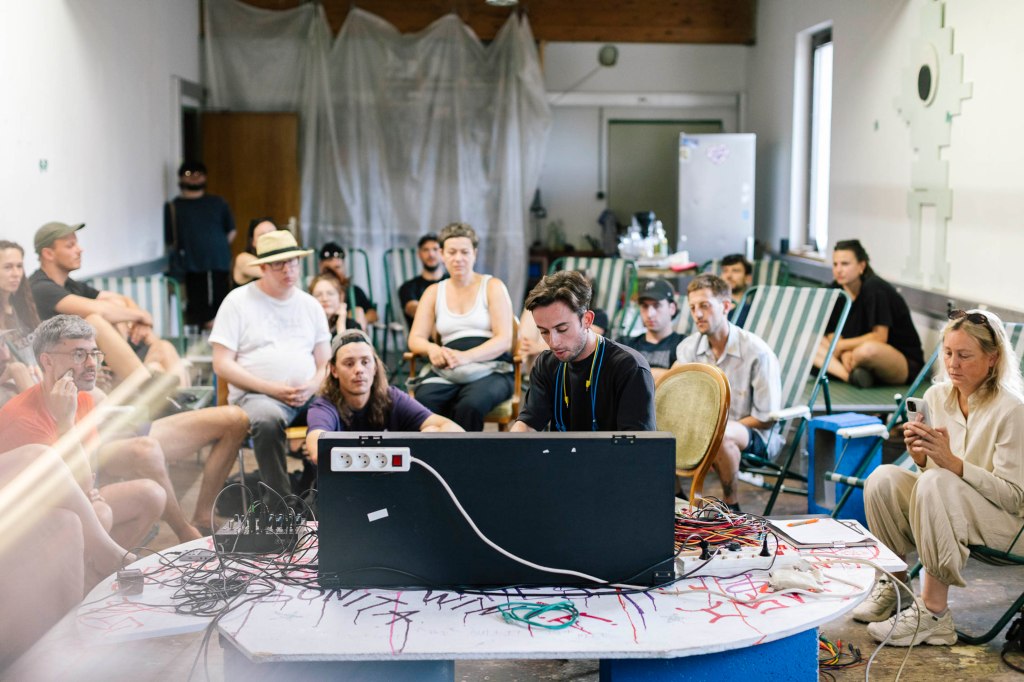
At the Listening Session at Bartibae, you also played a DJ-set. Is this something that you do regularly, or what part does DJing play in your artistic practice?
Louis Naudin: Well, I’ve been DJing since I’m 15. I played quite a lot in Paris when I was like 20 years old because I used to organize events with two friends for two to three years. Nowadays, I don’t have the chance to play that much, to be honest. I don’t know a lot of people in the scene, and I’m not the one that will make a network. But I love to do that. I DJ a lot at home or for friends, which is very different from creating music. But I think it’s complementary, in a way.
And when you create electronic music, such as techno, you create it for DJs to play the tracks. So when you DJ, you understand a little bit more about what is important when you create a track for the dancefloor, how you have to arrange it for it not to be such a burden to play.
Do you have a specific genre focus when you DJ? And what was the thought behind the selection at Bartibae?
Louis Naudin: Bartibae was a bit special because I tried to play everything but techno, just the tracks that inspire me a lot, from ambient to sound to weird noise.
But when I play techno, I think I’m very drawn to broken beat stuff and tracks that are experimental in a way. And I always play quite fast. I just play two to three minutes of the track and then I go to another and another. Otherwise, I get bored.
Can you share three tracks of your Bartibae set that are inspiring to you?
- シャカラ Xácara – Infinity [Japan] Balearic Folk (1991)
- Astrid Engberg – Tulpa (2020)
- Oliver Coates – Soaring X (feat. Malibu) (2020)
Let’s finally talk about your experience of the residency. Now that a few weeks have passed and you’ve had some distance from the experience, how do you reflect on your time in Innsbruck?
Louis Naudin: Well, I think I had one of the best times of my life. Really, because of all the people I met and who were there and with whom I became real friends.
I was a bit scared arriving in Innsbruck because I was like, okay, so I have to create sounds for a month. And I wondered if I would be a little bit on my own. But it was the opposite.
Every time I was invited to have a drink or to spend some time, to speak with new friends, to go swimming, to go to the mountain, to just spend some real quality time with people that I didn’t know at first and who are now part of my life. I had a very good time.
You had your studio in Halle 1 at the St. Bartlmä area. How did this location of the studio also influence your working process?
Louis Naudin: As a matter of fact, it was the first time in my life that I created music outside of my own home studio. And I didn’t realize when I arrived at Halle 1 that the music I would do there would change dramatically — I was very surprised to hear that the first tracks I’ve done there, I was like, “Oh, okay, so I can make sounds like this,” which I didn’t know I was capable of.
And I think this space, which is very, how to say it, industrial, shaped the music a lot. And I was very drawn to sounds that felt, in a way, very ill or exhausted. And so I’ve done six tracks of very ill-sounding ritual music. And I think, yes, it has a lot to do with all of the space, not even only Halle 1, but St. Bartlmä in general. And it shaped a lot.
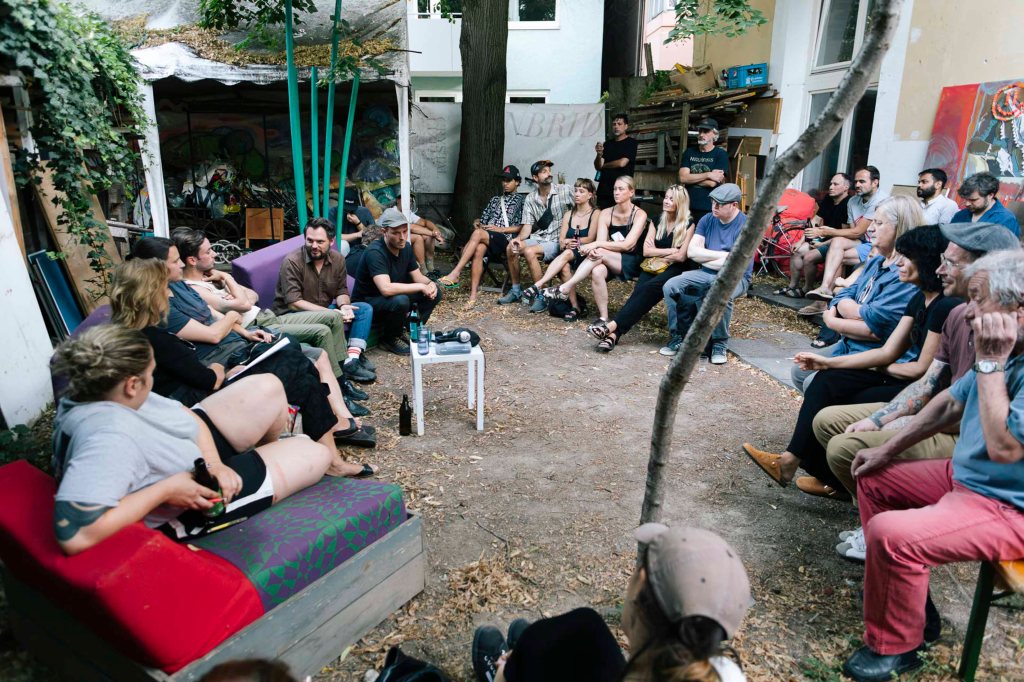
But what also shaped the sound a lot is speaking with everyone, with Marco, Judith, Paulina, etc. And because of the kind of repressive political maneuver, because the events there are limited to ten days now, I tried to translate this into the music.
How can you do that — how do you translate this situation of precarity into sound?
Louis Naudin: It’s just a matter of feeling. Also, when I said “techno of technological constraint,” it can also be about psychological constraints or constraints of ideas.
It’s just I have to bear in mind one simple idea or concept, and I try to think about it and make it a sound. I don’t know how to explain it, but I work a lot with situations and speaking a lot with the people there and creating at Halle 1.
It’s like, okay, so the sound will sound this way because I can’t do it any other way. It was like I was not forced, but it managed to sound this way because of all of the environment.
And I think, reflecting on it, I couldn’t do anything else different. It’s just like this.
For the final presentation, you developed the Fog Pillows as an installation. What was the idea behind them, and how was the working process like?
Louis Naudin: Well, I wanted to create a very simple image of the political maneuver of suppressing events and limiting the number of event days to ten. I thought there was this big fog over the future of the space, over the future of St. Bartlmä.
So I wanted to create an image of this fog, but a fog in a constrained space. People can see it, but they have no access to it. They can’t interact with it because it’s not in their hands. So we thought about doing the pillows so people can see that the future of the space is very uncertain, but they really can’t touch it. They have no power over it. It just acts.
And I think when I saw the pillows and discussed them with David and Luca for the first time, I understood the process of all the fog integration we did for the pillows. The shape of the pillows, but also every difficulty and encounter involved in putting fog into them, quite shaped some of the sounds, because they had this foggy, but also soft image of the sound in mind. So some parts of the music are a direct echo of this.
komplex: The project itself you titled Collective Commotion. How does the title reflect your work?
Louis Naudin: Well, working with very simple ideas I had in mind, I just wanted to express that it’s about a mass or a communal… So, about the community, like all of the people, and commotion as in agitation or like noise. I think directly related to St. Bartlmä’s space. You know what we did with Anna and Cenk (MeAndOtherMe) and with the virtual side of the project, we did a live scanning of the people, which are represented with blurred, frantic lines and noisy stuff.
I like this idea because I think the community of St. Bartlmä and the space, because of the decisions of the city officials, are a bit wounded, in a way. Because now they are limited in how they can earn money to pay rent. So Collective Commotion is like maybe a dizziness of the community.
You’ve created six tracks as parts of the same ritual. What does this idea of ritual mean in relation to the space, and will the music also be released?
Louis Naudin: The idea is linked to the past of St. Bartlmä, it was the former foundry of Oberhammer. And speaking with Daniela and Judith, I understood that the past of this place was an industrial kind of repetitive movement area. So I was thinking it could be nice to make music for a ritual for the space. And I really wanted to work around a tempo that I didn’t do yet. So either really slow or fast.
Would you still call it techno?
Louis Naudin: I mean, for me, it is. I know a lot of people would say it’s not. But I find, yeah, that in a way it is because it’s music made with technology for the dancefloor. So for me, it is techno.
What meaning does techno have for you, also in a political sense?
Louis Naudin: It’s about freedom. I feel it’s music for everybody, which is not very true today in the scene, because it’s such a business. And if you want to go to an event, you have to pay good money. There is also kind of an outfit that you must have now, which bums me out a bit. Because, I mean, you can dress however you want, be who you are, just come and dance to it. You can come from any background and just have fun to it.
| Brigitte Egger

